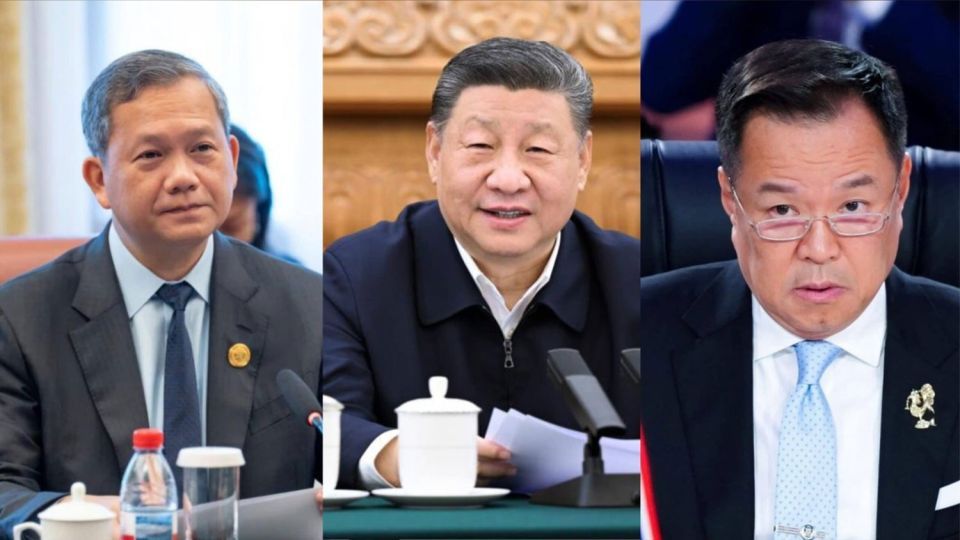
Cambodia and Thailand's prime ministers, Hun Manet and Anutin Chanvirakul, will converge on Shanghai next month to participate in the opening ceremony of the World AI Conference 2026 on July 17 at the personal invitation of Chinese President Xi Jinping. The high-profile gathering presents a rare diplomatic opportunity for the two Southeast Asian neighbours, though simmering tensions over disputed territory continue to cast a shadow over their bilateral relationship. Both leaders are expected to hold separate meetings with Xi and Chinese Premier Li Qiang during the conference, signalling Beijing's intent to engage closely with both capitals on matters of strategic importance.
The Cambodian delegation will travel to Shanghai from July 15-17, with a notably senior entourage that underscores Phnom Penh's commitment to the visit. Foreign Minister Prak Sokhonn, Defence Minister Tea Seiha, and Sun Chanthol, the first vice-chairman of the Council for the Development of Cambodia, will accompany Hun Manet. This composition suggests that Cambodia intends to raise substantive matters spanning foreign relations and defence during their meetings in Shanghai. Thailand's representation will similarly reflect ministerial-level engagement, with Foreign Minister Sihasak Phuangketkeow expected to join Anutin.
Cambodia's foreign ministry has framed the Shanghai visit as an extension of the two nations' strategic partnership, emphasizing the advancement of their Comprehensive Strategic Partnership of Cooperation and the Diamond Cooperation Framework. Official statements have highlighted Cambodia's ambition to build what officials describe as an all-weather Cambodia-China Community with a Shared Future. Bangkok has similarly positioned the visit as an opportunity to strengthen the Thailand-China Comprehensive Strategic Cooperative Partnership. These carefully worded statements reflect the diplomatic language both governments employ to signal their alignment with Chinese interests in the region.
However, the substantive question looming over the Shanghai conference is whether China will leverage its economic and diplomatic influence to broker progress on the Cambodia-Thailand border dispute, which has remained unresolved since their last formal negotiating session in December. The two premiers most recently encountered each other at the 3rd ASEAN Future Forum in Hanoi in early June, where they exchanged handshakes for photographers but notably refrained from substantive discussions on their territorial differences. This pattern of public civility masking private tension has characterized their interactions in recent months, leaving observers uncertain whether the Shanghai platform will catalyse meaningful dialogue.
Analysts watching the region closely suggest that China, as the primary trading partner and investor for both nations, is positioned to exert considerable pressure on Cambodia and Thailand to pursue a negotiated settlement. China's economic leverage over both capitals is substantial, and Beijing has previously demonstrated a willingness to use regional platforms and personal meetings between Xi and other leaders to advance its strategic objectives. The Shanghai conference therefore represents a potential inflection point where China could signal to both governments that resolving their border tensions aligns with broader regional stability and development goals that Beijing prioritizes.
Yet observers caution that institutional and political obstacles within Thailand may impede progress regardless of external pressure. Kin Phea, director of the International Relations Institute at Cambodia's Royal Academy, has identified a critical structural problem: Thailand's civilian government may lack the authority to enforce agreements with its Cambodian counterpart, particularly when the Thai military views certain territories as strategically vital. According to Phea, the military establishment has systematically disregarded diplomatic commitments made by Bangkok's civilian leaders, using its autonomous position to encroach upon Cambodian sovereign territory and prevent the implementation of negotiated settlements.
Phea has called for China to assume a more proactive role as a neutral arbiter between the two nations, urging Beijing to pressure both sides to resume formal talks and to respect the terms of the Fuxian Consensus—a Chinese-brokered agreement reached in December 2025. That consensus ostensibly committed both parties to resolving their differences through peaceful diplomatic channels grounded in international law. Phea emphasized that Thailand must be compelled to honour this agreement by withdrawing its military forces from occupied areas and returning to the Joint Boundary Commission negotiating table without further delays.
The humanitarian dimension of the dispute underscores its gravity and the urgency of resolving it through diplomatic means. Approximately 20,000 Cambodian civilians remain displaced from their homes due to Thai occupation of several border zones. These affected communities face prolonged uncertainty about their ability to return to their properties and rebuild their lives, a situation that has persisted for years despite international attention and regional calls for resolution. The human cost of the border deadlock extends beyond diplomatic rhetoric and statistics, affecting ordinary people whose daily existence is constrained by geopolitical tensions beyond their control.
The timing of the Shanghai conference reflects broader shifts in how China engages with its Southeast Asian neighbours on bilateral issues. Rather than confining discussions to traditional diplomatic channels or bilateral meetings, Beijing has increasingly used multilateral forums and ceremonial occasions to convene leaders and address regional concerns. The World AI Conference serves as a neutral, forward-looking platform that allows China to engage on technological cooperation while simultaneously addressing more sensitive political matters through side meetings and informal discussions. This approach allows Chinese leaders to pursue multiple objectives simultaneously without the appearance of openly favouring one party over another.
For Cambodia, the Shanghai visit represents an opportunity to elevate its concerns about Thai military activities to the highest levels of the Chinese government while demonstrating its alignment with Beijing's strategic vision for the region. Hun Manet's delegation has clearly prioritized defence and foreign ministry representation, signalling that territorial integrity remains a paramount concern even as Phnom Penh pursues closer economic ties with China. The presence of senior defence officials suggests Cambodia may seek assurances or symbolic support from Beijing regarding the border situation.
For Thailand, the challenge lies in reconciling its aspirations for closer engagement with China on development and technology issues with the reality that Beijing increasingly expects its partners to resolve outstanding disputes through negotiation. Bangkok's decision to send Anutin to Shanghai despite the unresolved border situation indicates that Thai policymakers believe maintaining momentum in the China relationship supersedes the need to secure a border settlement before the meeting. This calculation, however, risks perpetuating the stalemate if neither side commits to substantive negotiations during the conference.
The Shanghai conference ultimately serves as a test of whether China is willing and able to move beyond symbolic diplomacy toward concrete conflict resolution in Southeast Asia. Both Cambodia and Thailand value their relationships with Beijing sufficiently that Chinese pressure could theoretically catalyse movement on the border dispute. However, the structural factors that Phea identified—particularly Thailand's military intransigence—suggest that even Chinese pressure may prove insufficient to unlock negotiations without a fundamental shift in Bangkok's political dynamics. The coming weeks will reveal whether the Shanghai meeting produces any tangible movement toward resolving one of Southeast Asia's most persistent territorial disputes.

