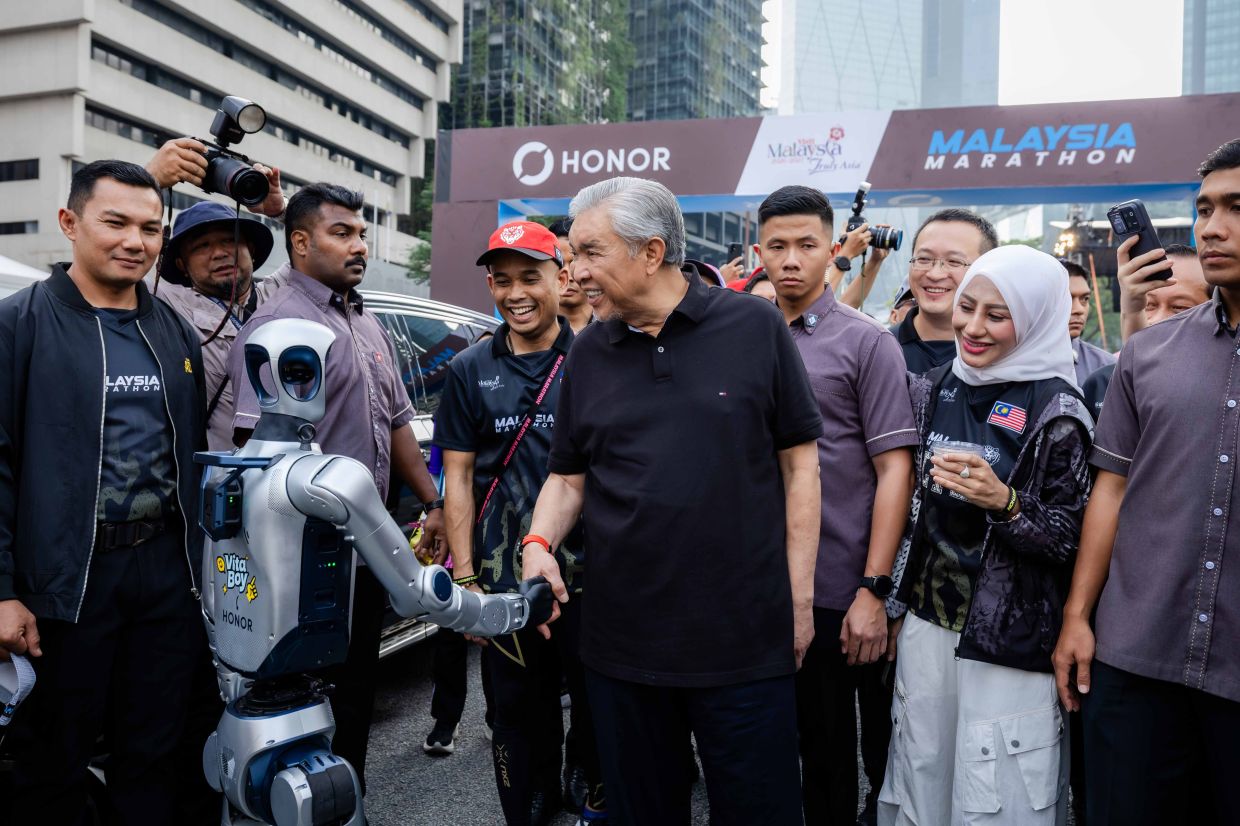
HONOR has achieved a significant milestone in international robotics deployment by sending its flagship humanoid robots to Malaysia Marathon 2026 in Kuala Lumpur, marking their official debut outside China. The two competing units, the D1 and A1 models, represented a watershed moment for the technology sector across Southeast Asia, bringing advanced autonomous systems into public engagement for the first time in the region.
The D1 robot's track record precedes its Malaysian venture substantially. In the Beijing Yizhuang Humanoid Robot Half Marathon, this unit established performance benchmarks that still dominate industry discussion, finishing in 50 minutes and 26 seconds with peak velocities reaching 14.5 metres per second. Such metrics had positioned HONOR at the forefront of practical humanoid robotics development globally. The decision to test these capabilities beyond controlled laboratory or domestic environments represented a calculated risk designed to validate the technology's resilience across different geographical and climatic contexts.
Malaysia's tropical setting presented a distinctly different operational challenge compared to the cooler, more controlled conditions of Beijing's racing circuit. The sustained high temperatures and humidity characteristic of the region imposed rigorous demands on the robot's battery management systems, thermal regulation, and overall mechanical stability during extended physical exertion. This environmental stress-testing proved invaluable for engineers seeking real-world performance data on how the D1 platform responds to prolonged outdoor operation in equatorial climates. The successful completion of the 10-kilometre route demonstrated that HONOR's engineering had factored in regional environmental variables, a consideration essential for any manufacturer targeting widespread Southeast Asian adoption.
The A1 model's participation in the 5-kilometre category received ceremonial prominence when Deputy Prime Minister Datuk Seri Dr Ahmad Zahid Hamidi flagged off the route alongside ministerial colleagues and entertainment figures. This governmental endorsement underscored Malaysia's positioning as a serious market for advanced technology integration and signalled official recognition of robotics development as strategically important. The presence of high-level political participation transformed what might have been merely a corporate publicity exercise into a statement about national technological ambitions and Malaysia's openness to innovation.
The symbolic dimensions of the event extended beyond simple product demonstration. HONOR synchronized the robot deployments with National Day celebrations and orchestrated a particularly poignant moment when the D1 and A1 units marched alongside one thousand local students carrying what has been recognized as Malaysia's longest Jalur Gemilang. This convergence of advancing technology with cultural tradition created a powerful narrative about progress that honours heritage rather than displacing it—a messaging strategy especially resonant in Southeast Asian markets where technological adoption frequently encounters questions about cultural preservation.
From HONOR's corporate perspective, the Malaysian incursion reflected broader strategic positioning within Southeast Asia. The company achieved number one market share ranking in Malaysia during the first quarter of 2026, according to Counterpoint Research data, establishing the foundation for deeper consumer penetration and brand loyalty. This leadership position justified investment in high-visibility initiatives like the marathon participation, as such events amplify market presence among both consumers and enterprise clients actively evaluating technology vendors.
The philosophical framing HONOR applied to the initiative transcended hardware specifications and competitive metrics. Company messaging positioned the robots as embodiments of a transition from technology that merely "serves people" toward systems that operate as collaborative companions, moving alongside users in navigating daily challenges. This narrative reflects broader industry evolution away from purely utilitarian automation toward more integrated, contextually aware autonomous systems that acknowledge human agency rather than replacing it entirely.
For Malaysian technology observers and policymakers, the HONOR deployment carries implications extending across multiple sectors. Successful tropicalization of humanoid platforms establishes feasibility models for regional manufacturing and localization discussions. Malaysian institutions increasingly focused on advanced manufacturing and Industry 4.0 adoption can point to HONOR's proof-of-concept as evidence that cutting-edge robotics remain commercially viable despite Southeast Asia's specific environmental and infrastructural conditions. The public engagement component also normalizes humanoid robotics within consumer consciousness at a developmental stage when widespread societal acceptance remains fluid.
The technical parameters of the D1's Beijing performance—particularly its peak speed and endurance metrics—acquire fresh significance when evaluated against the environmental stressors present during the Malaysia Marathon execution. The robot's ability to maintain structural integrity and functional performance across climate zones and extended operational cycles suggests engineering sophistication that addresses practical deployment considerations often neglected by laboratory-focused development. Such attention to real-world applicability increases probability that these platforms transition from novelty demonstrations toward genuine industrial and service sector integration.
OHONOR's broader technology portfolio, spanning consumer devices through artificial intelligence applications to humanoid robotics, positions the company within an ecosystem approach to automation rather than isolated product categories. The Malaysia Marathon appearance represents a juncture where these previously separated domains converge visually and conceptually. Observers witness not merely a robot completing a physical challenge, but rather a tangible manifestation of how connected systems—device networks, AI decision-making, robotic execution—function as integrated wholes addressing real-world challenges.
Looking ahead, HONOR's commitment to continued regional investment and localized technological development will substantially influence how Malaysian and broader Southeast Asian markets evaluate robotics adoption trajectories. The company's positioning of humanoid platforms as harbingers of technology that enhances rather than displaces human potential speaks directly to anxieties about automation's societal impacts. By coupling robotic demonstrations with cultural celebrations and public engagement rather than insulated industrial showcases, HONOR establishes frameworks where technological progress appears woven into community fabric rather than imposed externally.

