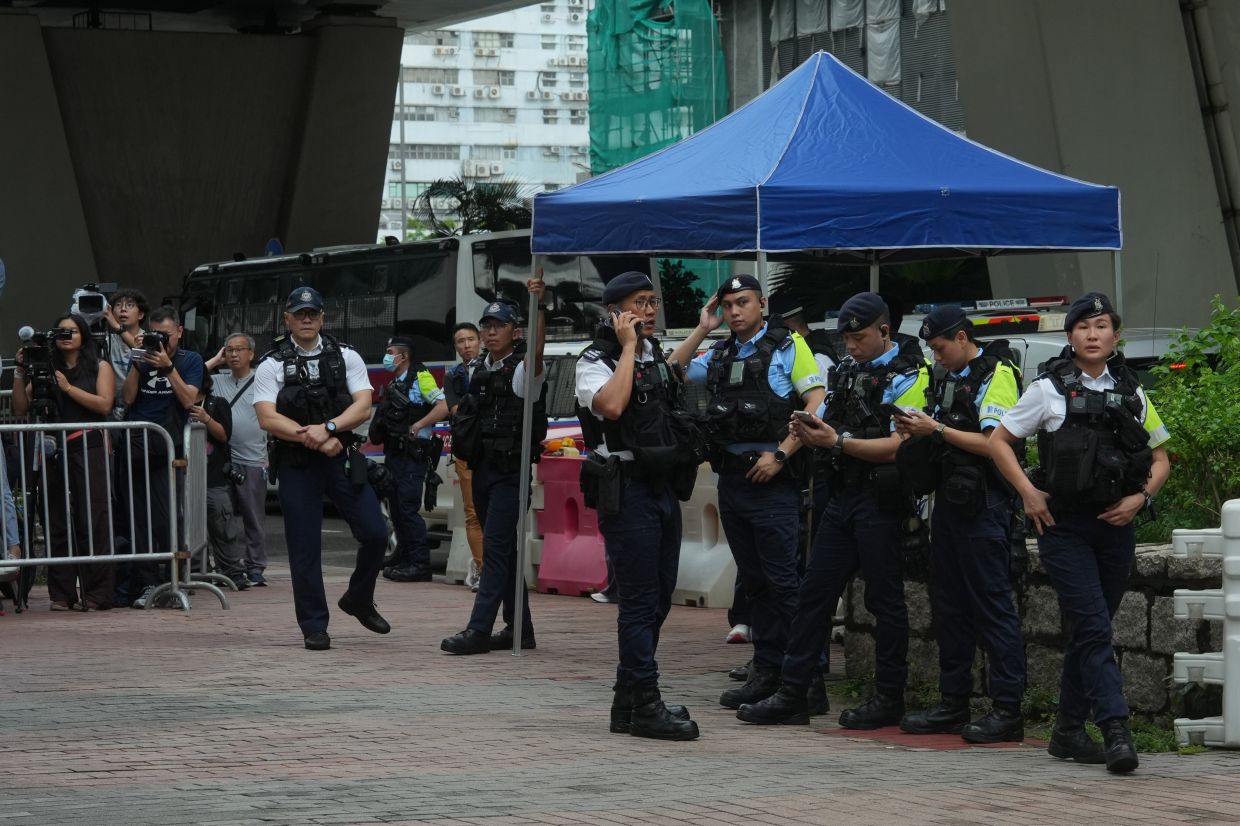
Hong Kong police arrested a woman on suspicion of sedition for allegedly wearing a T-shirt with prohibited messaging outside West Kowloon Court, authorities announced Monday evening. The detention occurred during heightened security operations ahead of a significant ruling against democracy activists, marking another flashpoint in the territory's increasingly restrictive political environment. Police cited disorder in a public place, obstruction, and seditious intention as grounds for the arrest, though officials declined to elaborate on operational specifics, citing public safety concerns.
The episode unfolded early Friday morning as more than 50 people gathered outside the courthouse hours before dawn, assembling to witness or report on the judgment against Lee Cheuk‑yan and Chow Hang‑tung, former leaders of the now‑disbanded Hong Kong Alliance in Support of Patriotic Democratic Movements of China. According to eyewitness accounts and media footage, a plainclothes officer identified the woman based on her black T-shirt printed with Japanese characters and removed her from the scene despite her apparent lack of disruption. Journalists capturing the moment were reportedly directed away by officers as she was placed into a police vehicle, an incident that underscores the growing tension between press freedom and state security enforcement in Hong Kong.
The arrest's timing proved symbolic, occurring mere hours before the High Court delivered guilty verdicts against Lee and Chow on subversion charges. The pair, along with their disbanded alliance, faced prosecution under Hong Kong's national security law for organising the territory's annual Tiananmen Square vigil—a commemoration of the 1989 military crackdown that Beijing had long tolerated until recent years. Prosecutors accused them of inciting subversion by calling for an end to "one‑party dictatorship" in mainland China, a message that authorities determined violated post-2020 security legislation.
The three High Court judges' 216-page ruling established a sweeping interpretation of subversion law. The court held that any effort to overthrow or undermine the leadership of the Communist Party of China constitutes subversion under the statute, effectively determining that the country's constitution precludes Western-style democratic governance. This interpretation has profound implications across Hong Kong and beyond, as it essentially criminalises advocacy for systemic political change in mainland China—a position that brings Hong Kong's legal framework into alignment with Beijing's constitutional theology rather than traditional common law principles.
Lee, a former legislator with decades of pro-democracy activism, and Chow, a practising barrister, have spent nearly five years in custody awaiting this verdict. The case represents one of the most high-profile prosecutions under the National Security Law, signalling authorities' determination to eliminate organised spaces for political dissent. A fourth defendant, Albert Ho Chun‑yan, the alliance's former vice-chairman, remains detained after nearly four years and has already pleaded guilty to subversion charges, with sentencing pending.
For Malaysian observers, the Hong Kong developments carry particular relevance. Southeast Asia has watched closely as Beijing's security architecture extends into the territory, setting precedents that shape regional discussions around national security legislation and civil liberties. The conviction of activists for organising commemorative events and the arrest of individuals based on clothing raises questions about the trajectory of freedoms in the region and how different governments calibrate security measures against fundamental rights.
The case also illustrates how security laws, once enacted, frequently expand beyond their stated scope. Hong Kong's National Security Law, introduced in 2020 ostensibly to address violence and foreign interference, has evolved into a tool for prosecuting peaceful political expression and historical commemoration. This pattern concerns regional democracies considering similar legislation, as mission creep becomes a recurring feature rather than exception.
The woman arrested Friday has not been publicly identified, and details of her alleged seditious message remain unclear beyond witness descriptions of Japanese characters on her shirt. This opacity reflects broader transparency concerns surrounding security operations in Hong Kong, where police increasingly conduct enforcement actions with minimal disclosure. The contrast between heavy-handed police response to a woman's clothing and the protection afforded to other forms of expression elsewhere underscores how selectively national security frameworks are applied.
The timing of these events—the arrest preceding the verdict by hours—raises questions about coordination between law enforcement and the judiciary, though officials maintain operations were conducted independently. The choreography nevertheless suggested authorities anticipated significant public gathering and sought to prevent any demonstration or visible opposition near the courthouse.
For Hong Kong's international standing, these cases compound concerns raised by human rights organisations and foreign governments regarding judicial independence and the rule of law. Verdicts in security cases increasingly reflect political outcomes rather than narrow legal interpretations, a trajectory that undermines confidence in the territory's institutions among international investors, academics, and civil society actors.
The broader implication extends to how Asian democracies and semi-democracies respond to stability concerns. Hong Kong's experience demonstrates that sweeping security legislation, once normalised, becomes difficult to restrain. Malaysian policymakers and commentators engaged with national security questions might reflect on whether procedural safeguards and definitional precision can genuinely constrain expansionist legal interpretations, or whether such laws inevitably drift toward suppressing legitimate political activity.

