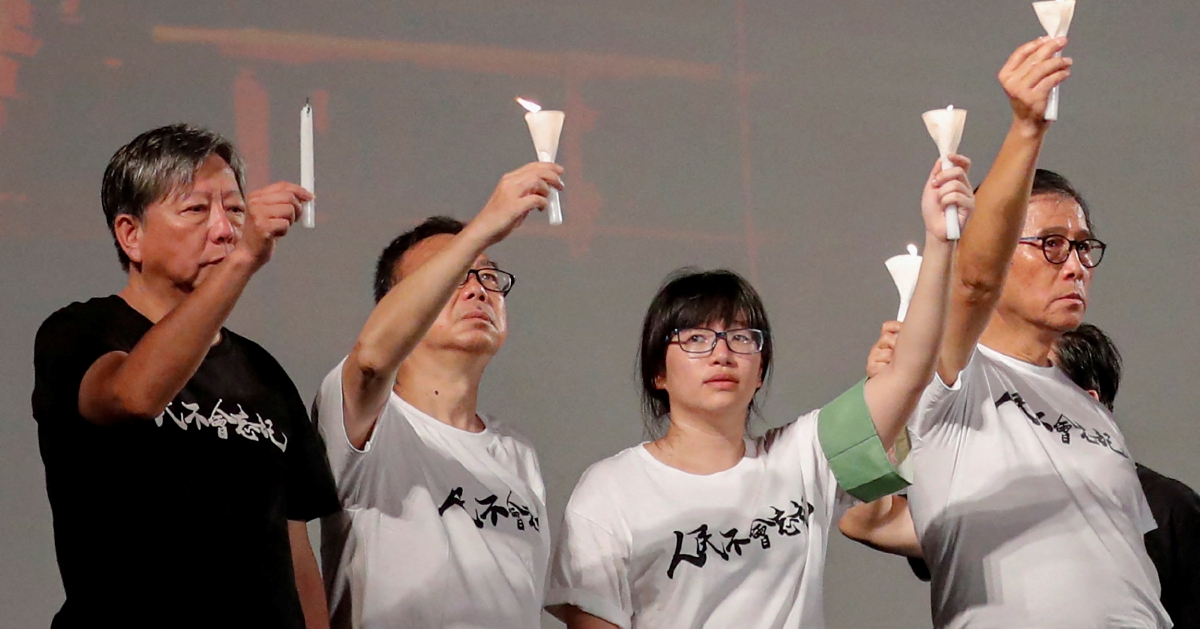
Two Hong Kong activists who spearheaded the organisation of annual memorial vigils honouring victims of the 1989 Tiananmen crackdown have been found guilty of inciting subversion by a Hong Kong court on Friday, signalling an increasingly restrictive climate for political expression in the territory. The conviction, handed down under laws introduced since China's sweeping National Security Law of 2020, underscores Beijing's tightening grip over public commemoration of historically sensitive events and demonstrates how broadly authorities are now interpreting and applying subversion charges.
The two defendants had organised recurring vigils in Hong Kong to remember those killed during the military suppression of pro-democracy demonstrations in Beijing's Tiananmen Square three decades ago. These annual gatherings had for years served as one of the most visible symbols of Hong Kong's historically open political culture and its distinction from mainland China in permitting such public acts of remembrance. The conviction represents a watershed moment in the erosion of such freedoms, as the court determined that the act of organising and promoting these commemorative events constituted behaviour designed to undermine state authority.
For Malaysian observers, the case carries particular significance as it illustrates how national security legislation can be weaponised to suppress legitimate forms of civic expression and political memory. Hong Kong's experience over the past three years offers a cautionary example of how rapidly the legal environment can shift when security frameworks are introduced without robust constitutional safeguards. The expansion of subversion charges to encompass memorial activities suggests that authorities are interpreting such laws with maximum breadth, creating a chilling effect that extends well beyond overt political activism.
The National Security Law imposed by Beijing in 2020 fundamentally altered the legal terrain in Hong Kong, introducing offences for secession, subversion, terrorism, and foreign collusion that carry sentences up to life imprisonment. What distinguishes this latest conviction is the application of subversion charges to activities that, in an earlier era, would have been protected forms of political speech and historical commemoration. The court's findings suggest that even peaceful, annual gatherings designed to preserve historical memory can now be classified as attempts to undermine state power, a standard far broader than what Western democracies typically recognise as criminal subversion.
The vigils themselves had become increasingly controversial in mainland China and among Beijing-aligned officials in Hong Kong, with authorities warning that such gatherings violated the National Security Law. The annual candlelit remembrances, once drawing tens of thousands of participants, have grown smaller in recent years as organisers faced police harassment and as the broader pro-democracy movement in Hong Kong was systematically dismantled following the 2019-2020 protest period. The conviction of the activists who coordinated these events effectively criminalises the institutional memory and organisational structures that kept the Tiananmen commemoration alive as a public practice.
From a regional perspective, this development reflects broader patterns across Asia where governments are deploying national security laws as tools to manage historical narratives and control political space. Southeast Asian nations watching Hong Kong's transformation should consider how similar legislation in their own jurisdictions might eventually be applied to previously protected forms of expression. The Malaysian context becomes relevant here, given ongoing debates about how national security frameworks should operate and where the boundaries between legitimate law enforcement and political repression ought to lie.
The conviction also carries implications for civil society organisations throughout the region that engage in historical advocacy and remembrance work. If activities designed to educate the public about past events and promote reflection on historical injustices can be prosecuted as subversion, then the space for civil society to function as a repository of historical conscience becomes severely compromised. This is particularly concerning in societies where official historical narratives may be contested or incomplete.
International human rights organisations have long expressed concern about the application of subversion laws in Hong Kong, arguing that they represent a departure from established principles of freedom of expression and assembly. The conviction of activists for organising peaceful vigils provides concrete evidence supporting these warnings. It demonstrates that authorities are willing to deploy the full machinery of the criminal justice system against individuals whose only action is maintaining public memory of a historical event.
Looking forward, the conviction will likely have a deterrent effect on other memorial activities and commemorative gatherings in Hong Kong. Few organisations will now be willing to coordinate large-scale public remembrance events if doing so exposes them to criminal prosecution under broadly interpreted subversion statutes. This represents a qualitative shift in how Hong Kong's public sphere operates, fundamentally altering what citizens can openly discuss, commemorate, and organise around without fear of legal consequences.
For Southeast Asian nations considering their own national security frameworks, Hong Kong's trajectory offers important lessons about the importance of maintaining clear distinctions between activities that genuinely threaten state security and those that constitute legitimate political expression, historical remembrance, and civic engagement. The conviction of vigil organisers demonstrates how quickly and expansively such legislation can be applied once enacted, making the design and safeguards of such laws crucial from the outset.

