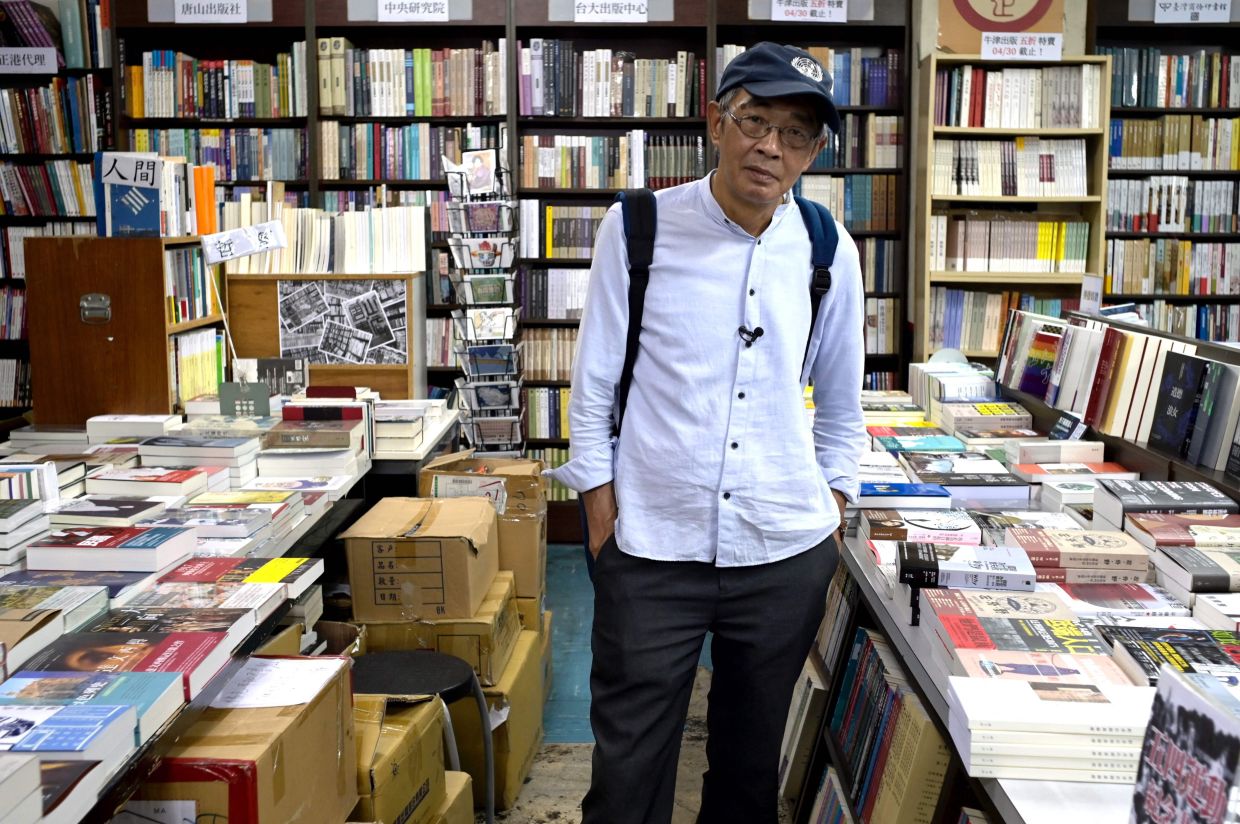
Lam Wing-kee, the former Hong Kong bookseller whose public account of arbitrary detention by Chinese authorities became a defining moment in the struggle for press freedom in Hong Kong, has died in Taiwan at the age of 70. Taiwan's Central News Agency confirmed his death on Thursday evening following his admission to MacKay Memorial Hospital in Taipei just days earlier. The news agency reported that Lam had experienced a recurrence of cancer the previous year, which precipitated his final hospitalisation. He lapsed into unconsciousness on Wednesday and passed away that evening, though the exact cause was not publicly disclosed.
Lam's prominence as a voice for freedom of expression stemmed from his experience as manager of Causeway Bay Books, a Hong Kong bookstore that specialised in publications unavailable on mainland China. The shop became controversial for stocking materials that purportedly exposed private details about senior Chinese Communist Party officials and various political scandals. This contentious inventory would eventually place him and his colleagues in the crosshairs of Beijing's security apparatus and fundamentally alter the trajectory of his life.
In late 2015, Lam vanished alongside four other individuals connected to Causeway Bay Books in what became a watershed moment for Hong Kong's civil society and the international community monitoring press freedoms in Asia. His disappearance, along with that of fellow booksellers, sent shockwaves through the territory and raised urgent questions about whether the Basic Law framework supposedly protecting Hong Kong's autonomy could withstand pressure from the mainland. The coordinated nature of the abductions suggested a sophisticated operation targeting those perceived as threats to Beijing's information control.
The most dramatic and consequential moment in Lam's ordeal came when he publicly recounted his experience at a crowded Hong Kong press conference in 2016, directly contradicting the sanitised narratives offered by Chinese officials. He revealed that plainclothes operatives had apprehended him in October 2015 as he crossed from Hong Kong into Shenzhen. What followed was an Orwellian sequence of events: a 13-hour train journey during which he remained blindfolded, followed by confinement in Ningbo in eastern China. For five months, he endured round-the-clock surveillance, watched continuously by rotating teams of two guards. The authorities subsequently compelled him to appear on Chinese state television and issue a televised confession to unspecified crimes, a coercive tactic designed both to punish and to send a chilling message to others who might contemplate similar resistance.
Lam's testimony represented an extraordinary act of courage in an environment increasingly hostile to dissent. By speaking publicly about his mistreatment, he risked further retaliation and complicated any prospect of normalising his situation within China's political system. His account served as irrefutable documentation that the disappearances had not been voluntary surrenders or routine legal processes, but rather extrajudicial seizures conducted without transparent procedures or due process protections.
The fate of his colleagues underscored the gravity of the crackdown. Gui Minhai, a publisher and part-owner of Causeway Bay Books who had been detained while on holiday in Thailand, received a 10-year prison sentence in mainland China in 2020 on charges of illegally transmitting intelligence overseas. The case illustrated how authorities extended their reach beyond Hong Kong's borders and how they constructed legal frameworks to legitimise the suppression of those deemed enemies of the state.
Fearing escalating persecution and alarmed by the trajectory of Hong Kong's political situation, Lam relocated to Taiwan in 2019, seeking refuge in a democracy that had begun accepting political refugees from Hong Kong. In 2020, he reopened Causeway Bay Books in Taipei, attempting to preserve the bookstore's mission of providing uncensored information in a free society. The symbolic importance of relaunching the shop in Taiwan could not be overstated: it represented a continuation of the project Beijing had sought to eliminate, merely transplanted to soil where such activity enjoyed legal protection and societal support.
However, Lam's health struggles increasingly constrained his ability to sustain the enterprise. Just weeks before his death, he informed Taiwan's Central News Agency that he had temporarily suspended operations at the Taipei location due to his deteriorating medical condition, offering no timeline for when the bookstore might resume service. The temporary closure seemed to hint at deeper uncertainties about his prognosis, though he did not explicitly acknowledge the gravity of his situation in those final public statements.
Taiwan's President Lai Ching-te paid public tribute to Lam following news of his passing, using the occasion to reflect on broader themes of freedom and democratic resilience. In his Facebook statement, Lai characterised Lam's legacy not merely as one of individual suffering, but as a testimony to the transcendent value of liberty. The President emphasised that Lam's ordinariness—his status as a shopkeeper rather than a celebrated dissident—made his commitment to principle all the more moving. Lai framed the bookstore manager's life as an object lesson for successive generations about the fragility of democracy and the perpetual vigilance required to defend it against erosion.
The political context surrounding Lam's death has only darkened since his 2015 detention. The 2019 anti-government protests that convulsed Hong Kong provoked Beijing and Hong Kong's leadership to implement progressively more stringent security measures. The 2024 National Security Law represents an extension and hardening of control mechanisms, creating a legal architecture that criminalises dissent with unprecedented breadth. In June 2024, Hong Kong police arrested two individuals connected to a bookstore under this legislation, alleging they had sold seditious materials and accepted funds from foreign political organisations. This recent enforcement action suggests that Lam's struggle against censorship and arbitrary state power remains unresolved in Hong Kong, continuing to define the political contest between freedom and authoritarian control in the territory.
A solitary mourner left a white rose at the entrance of the Taipei bookstore on Monday, a gesture of silent tribute to a man whose quiet persistence had illuminated the consequences of resistance to Beijing's vision of absolute political order. Lam's death marks not merely the end of an individual life, but also a symbolic closing of one chapter in Hong Kong's historical struggle for autonomy and the protection of fundamental freedoms that democracies take as foundational.

