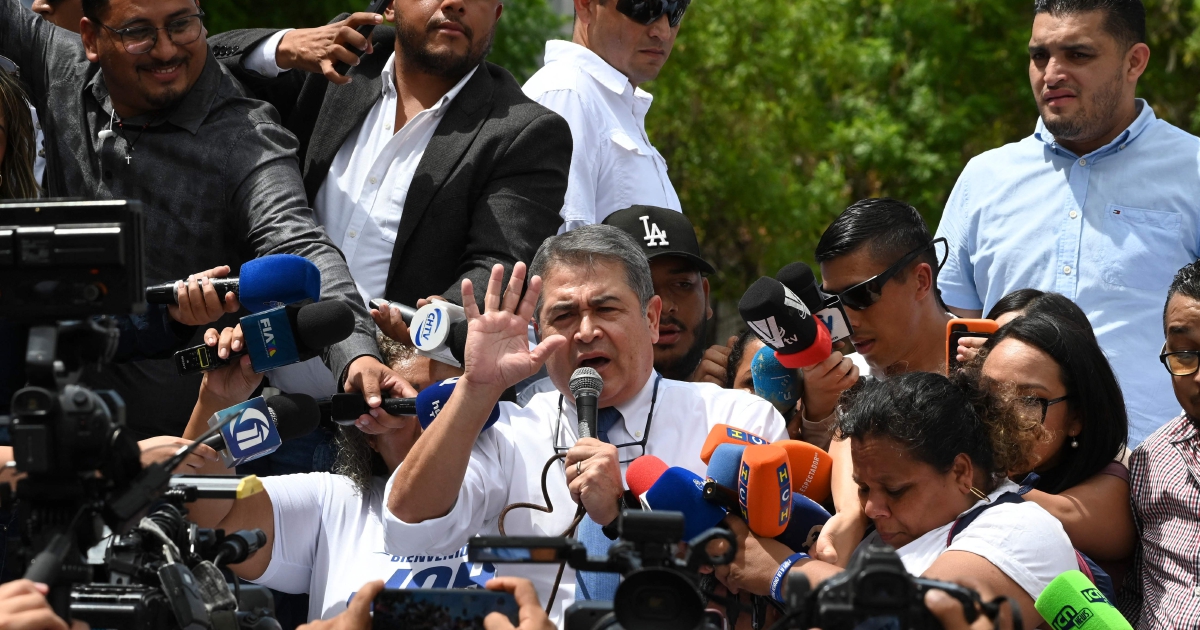
A court in Honduras has permitted former President Juan Orlando Hernandez to stay free while he faces trial on corruption allegations, marking another legal reprieve for the controversial political figure who secured a controversial pardon from Donald Trump in early 2025. The decision, handed down by a Honduran judge in Tegucigalpa on Monday, came after prosecutors sought his detention pending the trial proceedings. The ruling underscores the complex legal circumstances surrounding Hernandez, whose political career has been shadowed by persistent allegations of graft and connections to organised crime.
Hernandez's trajectory from the presidency to the dock illustrates the shifting fortunes of Central American leadership in an era of heightened international scrutiny. He served as Honduras's president from 2014 to 2022, a period marked by widespread corruption allegations involving state resources and drug trafficking connections. His departure from office came amid deepening investigation into his administrative practices, and he faced mounting pressure from both domestic and international authorities concerned with financial impropriety and alleged ties to organised criminal networks.
The Trump pardon issued in late 2024 represented a dramatic reversal in Hernandez's legal jeopardy, dissolving the cloud of federal drug trafficking charges in the United States that had threatened lengthy incarceration. Trump's decision to pardon the former Honduran leader surprised observers and raised questions about the criteria governing such clemency decisions. The pardon specifically addressed the US drug trafficking allegations, effectively closing that chapter of his legal troubles and allowing his return to Honduras without extradition concerns.
However, the Trump pardon carried geographical and jurisdictional limitations that proved consequential. Honduran authorities, operating within their own legal system, pursued separate corruption investigations rooted in alleged misappropriation of public funds during his administration. These domestic charges represent fundamentally different allegations than the drug trafficking accusations handled by American courts, and therefore fall entirely outside the scope of Trump's clemency decision. This distinction has proven legally significant, as the Honduran state maintains full authority to prosecute its former leader for crimes committed within its borders.
The corruption allegations against Hernandez centre on his administration's allegedly improper management of substantial sums, including funds directed toward social programmes and state security initiatives. Prosecutors contend that public money was diverted to private benefit and that Hernandez wielded his executive authority to facilitate illicit financial transfers. Such allegations resonate deeply throughout Central America, where concerns about presidential corruption and weakened institutional accountability persist across multiple countries. Honduras in particular has struggled with governance challenges and public sector transparency deficits that these charges exemplify.
Monday's judicial decision represents a setback for prosecutors seeking his preventive detention, an outcome that reflects particular assessment of flight risk and evidence considerations specific to the Honduran legal context. Courts typically weigh whether a defendant poses danger of absconding before trial, the strength of evidence presented, and the nature of the charges involved. The judge's determination that Hernandez could safely remain at liberty suggests judicial confidence in these factors, or possibly deference to his standing as a former head of state seeking to contest charges within his home country's legal system.
The ruling carries implications extending beyond Hernandez's personal circumstances. It signals something about judicial independence and the rule of law in contemporary Honduras, where questions have long circulated regarding whether courts can operate free from political influence and elite protection. That a former president faces trial at all demonstrates some institutional capacity to hold powerful figures accountable. Yet the grant of freedom pending trial may also be read as evidence that such accountability remains constrained or selective, particularly when powerful individuals command resources and networks capable of influencing proceedings.
For Malaysia and broader Southeast Asia, the Hernandez situation offers instructive lessons about the relationship between international and domestic accountability mechanisms. It demonstrates that foreign legal actions—whether prosecutions or pardons—cannot supersede a nation's sovereign right to address crimes committed within its borders. This principle holds particular relevance in a region where cross-border corruption, transnational organised crime, and questions of presidential accountability frequently arise. The case underscores that leaders and officials cannot assume that navigating one jurisdiction's legal system resolves all legal exposure.
The forthcoming corruption trial will test Honduran institutions and their willingness to sustain prosecution of a politically prominent former leader despite obvious complications and potential domestic resistance. International observers, including anti-corruption advocates and governance monitoring organisations, will likely scrutinise the trial's conduct for evidence of fairness and procedural integrity. The outcome will signal whether Honduras can maintain investigative and prosecutorial momentum against high-level corruption, or whether political realities ultimately constrain accountability for former senior officials who retain networks and influence.
Hernandez's ongoing legal entanglement reflects broader Central American patterns where governance challenges, institutional fragility, and questions of elite accountability remain persistent obstacles to stable, transparent government. His pardon from Washington did not resolve all difficulties, and the Honduran system continues its reckoning with the allegations of his presidency. As the trial unfolds, the region and international community will observe whether local courts can deliver justice independent of outside pressure and whether mechanisms exist to hold accountable those wielding state power.

