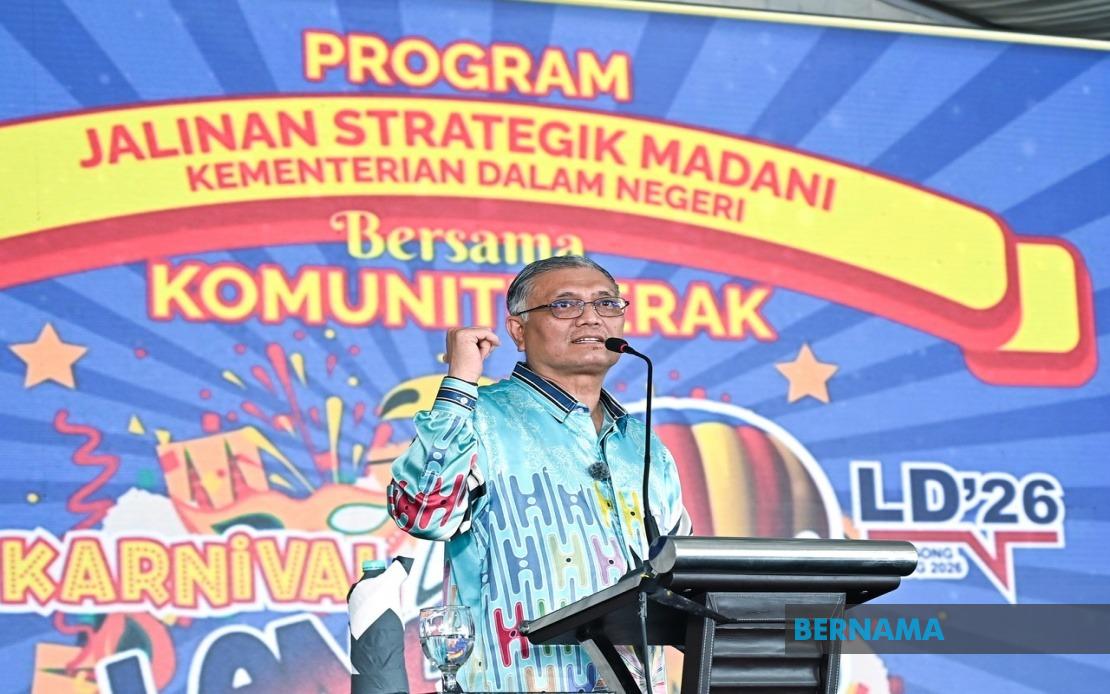
The Home Ministry's MADANI Strategic Partnership Programme has demonstrated how strategic public engagement can bridge the gap between government agencies and local communities, as demonstrated by a two-day event held recently in Lenggong, Perak. Held at Dataran Lenggong, the initiative brought together representatives from multiple security and administrative agencies to interact directly with residents, fundamentally shifting the approach to public service delivery from a bureaucratic model to one centered on accessibility and dialogue. This approach reflects a broader strategic shift within the Malaysian government towards what officials term "bottom-up" governance, where communities have direct channels to address local concerns through the agencies responsible for public safety and administration.
Deputy Home Minister Datuk Seri Dr Shamsul Anuar Nasarah articulated the core purpose of the programme as creating opportunities for citizens to engage with Home Ministry services without navigating complex administrative procedures. He emphasized that the initiative serves as a crucial platform for two-directional communication, allowing security agencies to hear directly from communities about pressing issues such as crime prevention, drug trafficking, and neighbourhood safety concerns. By positioning the programme this way, the ministry effectively reframes security and immigration services from distant institutions into responsive entities accountable to the people they serve. This decentralization of service delivery is particularly significant in a Malaysian context where rural and semi-urban areas often experience limited direct access to federal government resources and information.
The event's structure reflected careful planning to maximize community participation across different demographics. Approximately 1,190 residents participated in coordinated fun run and cycling activities organized jointly by the People's Volunteer Corps and the National Anti-Drugs Agency, deliberately incorporating physical wellness alongside civic engagement. The route through surrounding villages was designed to showcase the natural appeal of the Lenggong Valley, leveraging the area's status as a UNESCO World Heritage Site to create a sense of local pride and connection. This integration of tourism promotion with government service delivery suggests an understanding that community investment must also support broader economic development objectives, positioning local residents as stakeholders in their region's cultural and economic trajectory.
The participating agencies—the Royal Malaysia Police, the Immigration Department, and the National Anti-Drugs Agency—established dedicated service counters that processed requests, received public input, and provided advisory services. Rather than serving merely as information booths, these counters functioned as functioning government offices, enabling residents to update personal records, file complaints, and access specific guidance on matters affecting their daily lives. For residents in communities often overlooked by federal initiatives, this direct access eliminates the need for time-consuming trips to urban centres, reducing both financial and administrative barriers to obtaining government services. The enthusiastic response to these counters throughout the two-day event suggests genuine demand for such accessible service delivery models.
The programme also incorporated cultural and educational components that extended beyond administrative transactions. Religious talks, children's creative performances, and colouring competitions created an environment where government engagement felt inclusive and family-oriented rather than institutional or imposing. This deliberate softening of the government's public face, particularly through youth engagement, builds long-term civic consciousness by normalizing positive interactions between citizens and public institutions from an early age. Such programming recognizes that public trust is constructed through repeated positive experiences, and that security agencies benefit from being perceived as community-oriented rather than purely enforcement-focused.
Exhibitions showcasing the capabilities and services of participating agencies provided educational value beyond immediate service provision. By demonstrating the range of activities conducted by police, immigration, and anti-drugs bodies, these displays demystified government operations and helped residents understand how various agencies intersect with their daily security and safety. For many community members, understanding the full scope of government resources available for addressing local problems may encourage more proactive reporting and cooperation. The exhibition format also allowed for informal dialogue, where residents could ask questions and receive explanations in accessible language, contrasting with the formal, document-heavy nature of typical government communications.
The choice of Lenggong as the venue carries particular significance, as Datuk Seri Dr Shamsul Anuar Nasarah represents this constituency as Member of Parliament. This alignment between the visiting official's constituency responsibilities and the programme location underscores the integration of elected representation with bureaucratic outreach. For residents accustomed to viewing government as a distant entity, the simultaneous presence of their elected representative and multiple federal agencies reinforces the notion that their concerns matter at multiple levels of government and that avenues exist for escalating issues when necessary.
The MADANI programme's emphasis on partnership with local communities reflects a programmatic recognition that modern governance requires genuine consultation and responsiveness. Rather than implementing top-down policies without community input, this model invites residents to contribute their perspectives on security challenges, immigration concerns, and substance abuse issues. Such engagement provides government agencies with intelligence about local conditions that might not emerge through formal reporting channels, while simultaneously creating accountability mechanisms where officials must respond to community concerns articulated in face-to-face settings.
For Malaysian readers beyond Perak, this initiative offers insights into how government services might be reimagined to serve citizens more effectively. The model demonstrates that accessibility to government requires intentional structural changes: relocating services into communities, simplifying procedural requirements, and embedding administrative functions within broader civic and cultural activities. As Malaysia continues developing its administrative capacity, the scalability of such programmes to other communities remains an important question, particularly in less urbanized areas where service gaps are most acute.
The integration of health promotion through the fun run and cycling activities also reflects contemporary understanding of holistic community development. By linking physical wellness initiatives with security agency engagement and anti-drugs messaging, the programme treats public health and public safety as interconnected concerns requiring coordinated responses. This approach acknowledges that communities facing drug abuse problems often experience compounding challenges related to health infrastructure, economic opportunity, and social support systems, requiring multi-sectoral responses rather than isolated enforcement efforts.
Looking forward, the success of the Lenggong MADANI programme suggests potential for replication and adaptation in other communities throughout Malaysia. The model's flexibility—allowing customization of activities, exhibits, and partner agencies based on local conditions and needs—makes it potentially transferable to urban neighbourhoods, indigenous communities, and other diverse settings. However, sustained impact will require ongoing commitment beyond individual events, with these programmes establishing regular engagement schedules and mechanisms for tracking whether community concerns raised during such gatherings translate into actual policy adjustments or resource allocation changes.
The broader significance of initiatives like the MADANI programme lies in their implicit acknowledgment that governmental legitimacy depends on demonstrated responsiveness to citizen needs. In an era of declining institutional trust globally, Malaysian agencies investing in direct, accessible engagement with communities are building foundations for sustainable public support and cooperation. For residents participating in such programmes, the experience of being consulted, heard, and served by government institutions directly strengthens civic bonds and reinforces democratic participation at grassroots levels.

