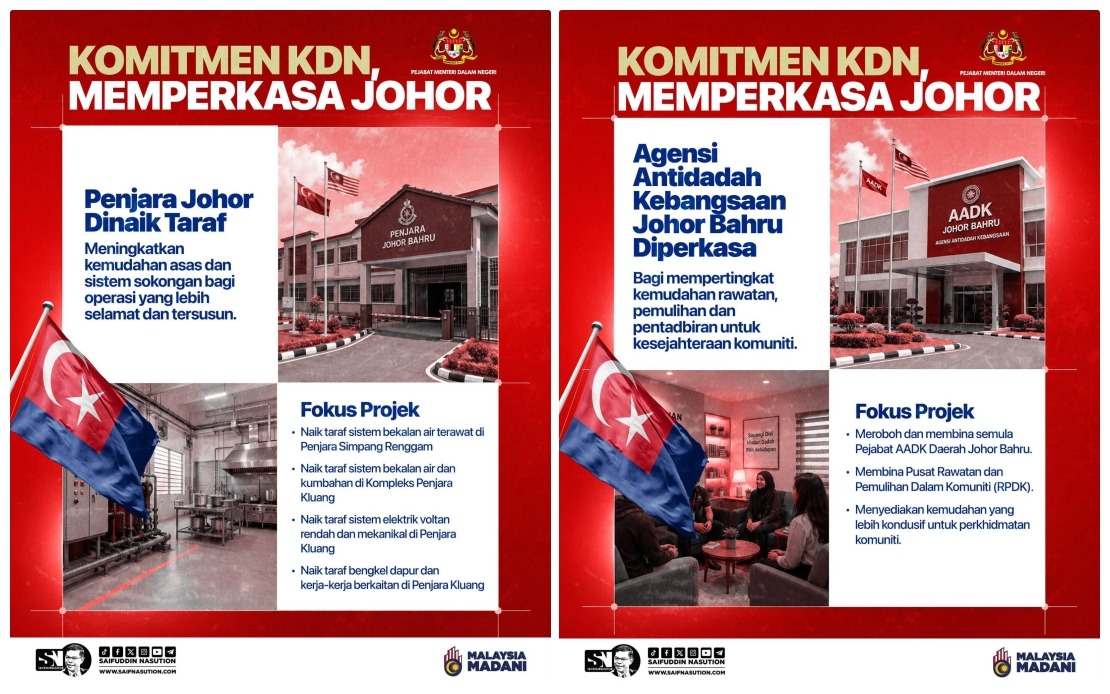
The Home Ministry intends to accelerate a series of development initiatives across Johor that will strengthen the state's security apparatus while modernising public-facing services. Home Minister Datuk Seri Saifuddin Nasution Ismail disclosed the ministry's roadmap during a statement that underscores the government's commitment to transforming Johor into a more secure and efficiently administered region. The announcement arrives as voters prepare to head to the ballot box tomorrow in the 16th Johor state election, with approximately 2.7 million registered electors set to choose 56 state assemblymen.
Johor occupies a strategically vital position within Malaysia's national security landscape. As the nation's southern gateway and a critical hub for administrative governance, the state serves as a crucial entry and exit point for cross-border movements while housing essential security infrastructure. The state's geographic importance, combined with its role as a major commercial and tourism hub, has made infrastructure investment and operational enhancement priorities for federal agencies. Saifuddin Nasution emphasised that contemporary governance demands that security services and public administration keep pace with rising demand and evolving operational complexities.
The Home Ministry's proposed initiatives draw across multiple subordinate agencies, each addressing specific operational gaps within their respective domains. The Royal Malaysia Police will pursue construction of the Segamat district police headquarters while simultaneously acquiring land for a comparable facility in Pengerang. Additionally, the force will undertake substantial renovation work on residential quarters and lift systems at various police premises throughout the state. These projects reflect an acknowledgement that ageing facilities can compromise both officer welfare and operational readiness.
Immigration and border management represents another significant focus area. The ministry plans major upgrades to immigration processing facilities housed within the Sultan Iskandar Building and the Sultan Abu Bakar Complex. These enhancements aim to streamline border operations, reduce congestion during peak travel periods, and ensure that international travellers experience services reflecting Malaysia's standards. Improved administrative infrastructure directly supports the state's role as a critical international gateway, particularly given the heavy traffic flows between Peninsular Malaysia and neighbouring Singapore.
The National Registration Department will benefit from the construction of a new district office in Batu Pahat, improving accessibility for residents requiring identity documentation and registration services. This project acknowledges that sprawling districts require decentralised administrative capacity to serve populations efficiently. The correctional system receives attention through systematic upgrades to basic infrastructure at both Kluang Prison and Simpang Renggam Prison, measures that typically improve facility safety and staff working conditions while supporting rehabilitation programmes.
The National Anti-Drugs Agency's footprint in Johor will expand through office redevelopment and treatment centre upgrades. Given Malaysia's ongoing struggle with drug trafficking and substance abuse, enhanced facilities allow AADK to expand counselling, rehabilitation and enforcement capacity. Similarly, the Malaysian Maritime Enforcement Agency will benefit from jetty and building improvements at Abu Bakar Maritime Base, strengthening the state's coastal security posture and maritime law enforcement capabilities in waters increasingly important for regional trade and fisheries management.
The collective scope of these initiatives reveals a comprehensive approach to governance modernisation. Rather than concentrating resources narrowly, the Home Ministry seeks to upgrade operational capacity across multiple security and administrative functions simultaneously. This breadth suggests recognition that modern governance requires coordinated investment across law enforcement, border management, civil administration, and maritime security. For Johor residents and businesses, improved facilities theoretically translate into faster police responses, more efficient passport processing, better-maintained correctional facilities, and enhanced coastal security.
The timing of this announcement carries political significance. Elections typically prompt incumbent administrations to highlight development achievements and future commitments, signalling competence and attention to regional needs. Saifuddin Nasution's emphasis on benefits to residents, security personnel, and national interests frames these projects as investments benefiting multiple constituencies rather than narrow partisan gains. The framing also underscores the federal government's role in infrastructure provision, a messaging strategy during electoral contests.
From a Southeast Asian perspective, Johor's security infrastructure improvements hold broader implications. The state hosts critical land routes and maritime passages through which regional commerce flows, making operational efficiency a concern extending beyond Malaysia's borders. Enhanced immigration facilities and maritime enforcement capacity affect how smoothly goods, capital, and people move through one of the region's busiest gateways. Neighbouring economies including Singapore and Indonesia have vested interests in maintaining Johor as a reliable, secure transit zone.
The implementation timeline for these projects remains unspecified, though typical infrastructure development cycles suggest phased rollouts over multiple years. Budget allocation, contractor procurement, and facility design specifications will determine actual delivery schedules. Past experience suggests that major construction projects in Malaysia often experience delays, requiring stakeholders to maintain realistic expectations about timelines. Success will ultimately depend on funding adequacy, effective project management, and maintenance of focus beyond the immediate electoral cycle.
For Johor's administrative ecosystem, these initiatives represent incremental rather than transformative change. Projects address known capacity constraints and deferred maintenance without fundamentally restructuring how services operate. Nevertheless, cumulative improvements in agency facilities, equipment, and infrastructure gradually enhance the state's capacity to deliver public services and maintain security standards. The Home Ministry's statement essentially commits to treating Johor as a priority jurisdiction deserving sustained federal investment, a positioning that carries both practical and symbolic weight for a state that has historically wielded significant political importance within Malaysian federalism.

