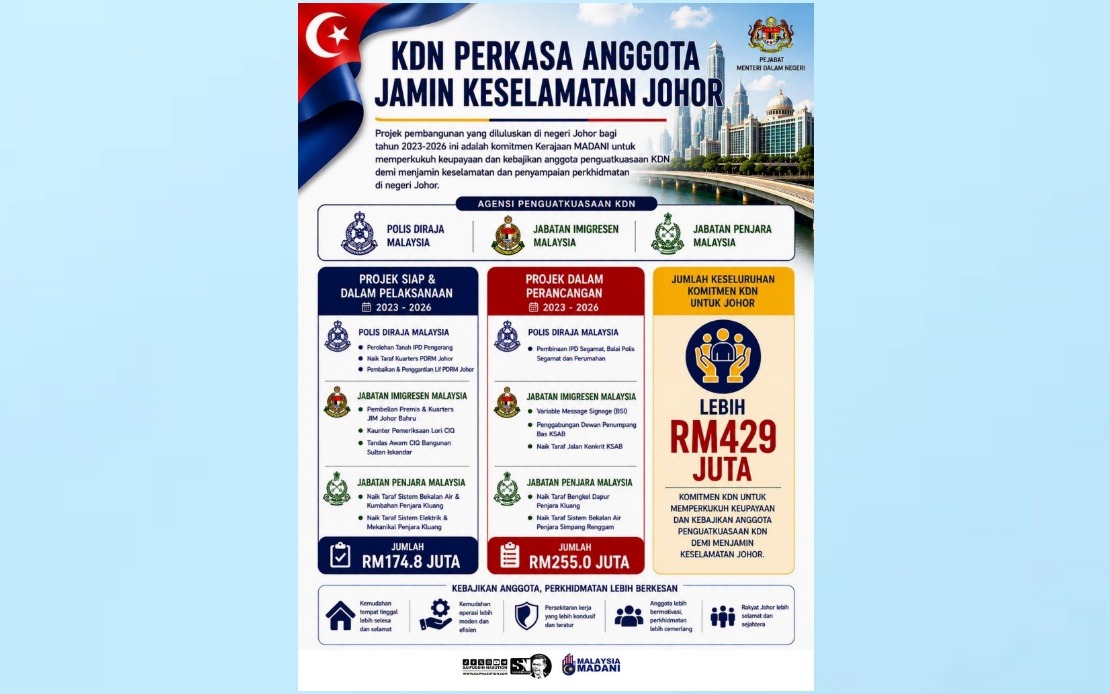
The Home Ministry has committed more than RM429 million since 2023 towards improving the welfare of personnel and strengthening the operational infrastructure of enforcement agencies across Johor, according to Home Minister Datuk Seri Saifuddin Nasution Ismail. The substantial investment targets three critical agencies responsible for maintaining public order and security: the Royal Malaysia Police, the Malaysian Immigration Department, and the Malaysian Prisons Department. This strategic allocation reflects the government's recognition that the effectiveness of law enforcement and correctional institutions depends fundamentally on the working conditions and morale of their personnel.
Saifuddin Nasution framed the investment in personnel welfare as extending well beyond simple amenities provision. Rather, he described it as a comprehensive approach to creating an environment where enforcement officers can discharge their responsibilities with greater efficiency, safety, and effectiveness in protecting the public. The underlying logic is straightforward yet significant: when officers work in conducive spaces with comfortable facilities and access to modern equipment, the quality of public-facing services improves correspondingly, translating into tangible benefits for citizens through enhanced security and faster, more professional service delivery. This perspective acknowledges that infrastructure investment and human welfare are not peripheral concerns but core components of effective governance.
The RM429 million allocation splits into two distinct phases. RM174.8 million covers projects already completed or currently in active implementation phases, while RM255 million remains earmarked for initiatives still in planning and preparation stages. This division signals a dual commitment: immediate delivery of tangible improvements while simultaneously laying groundwork for future enhancement. The combination of near-term and longer-term spending demonstrates sustained strategic planning rather than ad-hoc expenditure.
Currently under implementation are several high-priority projects that address longstanding capacity and infrastructure gaps. The Pengerang District Police Headquarters acquisition involves securing land for this new facility, aimed at improving police presence and responsiveness in the district. Simultaneously, the Johor Bahru Immigration Department is acquiring office premises and residential quarters, recognising that immigration personnel require adequate workspace and accommodation to manage the administrative demands of a major urban centre. At Kluang Prison, basic facility upgrades are proceeding to improve detention conditions and staff working environments, addressing maintenance backlogs that impact both security and prisoner rehabilitation efforts.
Projects in the pipeline reveal a longer-term vision for enforcement infrastructure across the state. The Segamat District Police Headquarters represents a major undertaking, designed to include both operational police station facilities and dedicated residential quarters for officers. Beyond policing infrastructure, the consolidation of bus passenger terminals at the Sultan Abu Bakar Complex indicates coordination between enforcement and transport management concerns. Kluang Prison's kitchen workshop upgrades and improvements to Simpang Renggam Prison's water supply system may appear modest individually, but collectively they address maintenance challenges that accumulate in older facilities. Such projects improve operational efficiency while enhancing the dignity and safety of incarcerated individuals.
The minister's statement positioned these investments within the broader MADANI Government framework, emphasising that resource allocation responds to state-specific development priorities rather than following centralised templates. This approach acknowledges that Johor, as Malaysia's southernmost peninsula state and a crucial economic and security frontier, has particular infrastructure and personnel requirements distinct from other states. The explicit reference to Johor's development and management allocation increasing to approximately RM14.6 billion from RM10.2 billion previously provides quantitative context for the enforcement sector investments. Prime Minister Datuk Seri Anwar Ibrahim had clarified these figures in Parliament, underscoring parliamentary transparency regarding resource distribution.
For Malaysian readers and policy observers, the significance of this allocation extends beyond immediate Johor concerns. Enforcement agencies operate across state boundaries through coordination mechanisms and shared responsibilities, meaning improvements in Johor's police, immigration, and prison infrastructure generate positive spillover effects. Enhanced police facilities in Pengerang strengthen regional surveillance capabilities relevant to border security and smuggling interdiction. Better immigration infrastructure in Johor Bahru—a major entry and exit point for both domestic and international movement—streamlines processing of millions of annual travellers and enhances security screening. Prison facility improvements affect not only Johor inmates but also manage population flows from other states through the national corrections system.
The investment also reflects implicit recognition of challenges within these agencies. Police headquarters expansions and new facilities suggest existing stations operate at capacity or lack adequate officer accommodation in strategic locations. Immigration department office and quarters acquisitions indicate growth in processing demands and difficulty attracting or retaining qualified personnel in high-cost urban areas without adequate housing support. Prison facility upgrades address chronic overcrowding and maintenance issues documented in multiple inspection reports. These investments therefore represent targeted responses to documented systemic pressures rather than generic infrastructure spending.
From an economic and development perspective, such allocations stimulate local employment and construction sector activity. Engineering firms, building contractors, architects, and suppliers benefit from these projects, creating jobs and economic circulation within Johor. Additionally, improved enforcement infrastructure enhances investor confidence by signalling credible commitment to public safety and rule of law—factors crucial for attracting business investment and supporting economic growth. Businesses requiring reliable security services, customs certainty, and personnel security benefit indirectly from enforcement agencies operating in well-resourced environments.
The temporal dimension merits consideration for Malaysian observers tracking government spending patterns. Allocations spanning 2023 onwards indicate sustained commitment through multiple budget cycles, reducing uncertainty about funding continuity. This multi-year approach allows for realistic project planning and execution rather than feast-famine spending cycles that characterise some government initiatives. For Johor specifically, this consistency matters given the state's geographic size and infrastructure complexity. Strategic sector development in Johor cannot be compressed into single-year budget allocations; multi-year commitments enable comprehensive facility upgrades and expansion.
Governance analysts will note the explicit statement that the ministry will ensure allocated funds are utilised optimally. This phrasing, while conventional in official statements, carries implicit accountability commitments. Given Malaysia's diverse enforcement landscape and historical concerns about infrastructure project management, transparency in utilisation of substantial allocations remains important for public confidence. The identification of specific projects and implementation timelines provides measurable benchmarks against which stakeholders can assess whether commitments translate into completed facilities and improved service delivery.
Looking forward, the pipeline projects suggest enforcement infrastructure development in Johor will remain prioritised across multiple budget cycles. The Segamat District Police Headquarters in particular represents major capital investment reflecting growth in demand for police services across interior Johor. As the state continues developing economically and demographically, enforcement agency infrastructure must scale correspondingly. These allocations acknowledge that Johor's status as Malaysia's gateway to Singapore and its extensive land border mean security and border management requirements differ markedly from other states, justifying proportionate resource commitment.

