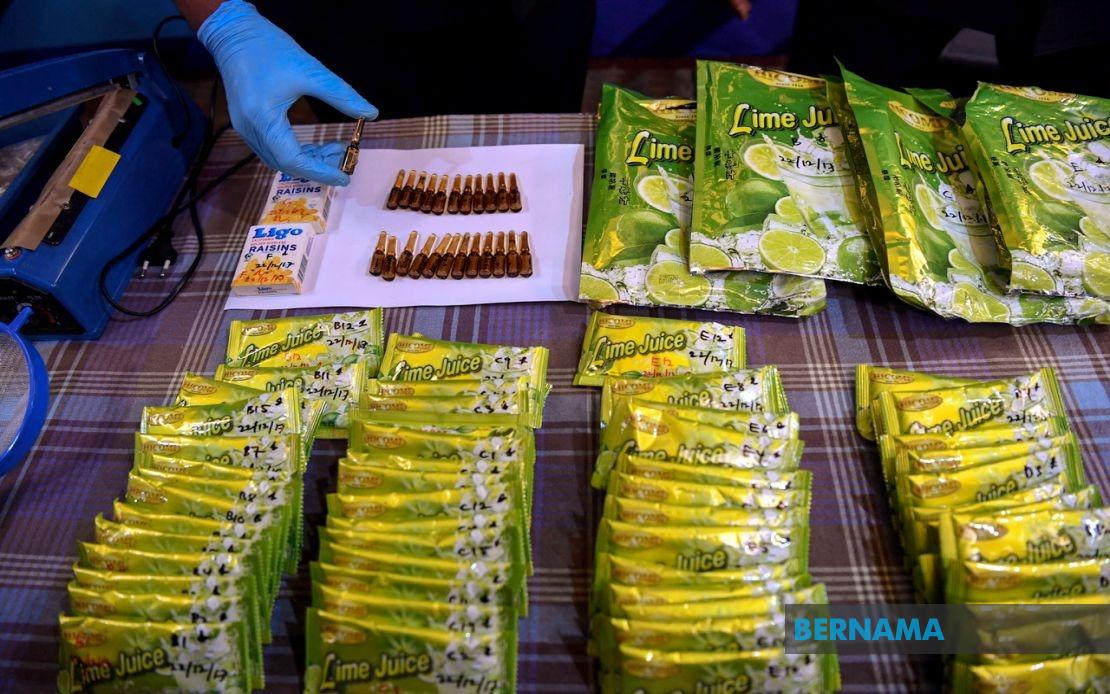
The Home Ministry has declared an intensified crackdown on synthetic drug trafficking and consumption, citing mounting evidence that methamphetamine, fentanyl, and illicit psychoactive tablets—colloquially referred to as "piu-piu"—pose unprecedented risks to public safety and social stability. Home Minister Datuk Seri Saifuddin Nasution Ismail signalled serious alarm at the proliferation of these substances, which combine extremely high addiction potential with fatal overdose risks and demonstrable links to violent crime and community deterioration.
The scale of the problem has prompted extraordinary enforcement activity. Between 2023 and June 2026, the Royal Malaysia Police recorded 238,704 arrests related to synthetic drug offences throughout the country. This figure underscores both the ubiquity of the issue and the resource commitment authorities are dedicating to supply chain disruption. The breadth of arrests—spanning manufacturing, trafficking, possession, and consumption—reflects a comprehensive enforcement strategy aimed at dismantling operations at every level.
Operational responses centre on two flagship initiatives: Op Tapis and Op Tapis Khas, which deploy personnel across diverse geographical settings from urban centres to isolated rural and remote locations. These operations represent coordinated action involving the Royal Malaysia Police, the National Anti-Drugs Agency, and the Royal Malaysian Customs Department, pooling investigative capabilities and intelligence networks. The geographical scope reflects recognition that synthetic drug distribution networks operate beyond traditional urban strongholds, requiring presence and enforcement capacity throughout the federation.
Technology has become central to modern enforcement architecture. Unmanned aerial vehicles and surveillance camera networks enable authorities to monitor trafficking corridors and identify distribution hubs with minimal warning to suspects. This technological enhancement represents a generational shift from traditional reactive policing toward anticipatory interdiction, allowing authorities to target shipments before street-level distribution occurs. The investment signals acknowledgement that conventional foot-patrol and informant-based approaches cannot match the speed and sophistication of contemporary drug operations.
Legal frameworks are undergoing adaptation to address the fundamental challenge posed by synthetic drug evolution. Manufacturers continuously modify chemical formulations to circumvent existing drug schedules, creating what regulators term New Psychoactive Substances. The Home Ministry is pursuing amendments to the Dangerous Drugs Act 1952 to incorporate emerging compounds more expeditiously, potentially allowing regulatory action without awaiting parliamentary amendment cycles for each new variant. This legislative flexibility represents tacit acknowledgement that the drug landscape moves faster than traditional lawmaking processes.
Sarawak, a jurisdiction with particular vulnerability to trafficking due to geographic proximity to international production centres and porous border control challenges, has witnessed concentrated enforcement activity. Between January and early June this year, authorities arrested 7,097 individuals across all drug-related categories: 342 traffickers facilitating distribution networks, 1,314 individuals apprehended with drugs, and 5,441 consumers or suspected regular users. Concurrent asset seizures—418 kilogrammes of substances valued at RM53.73 million—and forfeiture of syndicate property worth RM1.95 million demonstrate financial disruption alongside arrests. These figures suggest that Sarawak represents both a significant operational theatre and a bellwether for synthetic drug prevalence across Southeast Asia.
Drug prevention remains a policy cornerstone alongside enforcement. Between 2023 and June 2026, authorities conducted 1,144 awareness programmes nationwide, reflecting government commitment to reducing demand and identifying at-risk populations before consumption escalates. Community policing methodologies position frontline officers as educators and intervention points, not merely enforcement personnel. This preventive infrastructure theoretically operates in tandem with interdiction and prosecution, creating a three-tier response architecture: prevention through education, enforcement through arrest and prosecution, and rehabilitation through post-conviction diversion programs.
Specialised forensic capabilities have assumed heightened importance given the continuous emergence of fentanyl analogues and synthetic opioids that require sophisticated laboratory profiling to identify and quantify. Enhanced analytical capacity enables faster confirmation of drug composition, allowing faster prosecution and more precise understanding of trafficking patterns and supply chain origins. This technical sophistication helps authorities track whether batches originate from pharmaceutical diversion, illicit domestic synthesis, or international smuggling networks—distinctions with significant enforcement implications.
The legislative and operational response reflects broader regional anxiety about synthetic drug proliferation throughout Southeast Asia. Malaysia's geographic position as both a transhipment hub and domestic market makes it particularly vulnerable to the convergence of production capacity in nearby countries with infrastructure for regional distribution. The decision to pursue legislative amendments and technological enhancement signals that authorities recognise this problem as structural rather than cyclical, requiring sustained institutional adaptation rather than temporary escalation cycles.

