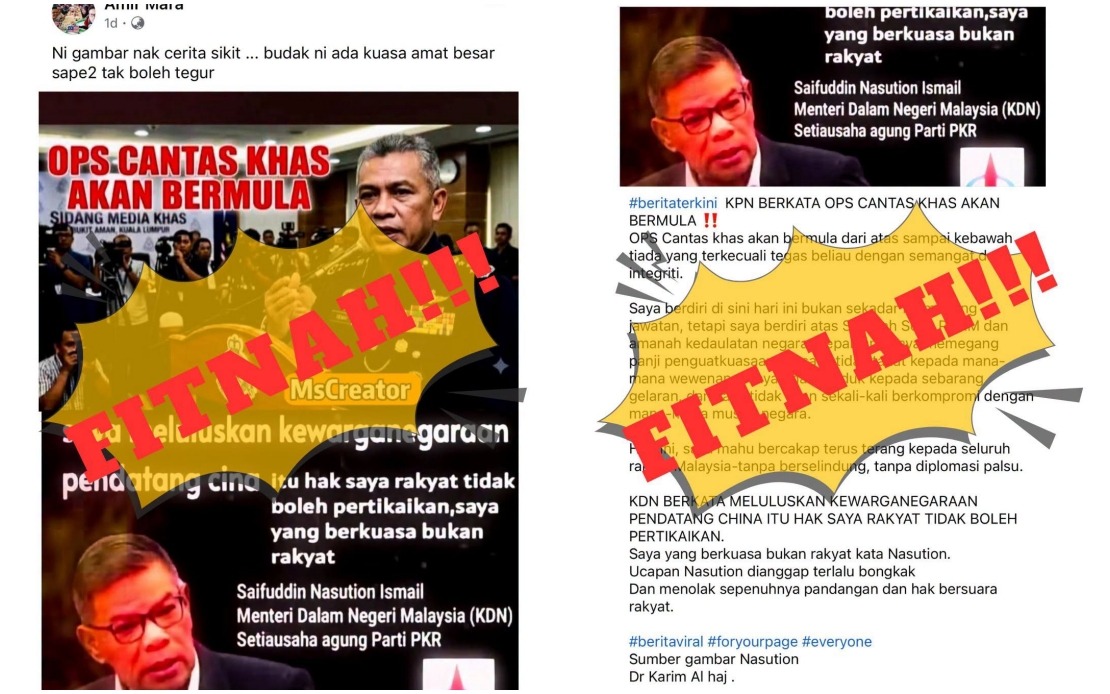
Malaysia's Home Minister Datuk Seri Saifuddin Nasution Ismail has emphatically rejected persistent allegations that the Home Ministry (KDN) conducted mass citizenship grants to foreign nationals, including claims that 1.2 million Chinese nationals have remained in the country. The minister's statement comes amid widespread circulation of unverified posters and social media content making such assertions, which he characterised as a deliberate effort to mislead the public and inflame communal tensions.
The Home Minister emphasised that he has repeatedly addressed these claims through official channels, providing detailed explanations supported by verified governmental data and documentation. Despite these efforts, he lamented that certain groups continue to recycle discredited videos, posters, and narratives that have already been publicly corrected and debunked by the ministry. This pattern suggests a coordinated strategy to maintain false narratives in circulation, particularly across social media platforms where misinformation spreads rapidly and widely.
Saifuddin Nasution underscored the broader societal dangers posed by such unfounded allegations, warning that they extend far beyond simple factual disputes. The dissemination of defamatory claims can damage the credibility of both individuals and government institutions, but more critically, they undermine public confidence in state structures and institutions that citizens depend upon for governance and services. He stressed that such misinformation campaigns risk eroding the social trust necessary for national cohesion.
The Home Minister highlighted how these false narratives, whether deliberately or inadvertently amplified, can inflame existing tensions between communities and foster interethnic hostility. By exploiting sensitive issues surrounding citizenship and national identity, the spread of unverified claims about mass naturalisation carries the potential to destabilise public order and peace. He characterised the circulation of such allegations as a threat to national security, given their capacity to provoke social discord and communal conflict.
In his address, Saifuddin Nasution urged all individuals and groups to cease propagating these claims and to refrain from weaponising sensitive national issues for political gain or to generate engagement on social media platforms. He called for greater responsibility in how information is shared, particularly through digital channels where verification mechanisms are often absent and emotional reactions drive amplification. The minister's tone suggested frustration that institutional denials and factual corrections have proven insufficient to halt the spread of misinformation.
The Home Minister appealed directly to the Malaysian public to exercise critical judgment when encountering such claims, encouraging citizens to verify information through official government sources before accepting or sharing it further. He emphasised that in an age of rapid information dissemination, individual responsibility plays a crucial role in combating misinformation. By checking sources and consulting authoritative channels, the public can help create a more truthful information environment.
Saifuddin Nasution's statement reflects broader regional concerns about the impact of unregulated social media and the proliferation of false narratives on platforms that lack robust fact-checking mechanisms. Southeast Asian nations, including Malaysia, have grappled with the challenge of combating misinformation that exploits communal sensitivities and national identity questions. The reach and speed of social media amplification make such campaigns particularly consequential in multiethnic societies where trust between communities remains fragile.
The emphasis on facts versus fiction in the minister's statement carries particular weight in the Malaysian context, where questions of citizenship and immigration intersect with sensitive discussions about national identity, Bumiputera rights, and demographic composition. False claims about large-scale naturalisation programmes can trigger anxieties about demographic change and resource competition, making such misinformation particularly effective in polarising public opinion. The government's challenge lies in both debunking individual false claims and addressing the underlying anxieties that make such narratives emotionally compelling to segments of the population.
The recirculation of already-debunked content suggests that misinformation regarding KDN's citizenship practices has achieved a kind of persistent life in digital spaces, circulating independently from any updating of facts or official corrections. This phenomenon, where false claims continue spreading despite being contradicted by authorities, represents a significant challenge to information governance. It demonstrates that institutional authority alone may be insufficient to counter the appeal of narratives that align with existing fears or prejudices.
Moving forward, the Home Minister's call for responsible social media use and verification of sources before sharing indicates the government's recognition that combating misinformation requires participation from multiple stakeholders beyond government institutions. Citizens, media organisations, and technology platforms must collectively work to establish higher standards for information sharing and validation. The minister's appeal reflects understanding that durably addressing misinformation requires cultural shifts in how information is treated and shared within society.
The timing and nature of these false claims, coupled with their persistence despite official denials, underscores the vulnerability of multiethnic democracies to divisive misinformation campaigns. Whether such campaigns emerge organically from public anxiety or are orchestrated by specific actors remains unclear, but their effect on public discourse and social cohesion is demonstrable. The Home Ministry's continued need to address these allegations suggests they retain resonance among certain segments of the population, indicating that information interventions must also engage with the legitimate concerns and questions that may underlie receptivity to such claims.

