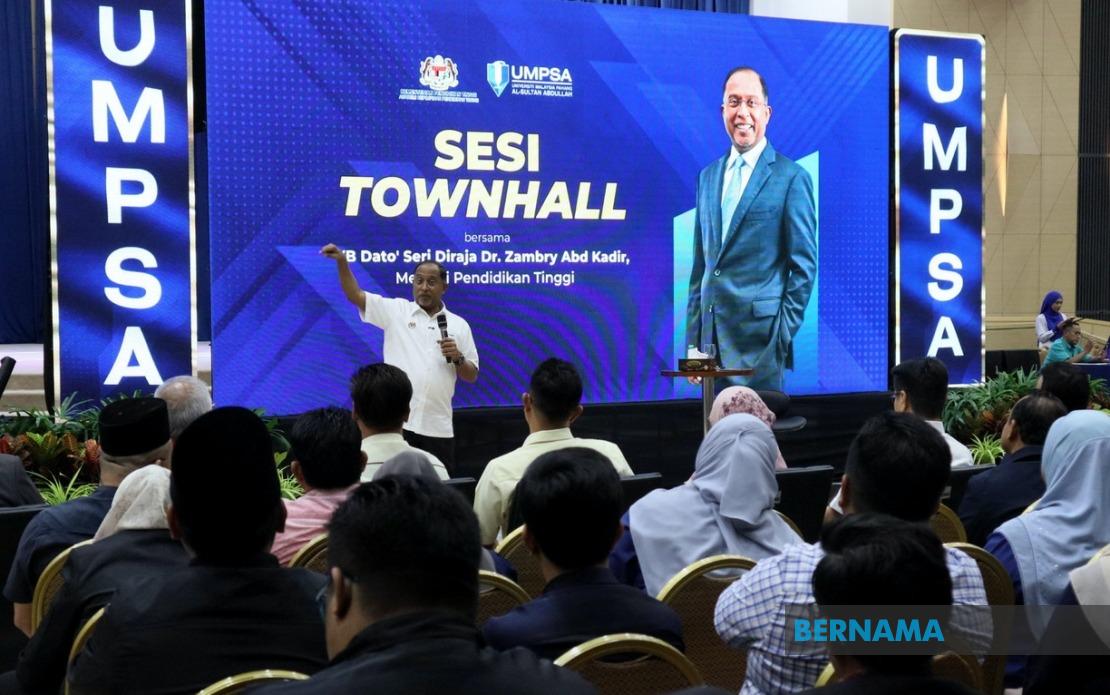
The Ministry of Higher Education (KPT) is moving swiftly to implement Prime Minister Datuk Seri Anwar Ibrahim's recent instruction requiring a comprehensive review of student disciplinary cases, with particular focus on cases where students faced sanctions for voicing criticism of government and political leadership. Minister Datuk Seri Dr. Zambry Abd Kadir announced the development during an appearance at Universiti Malaysia Pahang Al-Sultan Abdullah in Pekan, emphasising that the ministry recognises both the operational complexities and the broader policy implications of the directive.
The disciplinary review process reflects a significant shift in how Malaysian universities will approach student conduct matters going forward. The initiative acknowledges that existing university regulations governing student behaviour must be carefully reassessed to balance institutional discipline with the protection of academic freedom and political expression. Zambry indicated that the review touches upon matters previously settled at the legislative level and incorporates considerations regarding the legal framework surrounding student rights and freedoms within higher education settings.
Central to the implementation process is coordination among Malaysia's public universities. Zambry revealed that vice-chancellors from across the country convened with the director-general of Higher Education to discuss the practical implications and to develop a unified approach to the directive. The collaborative meeting signals the ministry's commitment to ensuring consistency in how institutions interpret and apply the new guidelines, preventing a fragmented response that might create confusion or inconsistency across the public higher education sector.
The timing of this directive reflects the government's broader agenda following the announced repeal of the Universities and University Colleges Act (AUKU) 1971, legislation long criticised for imposing restrictions on student political activity and expression. Anwar has previously indicated that students currently facing or having faced disciplinary measures for criticising government policies and leaders should be exonerated of related offences. This represents a significant philosophical departure from the paternalistic regulatory approach that has historically characterised Malaysian university administration.
However, the ministry's approach incorporates important nuances and limitations. The review process specifically targets administrative disciplinary measures handled at the Student Affairs Department level, distinguishing these from criminal matters. Cases involving violations of criminal law—those investigated or prosecuted by the Royal Malaysia Police—remain outside the scope of administrative absolution. This distinction is crucial for understanding the actual scope of the directive, as it clarifies that the government is not seeking to overturn criminal convictions or interfere with police investigations, but rather to revisit university-level sanctions.
The application of these changes across Malaysia's diverse higher education landscape presents practical challenges that the ministry is still working through. Public universities operating under specific statutory frameworks will likely implement the directive uniformly, but private higher education institutions operate under different legal structures, particularly the Private Higher Educational Institutions Act 1996 (Act 555). Zambry acknowledged this complexity, noting that private institutions are technically bound by different regulatory requirements. Nevertheless, the ministry expressed hope that private colleges, particularly those with state ownership or state involvement, would voluntarily adopt similar measures to ensure consistency across the sector and demonstrate commitment to the government's education policy direction.
The directive emerged from Anwar's remarks at the Malaysia Madani Intellectual Forum Series 13, where he framed the student disciplinary review within the context of institutional reform and democratic principles. The Prime Minister emphasised that the process of amending the AUKU represents a longer-term legislative undertaking requiring parliamentary procedures and consultation. Consequently, the immediate directive to absolve students of disciplinary penalties represents a pragmatic interim step to address perceived injustices while formal legislative amendments proceed through the proper channels.
For Malaysian higher education stakeholders, this development carries substantial implications. Students and their advocates have long viewed punitive disciplinary systems as mechanisms that suppress legitimate political discourse and restrict the marketplace of ideas within campus environments. The directive potentially opens space for more robust student activism and political engagement within university settings. Simultaneously, university administrators must navigate the transition from a disciplinary regime focused on controlling student political expression to one that permits greater freedom while maintaining institutional order and academic focus.
The broader context involves Malaysia's evolving commitment to democratic governance and civil liberties. Educational institutions play a formative role in developing informed citizens and leaders, and policies governing student conduct reflect societal values regarding free expression and political participation. By shifting away from punitive approaches to student political speech, the government signals a recalibration toward democratic principles, though questions remain about implementation consistency and whether genuine cultural change will accompany the policy directives.
The announcement also reflects demographic and generational considerations. The timing coincided with a gathering of 500 young university lecturers and administrators aged forty and below from higher education institutions across Pahang, Terengganu, and Kelantan. This younger cohort likely comprises individuals more sympathetic to expanded student freedoms and more comfortable with democratic norms of dissent. Their participation in the initiative suggests that the ministry is building support for policy change among those who will implement these directives and shape institutional culture moving forward.
Implementation of the directive will require developing clear protocols for identifying affected students, determining which disciplinary records warrant expungement, and communicating decisions to relevant stakeholders. The Student Affairs Department across all public universities will play a central coordinating role in this process. Universities must also consider whether expungement extends only to formal disciplinary records or includes informal notations that might affect student opportunities and references. These procedural questions, though administrative in nature, carry significant implications for students seeking to rebuild their academic standing and graduate records following controversial disciplinary episodes.
The policy shift underscores Malaysian higher education's transition toward more open institutional environments. Yet significant questions remain regarding implementation fidelity, particularly concerning whether private institutions will embrace equivalent measures and whether the cultural and systemic changes necessary to genuinely protect student expression will materialise. The effectiveness of the directive ultimately depends not merely on policy pronouncements but on how university administrators, faculty members, and student affairs staff respond to the mandate and whether they embrace or resist the underlying philosophy of expanded academic freedom.

