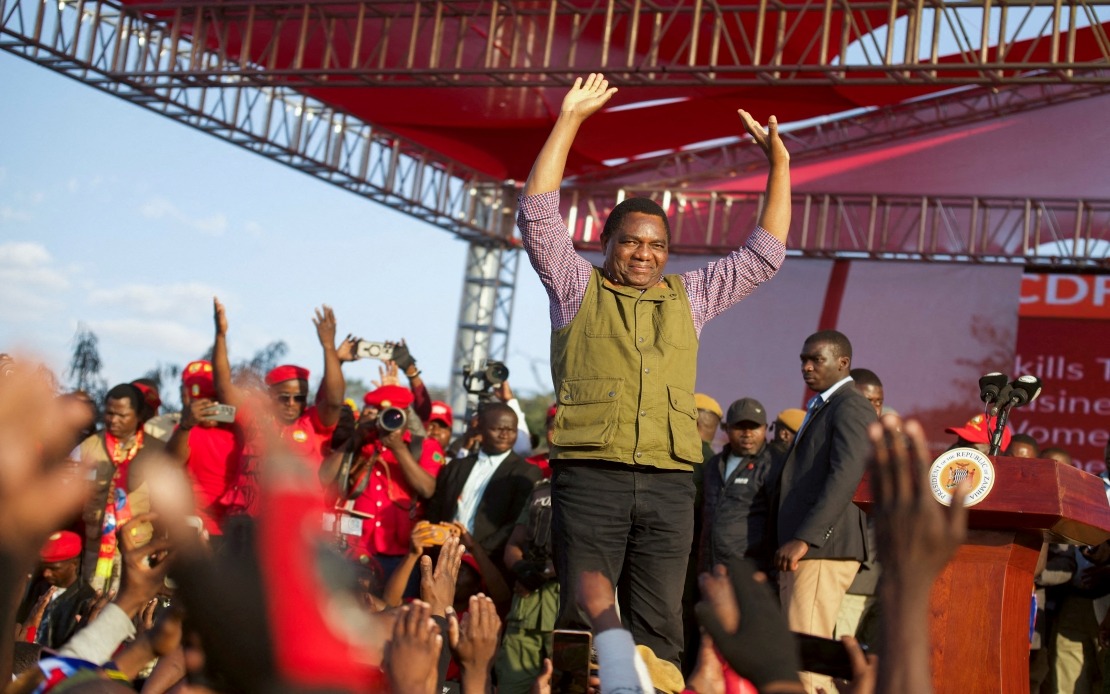
Zambian President Hakainde Hichilema has established a commanding position in the country's presidential contest, accumulating over 1.5 million votes as electoral officials continue counting ballots from a significant portion of the nation's 226 voting constituencies. With results from 135 constituencies now tabulated, the 64-year-old economist and rancher has captured 1,544,140 votes, putting him substantially ahead of his nearest rival. Electoral Commission of Zambia Chairperson Mwangala Zaloumis announced the consolidated results at the National Election Results Centre in the capital, Lusaka, providing a clearer picture of voter sentiment as the tallying process advances.
Hichilema, who is campaigning as the incumbent leader under the United Party for National Development, faces 12 other candidates vying for the presidency. His principal challenger, Brian Mundubile of the National Reconciliation Party for Unity and Prosperity, has garnered 1,030,662 votes from the same electoral divisions. The gap between the two frontrunners, roughly 500,000 votes at this stage, suggests that Hichilema's support base remains substantially broader than the opposition's consolidated strength across most regions.
The current electoral contest carries particular significance for Southern Africa's political trajectory and demonstrates the enduring appeal of Hichilema's first-term agenda among Zambian voters. His initial victory in 2021 constituted a landslide of historic proportions, when he decisively defeated incumbent Edgar Lungu by a margin exceeding one million votes. That overwhelming mandate enabled the UPND to govern with considerable parliamentary backing, allowing the party to pursue its policy priorities with relative stability during the first five-year term.
During his initial tenure, Hichilema has championed several signature initiatives that he presents as foundational achievements warranting his re-election. Foremost among these is his administration's restructuring of Zambia's debt burden, which had reached unsustainable levels under previous administrations. The government has pursued negotiations with international creditors and implemented fiscal reforms designed to restore financial stability. Additionally, Hichilema's government has focused on revitalising the mining sector, Zambia's traditional economic engine, through policies aimed at improving the investment climate and extracting greater value from mineral resources for national development.
Social spending has been another pillar of Hichilema's first-term programme. His administration introduced free education across public primary and secondary schools, a costly but politically significant initiative designed to improve educational access for rural and low-income populations. This programme reflects the government's commitment to expanding human capital development and reducing barriers to social mobility for disadvantaged Zambians. Such welfare-oriented policies have resonated with voters seeking tangible improvements in public services and economic opportunity.
Mundubile, the 55-year-old lawyer leading the NRPUP challenge, has managed to mobilise opposition forces across certain geographical strongholds, particularly within Zambia's urbanised corridor. This zone encompasses constituencies in the capital region and extends through the Copperbelt, historically one of the nation's most economically important and densely populated areas. The opposition alliance's parliamentary seat gains in these zones indicate that the ruling party does not command unanimous support in all quarters, though the presidential race appears to favour the incumbent.
Under Zambia's constitutional framework, securing the presidency requires more than a simple plurality of votes. A candidate must obtain more than 50 per cent of all valid votes cast to be declared president-elect on the first ballot. Should no candidate achieve this threshold, Zambian law mandates a second ballot restricted to the two leading candidates. This constitutional safeguard has shaped electoral strategies historically, occasionally producing surprising outcomes when opposition unity coalesces effectively around a single challenger.
Given Hichilema's current margin, the scenario in which the election proceeds to a second-round runoff appears increasingly unlikely. For such an outcome to occur, either Hichilema's vote share would need to fall below 50 per cent through tallying of remaining constituencies—a development the preliminary results make seem improbable—or substantial irregularities would need to be discovered during the counting process. Election monitoring groups have generally noted procedural compliance, though international observers continue their assessments as counting progresses.
The 2024 presidential election holds broader implications for the Southern African Development Community region, where Zambia has long occupied an important geopolitical position. A Hichilema victory would signal regional voter confidence in economic reform programmes, even when they impose near-term adjustment costs on populations accustomed to different policy approaches. Conversely, should opposition candidates gain ground in remaining constituency counts, it might suggest electoral fatigue with structural adjustment or dissatisfaction with the pace of visible economic improvement among ordinary Zambians.
Hichilema's potential second term would afford the government extended time to complete multi-year reform initiatives that require sustained implementation to yield results. Debt restructuring negotiations, mining sector rehabilitation, and educational system development typically require continuity of policy direction and administrative personnel. A renewed mandate would permit his administration to maintain strategic focus on these long-term objectives without the disruption that a change of government might entail.
Regional observers have noted that Zambia's electoral process, despite occasional challenges, has generally demonstrated institutional maturity and procedural integrity when compared to some neighbouring states. The Electoral Commission's transparent announcement of partial results and its methodical approach to consolidating constituency returns reflect institutional practices that have developed since the country's transition to multi-party democracy in the 1990s. These procedural standards, while imperfect, provide confidence that the eventual outcome will reflect genuine voter preferences.
As counting continues through the remaining constituencies, Hichilema's commanding lead suggests that Zambian voters are endorsing his government's policy direction and performance record. Whether this reflects satisfaction with economic improvement, acknowledgement of the difficulty inherent in macroeconomic adjustment, or other voter motivations will merit analysis once the electoral process concludes and academic researchers can conduct detailed post-election surveys. For now, the available data points toward a second consecutive victory for the UPND and a continued mandate for the president's reform agenda.

