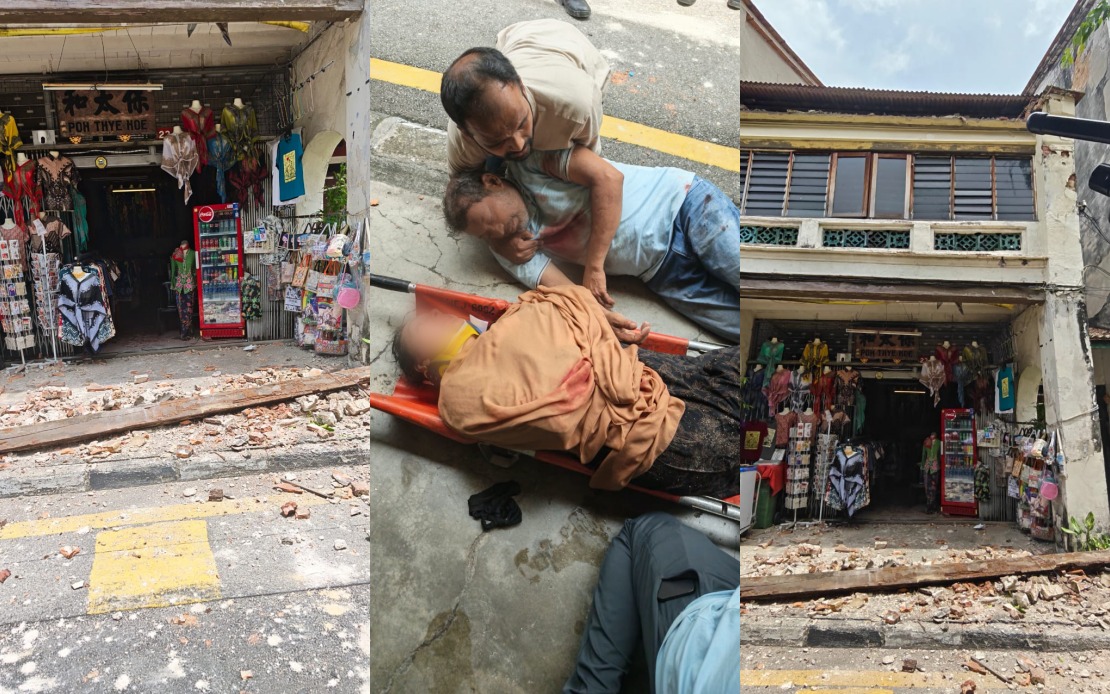
A concerning incident in one of Southeast Asia's most celebrated heritage zones has prompted urgent calls for structural safety measures across Penang's historic George Town. Two visiting tourists from Sri Lanka sustained injuries on August 4 when debris from an aging heritage building collapsed onto them while they walked along Armenian Street, one of the district's primary attractions drawing international visitors. The accident, occurring in broad daylight in a busy tourist area, has raised questions about the maintenance standards of buildings within the UNESCO World Heritage Site and the vulnerability of visitors navigating streets lined with centuries-old structures.
The two victims, identified as Mohamad Ammtar, aged 66, and Fatimah, aged 55, were struck by falling stones and timber fragments from a first-floor beam of the affected building. Emergency services responded quickly to the scene, with firefighters from the Lebuh Pantai Fire and Rescue Station arriving after receiving a distress call at 1.11 pm. The Penang Fire and Rescue Department's assistant director of operations, John Sagun Francis, coordinated the initial response, ensuring that paramedics provided on-site medical treatment before transporting both tourists to Penang Hospital for more comprehensive evaluation and care. The timing proved unfortunate for the couple, who had arranged their departure back to Sri Lanka for the following day and now faced unexpected hospitalisation instead.
The building involved in the incident operates a grocery shop at street level, with the upper storey appearing largely vacant. This mixed-use arrangement, common throughout George Town's heritage district, underscores a broader challenge facing the state: balancing the preservation and economic viability of historic structures with the critical need to maintain public safety. Many heritage buildings in the area function as working commercial spaces, their ground floors adapted for contemporary retail or business operations while upper levels remain underdeveloped or underutilised. This creates an ongoing tension between heritage conservation principles and practical building maintenance obligations.
The incident has catalysed a significant policy response from Penang's state government, which views the accident as symptomatic of potential systemic issues affecting the broader heritage precinct. Wong Hon Wai, chairman of the Penang State Tourism and Creative Economy Committee, visited the scene and subsequently announced that both George Town World Heritage Incorporated and Majlis Bandaraya Pulau Pinang, the local municipal authority, would be issuing formal advisories to all heritage building proprietors across the state. Wong's remarks stressed that the safety concerns extend far beyond the single building involved in Thursday's accident, emphasising instead a comprehensive need for structural assessment across the entire historic district.
The regulatory framework for heritage building maintenance in Penang has come under implicit scrutiny following the collapse. Wong articulated that every historic and aging structure within George Town should undergo thorough safety inspections to identify and remediate potential hazards that could threaten pedestrians and the substantial number of domestic and international visitors who traverse the district annually. His comments reflected recognition that George Town's status as a World Heritage Site carries not merely cultural significance but also public safety responsibilities. The district, recognised by UNESCO in 2008 for its outstanding architectural and cultural landscape, attracts hundreds of thousands of visitors annually, making the preservation of safe conditions a matter of both reputation and legal liability.
Penang's response demonstrates the heightened stakes of heritage tourism in a state that has positioned cultural conservation and tourism development as economic priorities. The incident occurred in a zone that has seen increasing investment in tourism infrastructure and marketing campaigns designed to showcase Malaysia's architectural heritage to regional and global audiences. A safety failure in such a visible location carries implications beyond the immediate injuries, potentially affecting visitor confidence and international perceptions of Penang as a secure destination. The government's swift acknowledgment of this broader context reflects understanding that heritage preservation cannot be divorced from contemporary safety standards and public welfare obligations.
The state government has committed to providing immediate assistance to the injured tourists and has initiated contact with the Sri Lankan High Commission in Kuala Lumpur to coordinate appropriate support mechanisms. This diplomatic dimension, while secondary to the immediate medical and safety concerns, illustrates how heritage tourism incidents acquire international dimensions. The tourists' injury, coupled with their status as foreign visitors to a promoted heritage destination, creates diplomatic considerations that extend beyond typical domestic accident response protocols. Malaysia's growing positioning as a heritage tourism destination in Southeast Asia means that safety incidents in World Heritage Sites acquire added significance and visibility.
Pending investigations will seek to establish the specific causes of the structural failure, including whether the collapse resulted from deferred maintenance, inadequate previous repairs, age-related deterioration, or environmental factors such as weather damage. Understanding causation will prove essential for formulating appropriate remediation strategies, whether focused on mandatory inspection schedules, updated building codes, owner incentives for repairs, or enhanced enforcement mechanisms. The Penang government's stated commitment to obtaining a comprehensive report from relevant authorities indicates that policy responses will likely await forensic findings before implementation.
The Armenian Street incident highlights an unresolved tension within heritage conservation frameworks across Southeast Asia more broadly. Historic districts in cities including Georgetown, Penang; Melaka; and Bangkok balance preservation objectives with the practical realities of aging infrastructure serving contemporary functions. Building owners often face competing pressures: heritage conservation requirements that may constrain modifications, economic constraints on expensive repairs, and liability concerns regarding public safety. This incident may catalyse broader discussions within Malaysian heritage management circles about establishing clearer maintenance standards, inspection protocols, and support mechanisms for building owners committed to both conservation and safety compliance.
For visitors and residents alike, the accident serves as a reminder that heritage tourism, while culturally enriching and economically valuable, operates within physical environments whose safety cannot be taken for granted. George Town's narrow streets and closely-packed historic structures create an intimate and distinctive character that attracts international tourists, yet this same topography and building density require careful stewardship to prevent structural failures. The coming weeks will reveal whether this incident prompts substantive changes to how Penang manages its heritage building stock or whether it remains an isolated accident requiring only specific remediation.

