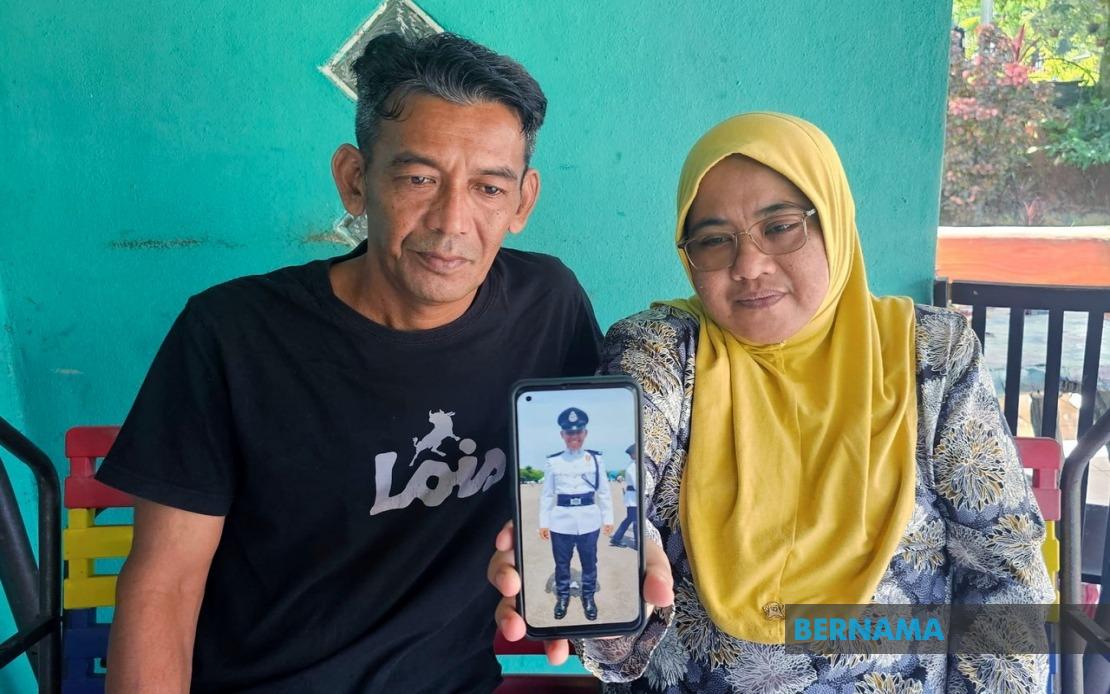
The joy of anticipation turned to profound grief for a Terengganu family when they learned that their son, who had been counting down days until his homecoming, had died in a workplace accident in Sabah. Constable Muhammad Raimi Ismarubee, 26, was stationed at the Weston Police Station in Beaufort when he and two colleagues were electrocuted while handling equipment outside their station. The incident has raised fresh concerns about workplace safety protocols in law enforcement agencies across the country, particularly regarding the use of electrical equipment in outdoor settings.
The young constable's parents, Ismarubee Ismail, 51, and Nor Azila Zakaria, 46, were still processing their loss when speaking to journalists at their home in Felda Kerteh 2, Dungun. Just hours before receiving the devastating news, they had been discussing holiday plans with their son. Ismarubee recounted that at 2 pm, Muhammad Raimi had messaged them via WhatsApp about a successful drug arrest—a proud achievement in his still-young career. By 6 pm the same day, a friend of the constable called with news that would shatter their world.
Muhammad Raimi had been working at the Weston Police Station for less than a year, having begun his posting in September 2024. Despite the brief tenure, he had already established himself as a dedicated officer. His last visit home to Terengganu was in January, a period his parents had treasured. Since then, the family had been looking forward to seeing him again before the month ended. However, securing affordable airfare from Sabah had been a challenge, and he had been waiting for flight prices to become more reasonable before finalizing his leave dates—a concern that resonates with many Malaysian workers stationed in different states who face the financial burden of regular travel home.
The electrocution occurred while Muhammad Raimi and his colleagues, Corporal Chiu Teck Siong, 40, and Lance Corporal Mohamad Nur Hafiz Ibrahim, 29, were moving a metal pole used for harvesting coconuts outside the station near Sekolah Kebangsaan Weston. The incident raises critical questions about why police stations were engaging in such activities and whether appropriate safety measures and electrical hazard assessments were in place. The use of metal poles in proximity to electrical sources, particularly without proper precautions or training, suggests potential gaps in workplace safety culture that extend beyond just this single station.
Beyond his uniform and duties, Muhammad Raimi was a deeply caring son and brother. He was the second of three children and had taken on informal responsibilities as a provider for his family. According to his mother, he harbored plans to propose to a woman from Sabah in the coming year but deliberately delayed the engagement until his youngest sibling had completed the Sijil Pelajaran Malaysia examinations. This decision reflected his commitment to family priorities and his desire to support his siblings' educational pursuits. His financial support, provided almost monthly, had been instrumental in helping his family manage educational expenses, including the purchase of laptops and other necessary school materials.
The loss has devastated parents who had watched their son grow into a responsible adult and dutiful police officer. His father works as a laborer, making his son's contribution to household finances and his siblings' education particularly significant. Nor Azila remembered her son not just as a dutiful officer but as a brother who consistently thought of his siblings' needs and futures. The couple will now face the additional burden of grief while supporting their remaining two children through what will undoubtedly be a difficult period of adjustment.
In accordance with Islamic funeral rites, Muhammad Raimi's remains were brought back to Terengganu by the police force, and he was laid to rest at the Felda Kerteh 2 Muslim Cemetery on the day his parents spoke to the press. The speed of the return and burial reflects both the gravity with which the authorities treated the matter and the family's wish to perform the final rites according to their faith and tradition. His story adds another name to the growing list of workplace fatalities in Malaysia that prompt questions about enforcement of safety standards.
The incident has broader implications for law enforcement agencies nationwide. Police stations across Malaysia must now confront uncomfortable questions about the adequacy of their safety protocols, the training provided to personnel handling potentially hazardous equipment, and the oversight mechanisms that should prevent such tragedies. The Royal Malaysia Police must initiate a comprehensive review of practices at stations similar to Weston to ensure that no family experiences the same sudden loss that has befallen the Ismail-Zakaria household. Muhammad Raimi's death serves as a stark reminder that occupational hazards do not discriminate between departments or ranks—they claim lives when prevention measures prove insufficient.
For the community in Felda Kerteh 2 and beyond, this incident underscores the human cost of insufficient workplace safety. It transforms abstract policy discussions into deeply personal tragedy, reminding policymakers and station commanders that every officer has loved ones waiting for their safe return home. The conversation around workplace electrocution safety in Malaysia must evolve from reactive investigations after deaths to proactive prevention systems that treat every worker's life as irreplaceable, whether they wear a uniform or not.

