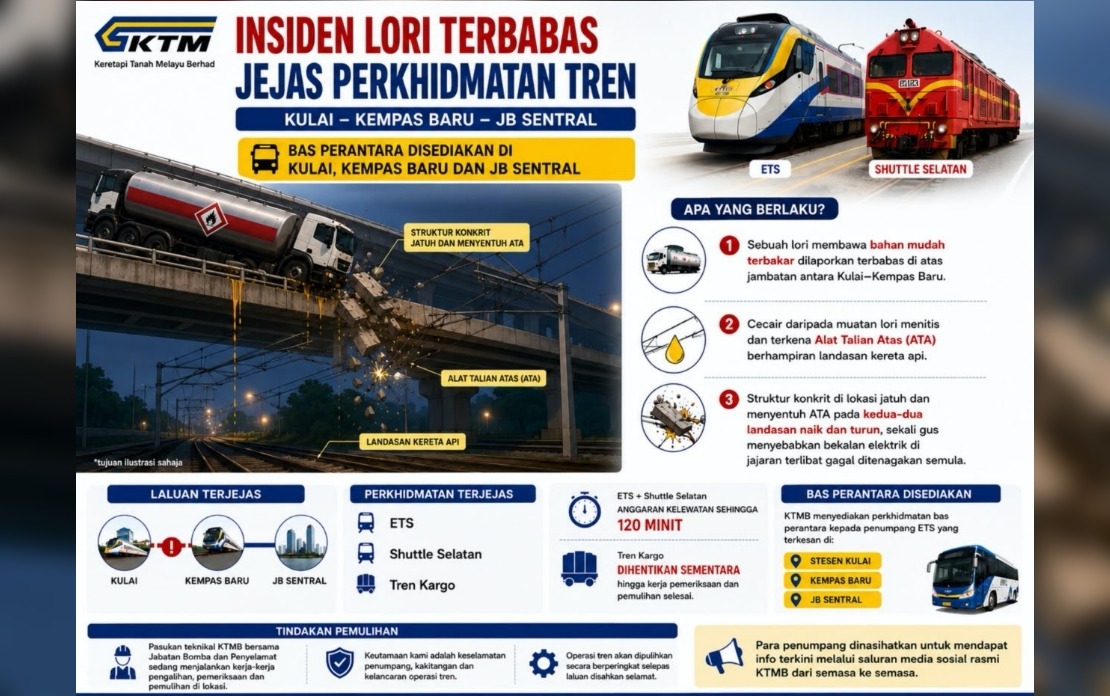
A hazardous materials incident in Johor Bahru on August 5 created significant disruption to commuter rail networks in the southern corridor, with authorities scrambling to restore essential services after a tanker lorry carrying flammable liquid veered dangerously close to railway infrastructure. The accident, which occurred near the tracks along the Kulai–Kempas corridor, triggered an electrical power outage that rippled through both the Electric Train Service (ETS) and Shuttle Selatan operations, affecting thousands of evening passengers attempting to travel through one of Malaysia's busier transport routes.
Keretapi Tanah Melayu Berhad (KTMB), the state-owned rail operator, immediately acknowledged the operational crisis through an official social media announcement, confirming that train movements on the affected route had been halted pending resolution of the power infrastructure failure. The incident underscored the vulnerability of Malaysia's rail networks to external hazards, particularly in high-density industrial corridors where commercial vehicles regularly operate in proximity to railway lines. Cleanup operations and technical repairs to restore electrical supply began immediately, though the operator did not specify an estimated timeframe for full service restoration.
Passengers faced a chaotic evening as KTMB implemented emergency contingency measures to mitigate the transport vacuum. For ETS users stranded at Kulai, Kempas Baru, and JB Sentral stations, the rail operator mobilised replacement shuttle bus services to transport commuters along the interrupted route, though such alternatives typically prove insufficient during peak evening hours when demand for southbound transport peaks. The deployment of buses represented the standard mitigation protocol for rail disruptions, yet the unpredictability of hazmat incidents means that operational planning and real-time passenger communication become critical to managing public frustration and safety.
The situation facing Shuttle Selatan passengers proved more complicated, as the suburban feeder service lacked the same level of replacement infrastructure. KTMB advised these commuters to pursue entirely different transport modes—effectively encouraging them to seek private taxis, ride-hailing services, or personal vehicles. This guidance implicitly acknowledged that the rail operator possessed insufficient backup capacity to absorb all displaced passengers, a reality that reflects broader challenges within Malaysia's public transport ecosystem where redundancy and surge capacity remain underfunded priorities.
Compensatory measures formed part of KTMB's response to the disruption, with the operator announcing that affected passengers would receive fare adjustments to offset the service failure. However, the operator provided minimal detail regarding the scope, magnitude, or methodology of such compensation, leaving many commuters uncertain about whether they would receive automatic refunds, service credits, or other reimbursement mechanisms. This lack of transparency in compensation policies has historically frustrated Malaysian rail users, who frequently encounter service disruptions without clear understanding of their entitlements.
Real-time service updates revealed the severity of cascade delays across the network. By 10:37 pm, specific ETS services reported cumulative delays stretching between thirty and fifty-five minutes, with ETS9449 trailing its schedule by thirty-two minutes while ETS9533 fell behind by fifty-five minutes. KTMB cautiously hedged its schedule projections by noting that delays remained subject to operational conditions, essentially signalling that service restoration timelines remained uncertain and could extend beyond initial estimates. Such delays trigger collateral disruptions throughout the southern rail corridor, potentially affecting hundreds of downstream services across the evening and night periods.
The incident exemplifies the intersection of industrial activity and public transport infrastructure that characterises Malaysia's transport landscape, particularly in developed economic corridors such as the Johor region. Heavy commercial traffic, including vehicles carrying flammable and hazardous materials, regularly shares road networks with railway installations, creating potential flashpoints for accidents that compromise public safety and transport reliability. Unlike Western jurisdictions with more segregated transport infrastructure, Malaysian roads and rails frequently operate in close proximity, a reality that demands robust safety protocols and emergency response frameworks.
From a passenger perspective, the disruption highlighted the precarious position of commuters dependent on public rail transport during emergencies. Unlike private vehicle users who can navigate alternative routes, rail passengers must wait for operator decisions regarding contingency arrangements. The evening timing of the incident maximised inconvenience, occurring during peak outbound travel when southbound capacity operates at maximum utilisation. Professionals, students, and shift workers relying on scheduled train departures faced cascading personal disruptions, from delayed arrivals at destinations to missed connections and compromised evening plans.
KTMB's public communication approach attempted to balance operational transparency with managing expectations, though the limited information regarding incident specifics—such as whether the lorry had actually struck the tracks or merely came into close contact, and the precise nature of the flammable cargo—left observers speculating about the severity and duration of required repairs. The operator's standard apology for inconvenience, coupled with invitations for affected passengers to seek staff assistance, represented conventional customer service responses that rarely address underlying systemic issues driving recurring service disruptions.
Looking beyond the immediate incident, the disruption underscores broader vulnerabilities within Malaysia's rail infrastructure and the interdependencies between transport systems and industrial operations. As the nation pursues ambitious public transport expansion through initiatives such as the Klang Valley Mass Rapid Transit and other regional networks, planners must incorporate robust contingency protocols, enhanced communication frameworks, and sufficient redundant capacity to absorb the inevitable disruptions that emerge when commercial and public transport networks intersect. The Kulai–Kempas incident, while operationally resolved relatively swiftly, served as a pointed reminder that transport reliability remains contingent on factors extending far beyond the rail operator's direct control.

