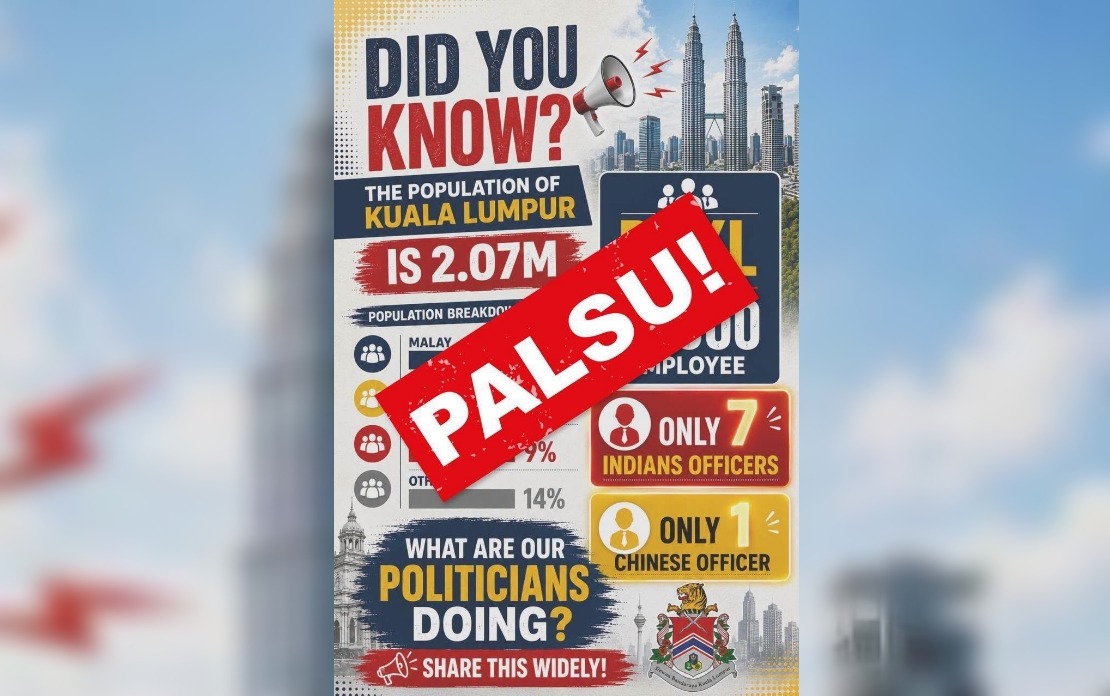
Minister in the Prime Minister's Department (Federal Territories) Hannah Yeoh has moved to counter inflammatory misinformation regarding the ethnic composition of Kuala Lumpur City Hall's workforce, cautioning the public against accepting unverified claims that have spread through social media channels during the current election campaign period.
A misleading poster distributed via WhatsApp alleged that DBKL employed only seven Indian staff members and a single Chinese employee, a claim that bears no resemblance to the actual staffing structure of Malaysia's capital city administration. Speaking through a Facebook post, Yeoh firmly rejected these figures and provided comprehensive employment statistics to set the record straight for concerned citizens and stakeholders.
According to official DBKL records as of July 1, 2026, the local authority maintains a workforce of 9,131 employees across all categories and classifications. Within this total complement, the authority employs 490 Indian staff members and 22 Chinese employees, substantially exceeding the falsely claimed figures by a considerable margin. These numbers provide a more accurate picture of ethnic diversity within the municipal administration than the sensationalist WhatsApp claims circulating in public forums.
The picture becomes more nuanced when examining professional and managerial levels specifically. Among officers occupying positions within the Management and Professional Group, DBKL has appointed 10 Indian officers and two Chinese officers, reflecting what Yeoh characterised as ongoing efforts to improve representation at higher echelons of the organization. This breakdown demonstrates that minority ethnic communities are present not merely in rank-and-file positions but also in decision-making roles within the hierarchy.
Recognising that perfect parity has not yet been achieved, Yeoh adopted a measured tone in acknowledging that diversity within DBKL remains an area requiring continued development and refinement. Rather than dismissing concerns entirely, she validated the underlying principle that all ethnic communities should be proportionally represented throughout the municipal workforce, signalling receptiveness to legitimate critiques while simultaneously rejecting the false narrative being weaponised during the election campaign.
In response to the revelations, Yeoh has issued direct instructions to DBKL management to undertake a comprehensive examination of its recruitment procedures, hiring mechanisms, promotion pathways, and the channels through which the authority advertises job vacancies. This systematic review aims to identify structural or procedural impediments that might inadvertently disadvantage applicants from particular communities and to establish remedial measures that operate on principles of transparency, impartiality, and genuine merit-based advancement.
The matter highlights a broader concern about the politicisation of administrative and civil service appointments, particularly during election cycles when rival political factions seek electoral advantage by stoking communal sensitivities. Yeoh's response attempts to deprive such narratives of traction by providing factual data and demonstrating governmental commitment to addressing legitimate representation deficits without capitulating to manufactured outrage.
Yeoh's statement carries particular resonance in the Malaysian context, where questions of Bumiputera privileges, ethnic representation in public institutions, and affirmative action policies remain perpetually contentious. The attempt to portray DBKL as systematically excluding minority ethnic communities contradicts both official statistics and the constitutional framework governing employment in federal territories, yet such claims can rapidly gain currency through digital rumour networks unless promptly rebutted with credible information.
The minister specifically appealed to all political parties and community organisations not to exploit workforce composition questions as a mechanism for generating communal polarisation or stoking ethnic discord. Instead, she advocated for a constructive approach focused on correcting factual inaccuracies while simultaneously engaging honestly with any genuine shortfalls in representation that might exist in specific departments or professional grades.
Beyond the immediate dispute over DBKL staffing numbers, Yeoh's intervention underscores the vulnerability of government institutions to disinformation campaigns, particularly when allegations touch upon sensitive ethnic or religious dimensions of Malaysian public life. The ease with which unsubstantiated claims can circulate through WhatsApp and social media platforms poses ongoing challenges for officials seeking to maintain public confidence in the fairness and impartiality of the civil service.
The controversy also raises questions about transparency in human resources management within government agencies. While Yeoh provided aggregate statistics refuting the most egregious false claims, establishing routine public reporting of workforce composition by ethnicity, religion, and gender across all government departments would reduce opportunities for misinformation to flourish and demonstrate genuine institutional commitment to representative governance. Such transparency, implemented carefully and sensitively, could enhance rather than undermine public trust in the meritocratic operation of Malaysia's public administration.

