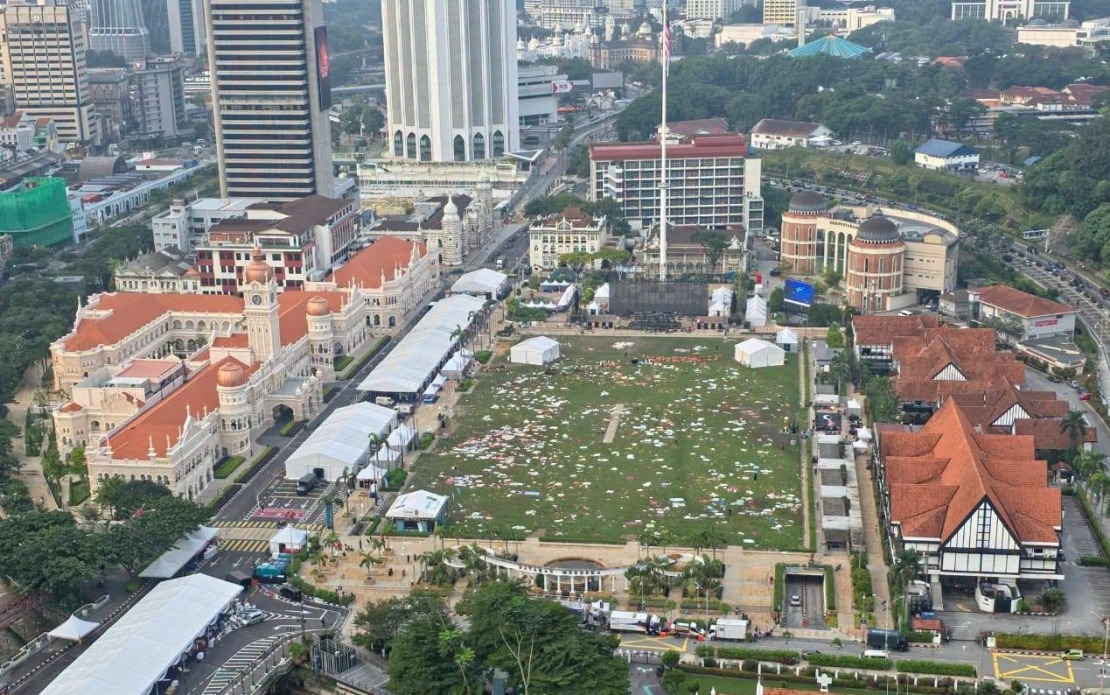
Federal Territories Minister Hannah Yeoh has acknowledged the efforts of Kuala Lumpur City Hall (DBKL) staff who undertook extensive cleaning operations at Dataran Merdeka after a public screening of the 2026 FIFA World Cup final left the historic venue covered in litter. Her remarks, shared on social media, reflected both gratitude for the municipal workers' dedication and a broader message about the obligations of citizens toward the upkeep of communal spaces.
The minister's intervention touches on a recurring challenge facing Malaysian cities: the tension between the government's duty to maintain public infrastructure and the individual's responsibility to keep such spaces clean. While acknowledging that DBKL has fulfilled its mandate as expected of a municipal authority, Yeoh emphasized that disposing of rubbish appropriately falls squarely within the realm of personal conduct rather than institutional obligation.
Yeoh articulated a nuanced position on the social contract between government and citizens. She noted that while taxpayers rightfully expect quality public services, this expectation should not extend to assuming that municipal workers will clean up deliberate littering. The distinction she drew is significant: there is a difference between maintaining infrastructure through routine maintenance and clearing up the consequences of careless behavior by large crowds.
The specific incident at Dataran Merdeka carries symbolic weight beyond the immediate hygiene concern. The venue holds profound historical significance as the location of Malaysia's independence proclamation, and its status as the capital's most recognizable public square makes its condition reflective of the city's broader character and the public's respect for national heritage.
Yeoh connected the cleanliness issue to the Malaysia MADANI vision articulated by Prime Minister Datuk Seri Anwar Ibrahim. Rather than interpreting this national aspiration as solely focused on government initiatives and infrastructure development, she framed it as fundamentally rooted in the behavioral standards of the populace. The philosophy suggests that genuine national progress cannot be built on physical development alone; it must be underpinned by a culture of civic consciousness and environmental stewardship.
The minister drew an analogy that resonated with the concept of collective ownership: Kuala Lumpur functions as a shared home for all residents and visitors, and therefore its maintenance cannot rest on the shoulders of service workers alone. This framing appeals to a sense of common purpose and mutual obligation rather than relying solely on regulatory enforcement or increased municipal resources.
Yeoh's statement implicitly acknowledged that government agencies operate within finite budgetary constraints. DBKL's capacity to respond to mass events cannot be infinite, and the expectation that cleaning crews will manage extensive littering from large gatherings places unreasonable strain on municipal budgets that could be redirected toward other essential services. By emphasizing personal responsibility, she highlighted the economic efficiency argument for public participation in cleanliness maintenance.
The World Cup screening incident also raises questions about event management and crowd control at major public gatherings. While the minister's focus remained on individual accountability, the episode suggests that large-scale events at Dataran Merdeka might require enhanced planning mechanisms, including strategically positioned waste receptacles, clear signage about disposal expectations, and perhaps volunteer coordination during the event itself.
Yeoh's appeal to civic duty reflects a broader challenge across Southeast Asia, where rapidly growing urban populations and increasing public event attendance have strained municipal services. Cities throughout the region grapple with balancing the right to public space usage against the responsibility to maintain those spaces for collective benefit. Her message speaks to Malaysian citizens' role in contributing to the solutions rather than expecting complete reliance on institutional responses.
The minister's reference to Prime Minister Anwar Ibrahim's philosophy about national progress underscores how senior government figures are increasingly framing development discourse beyond infrastructure metrics. This shift toward emphasizing behavioral and cultural dimensions of progress suggests a recognition that sustainable urban living depends on internalizing values of respect for communal spaces among the population.
The incident at Dataran Merdeka serves as a broader cautionary tale for Malaysian cities hosting large-scale public events, whether cultural festivals, sporting broadcasts, or national celebrations. The cleanup costs, environmental impact, and wear on municipal infrastructure resulting from negligent behavior create ripple effects that ultimately affect service quality in other areas. Public health and environmental standards depend fundamentally on individual choices made by thousands of people in the moment.
Yeoh's intervention, while acknowledging DBKL's professionalism, essentially calls for a cultural shift in how Malaysians view their relationship to public spaces. Rather than treating such venues as temporary gathering grounds with no lasting personal responsibility, the minister invited citizens to embrace them as shared national assets deserving respect and careful stewardship. This reframing positions civic cleanliness as integral to national identity and pride, moving beyond purely transactional relationships with government services.

