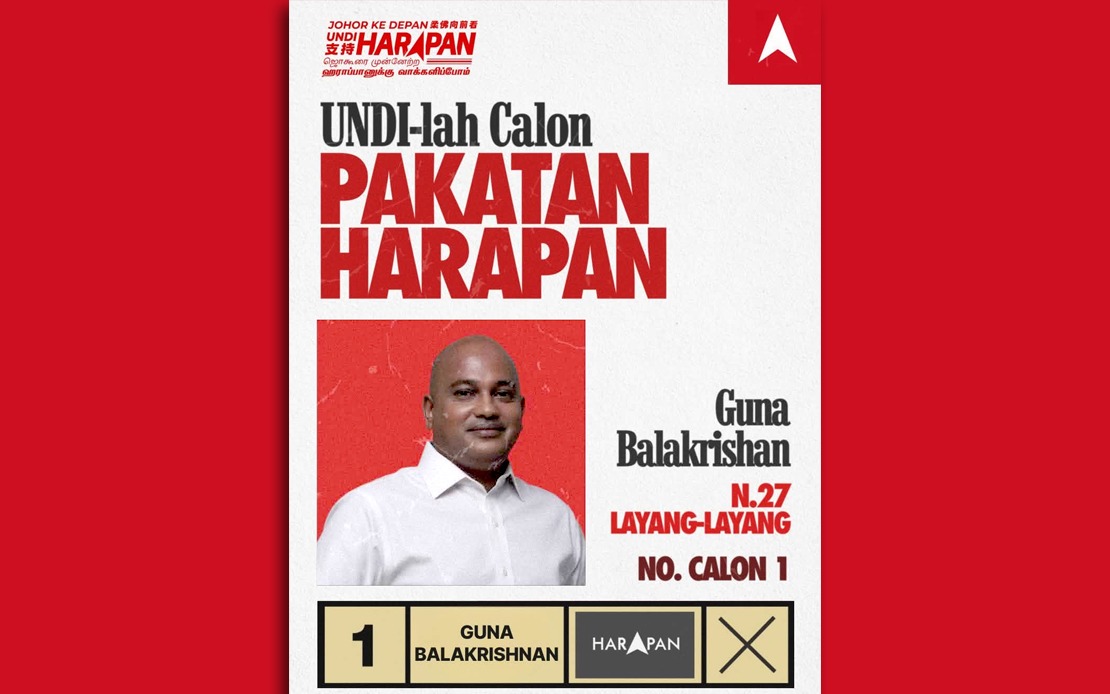
Pakatan Harapan candidate Guna Balakrishnan has put forward an ambitious six-point development agenda for the Layang-Layang state seat, positioning himself as an advocate for comprehensive constituency-wide improvement centred on addressing the pressing challenges that have historically afflicted the area. The manifesto signals a broad approach to governance that extends across infrastructure renewal, community welfare, and economic diversification, reflecting an attempt to build political support across multiple demographic groups and geographic zones within the constituency.
Guna's candidacy occurs within a competitive electoral environment in the 25,181-strong voter constituency, where he faces a three-cornered contest against Barisan Nasional's Chua Jian Boon and sitting representative Abd Mutalip Abd Rahim from Perikatan Nasional. The contest unfolds amid heightened political activity in Johor, with the state election scheduled for July 11 and early voting commencing on July 7, providing candidates with limited time to crystallise voter commitment. This compressed campaign period underscores the significance of early policy articulation to distinguish candidates among an increasingly sophisticated electorate.
Flooding represents perhaps the most tangible grievance animating residents across multiple settlements within Layang-Layang, with documented recurrent inundation affecting communities in Kampung Senda, Sungai Sayong, Kampung Tengah Renggam, Ulu Benut, Simpang Renggam, and Kampung Chokro. Guna's commitment to expedite flood mitigation infrastructure while simultaneously undertaking systematic drainage upgrades addresses a longstanding vulnerability that impacts agricultural productivity, residential safety, and quality of life. The pledge to ensure routine road and public facility maintenance reflects broader recognition that infrastructure degradation accumulates when maintenance budgets prove inadequate or inconsistently applied, a common complaint across rural Malaysian constituencies where development funds often prioritise new projects over preservation.
Infrastructure deficiencies extend beyond flood management into the digital realm, where rural communities frequently experience internet connectivity gaps that constrain educational opportunity and business expansion. Guna's proposal to strengthen internet coverage in underserved areas acknowledges the increasing centrality of digital access to economic participation and educational attainment, particularly relevant as Malaysia pursues broader digitalisation targets and as remote work opportunities expand. Enhanced street lighting complements this infrastructure vision by addressing public safety concerns that disproportionately affect vulnerable populations including women and the elderly, while simultaneously enabling evening economic activity and community engagement.
The candidate's economic development vision extends to leveraging Renggam's tourism potential, a strategic focus that aligns with broader regional efforts to diversify income sources beyond traditional agricultural and manufacturing bases. Supporting small traders through targeted policy interventions recognises the role of micro and small enterprises in generating employment and maintaining community vitality. This approach mirrors successful models adopted in other Malaysian constituencies where heritage tourism, agro-tourism, and cultural experiences have generated supplementary income streams while preserving local identity and environmental character.
Youth engagement figures prominently in Guna's manifesto through commitments to expand Technical and Vocational Education and Training access and establish organised motorsports infrastructure. The TVET expansion directly addresses Malaysia's persistent skills gap and youth unemployment, particularly acute in constituencies where higher education migration drains human capital. The proposed motorsports facility represents innovative thinking about youth engagement, channelling apparent enthusiasm for motorcycle culture into structured developmental contexts rather than viewing such interests as inherently problematic or ignoring them entirely.
Women's economic empowerment receives specific attention through entrepreneurship strengthening initiatives, reflecting recognition that women face distinctive barriers accessing capital, networks, and markets despite constituting substantial portions of microenterprise sectors. The establishment of a Senior Citizens Activity Centre addresses demographic realities whereby aging populations require structured community engagement to maintain physical and mental wellbeing while contributing accumulated knowledge and experience to community life. These welfare-focused pledges suggest attention to often-marginalised constituencies whose needs receive insufficient focus during election campaigns dominated by broad economic messaging.
Guna contextualises his pledges within a framework emphasising collaborative governance, positioning the state assemblyman role as a conduit between constituent needs and government capacity. This framing acknowledges that local representation operates within broader systems requiring coordination across local authorities, state government, and federal agencies—a reality that separates campaign promises from implementable outcomes. His emphasis on close community engagement and regular constituent contact reflects evolving expectations regarding representative responsiveness, particularly among constituencies experiencing historical policy neglect.
The candidate explicitly distances his pledges from what he characterises as unrealistic election promises, instead framing them as achievable commitments requiring sustained collaborative effort between government and community. This rhetorical move attempts to distinguish serious candidates from those perceived as offering hollow campaign rhetoric, potentially resonating with electorates increasingly skeptical of unfulfilled promises. However, voters will ultimately assess whether implementation occurs following the election, particularly regarding high-cost infrastructure projects whose execution extends across multiple budget cycles.
The timing of this manifesto announcement reflects campaign acceleration as the July 11 election approaches, with three-way contestation likely intensifying scrutiny of each candidate's feasibility and track record. Guna's relatively comprehensive policy framework suggests preparation through constituent engagement and issue prioritisation, though the seven-day campaign window limits opportunities for detailed public debate regarding implementation mechanisms and budgetary realism. For Malaysian voters in Layang-Layang and observers monitoring Johor electoral dynamics more broadly, evaluating candidates increasingly requires moving beyond policy announcements to examining candidate background, party fiscal credibility, and historical implementation records in comparable constituencies.
The broader Johor state election context matters significantly, as state government composition directly influences resource allocation and policy prioritisation at the constituency level. Voters considering Guna's manifesto must simultaneously contemplate which state government configuration would most effectively resource and support his pledges should he achieve election. This interdependence between local constituency representation and state-level governance power structures shapes the realistic prospect space within which any assemblyman operates, regardless of personal commitment or constituent support.

