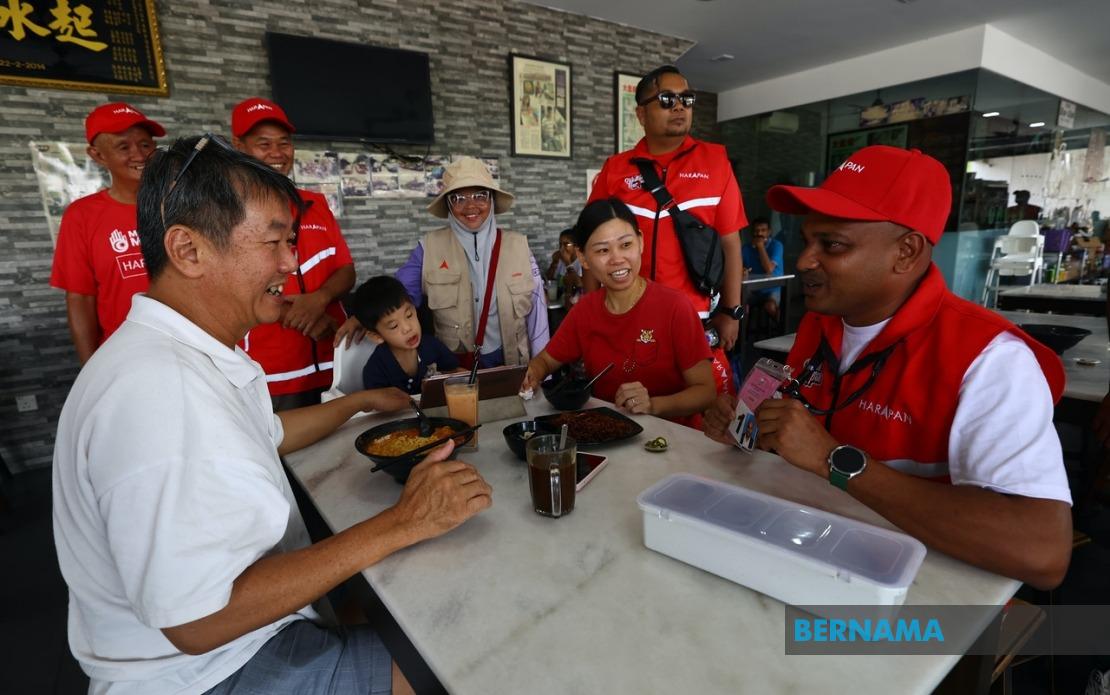
With just five days remaining before Johor voters head to the polls, Pakatan Harapan candidate Guna Balakrishnan is executing a final push to reach the remaining fifth of his constituency that has yet to receive a direct campaign visit. Speaking at the PH operations centre in Kluang on July 5, he outlined an ambitious plan to double down on grassroots engagement in the Layang-Layang state seat, where approximately 25,181 registered voters will determine the outcome of what has become a closely watched three-cornered race.
Guna's campaign machinery has already penetrated roughly 80 per cent of the constituency through door-to-door engagement and community events, but the candidate recognises that the margin between victory and defeat in Malaysian state elections often hinges on turning out uncommitted voters in the final days. He articulated his determination to convert these final weeks of electioneering into a maximum-intensity effort, employing the kind of hyperbolic language common among candidates in the closing stretch—declaring that he would need to operate at 200 per cent capacity to ensure every eligible voter receives his message and considers voting for PH.
The central challenge facing Guna, however, transcends mere logistical reach. Convincing voters that Pakatan Harapan represents genuine change remains the dominant theme of his communications strategy, a recurring refrain that speaks to persistent public scepticism about whether any coalition can deliver substantively different governance. This positioning reflects PH's broader campaign narrative across the Johor state election, anchored on the claim that the coalition possesses a proven record of delivering impactful reforms—though this assertion remains contested by other coalitions and by voters whose experiences diverged from PH's stated accomplishments during its time in federal government.
The manifesto unveiled by Guna for Layang-Layang addresses several bread-and-butter concerns that typically dominate state-level electoral competition in Malaysia. Flood mitigation emerges as a particularly salient issue, reflecting the constituency's vulnerability to seasonal inundation and the persistent failure of governments to implement comprehensive drainage solutions that protect vulnerable communities. Road upgrades and improved street lighting feature prominently in his platform, addressing infrastructure maintenance backlogs that have accumulated across many Malaysian constituencies. These promises resonate especially in constituencies like Layang-Layang, where rural or semi-rural character means that basic infrastructure maintenance frequently lags behind more urbanised areas.
Beyond conventional infrastructure pledges, Guna's manifesto encompasses human capital development initiatives that signal awareness of longer-term demographic and economic challenges. Expansion of Technical and Vocational Education and Training (TVET) opportunities for young people addresses persistent skills mismatches in the Malaysian labour market and the widespread perception that technical education has long suffered from inferior status compared to academic pathways. Complementary commitments to support women's entrepreneurship programmes acknowledge both gender equity concerns and the economic reality that small business ventures, particularly those led by women, require targeted assistance to overcome structural barriers.
The proposal to establish a senior citizen activity centre, or Pusat Aktiviti Warga Emas (PAWE), reflects emerging demographic pressures as Malaysia's population ages. This commitment goes beyond simple welfare provision to encompass social integration and purposeful engagement for older citizens, a nuanced approach that recognises the psychological and social dimensions of ageing rather than treating elderly citizens solely as passive welfare recipients. Digital access and internet connectivity round out the manifesto, addressing a divide that has become increasingly consequential for both education and economic opportunity in rural areas.
Local business operators have endorsed Guna's platform with specific reference to how his proposals address their immediate circumstances. Trader Tan Ah Kiat, aged 55, articulated particular appreciation for the candidate's focus on flood mitigation and drainage infrastructure improvements, concerns rooted in practical experience of how monsoon seasonality disrupts commerce and daily life. Tan's endorsement of the internet connectivity pledge reflects broader rural frustrations with the digital divide, where inadequate broadband coverage constrains both educational advancement and business-to-consumer commerce in communities physically distant from urban centres.
R. Kalaiselvan, 48, voiced support for the emphasis on youth development and entrepreneurship pathways, particularly the combination of expanded TVET offerings and women's business support schemes. His explicit reference to the PAWE initiative as evidence of inclusive vision reveals how electoral choices increasingly incorporate multi-generational considerations. Voters increasingly assess candidates not merely on what policies address their own immediate circumstances but on how comprehensive a vision a candidate presents for their entire community across different life stages.
The three-cornered contest in Layang-Layang adds complexity to the electoral dynamics. Guna faces competition from Barisan Nasional's Chua Jian Boon and the incumbent Abd Mutalip Abd Rahim, who represents Perikatan Nasional. This fragmentation of the opposition vote—with two non-PH candidates splitting the anti-Pakatan Harapan constituency—potentially advantages Guna, though much depends on how effectively rival candidates mobilise their respective bases in the remaining campaign period. The presence of an incumbent PN candidate reflects the broader reconfiguration of Malaysian politics following the fracturing of Perikatan Nasional's unity and the repositioning of various component parties.
The July 11 polling date represents a significant moment for Johor state politics and carries implications beyond the state's borders. As Malaysia's largest state by population and a traditional powerhouse in national political calculations, Johor election outcomes shape perceptions of momentum and viability across the federation. Early voting was scheduled for July 7, meaning that by the time Guna concludes his final campaign events, a portion of the electorate will have already voted, removing those committed supporters from the persuasion calculus.
The methodical documentation of community support from established residents—traders, entrepreneurs, and working professionals—reflects how PH seeks to construct a narrative of broad, cross-sectional backing rather than narrow factional support. By showcasing endorsements from economically productive citizens with concrete grievances and aspirations, Guna's campaign attempts to position PH as responsive to practical community needs rather than driven by abstract ideological commitments. Whether these final campaign efforts translate into the margins required to overcome any PN-BN split will become apparent when Johor voters render their verdict on July 11.

