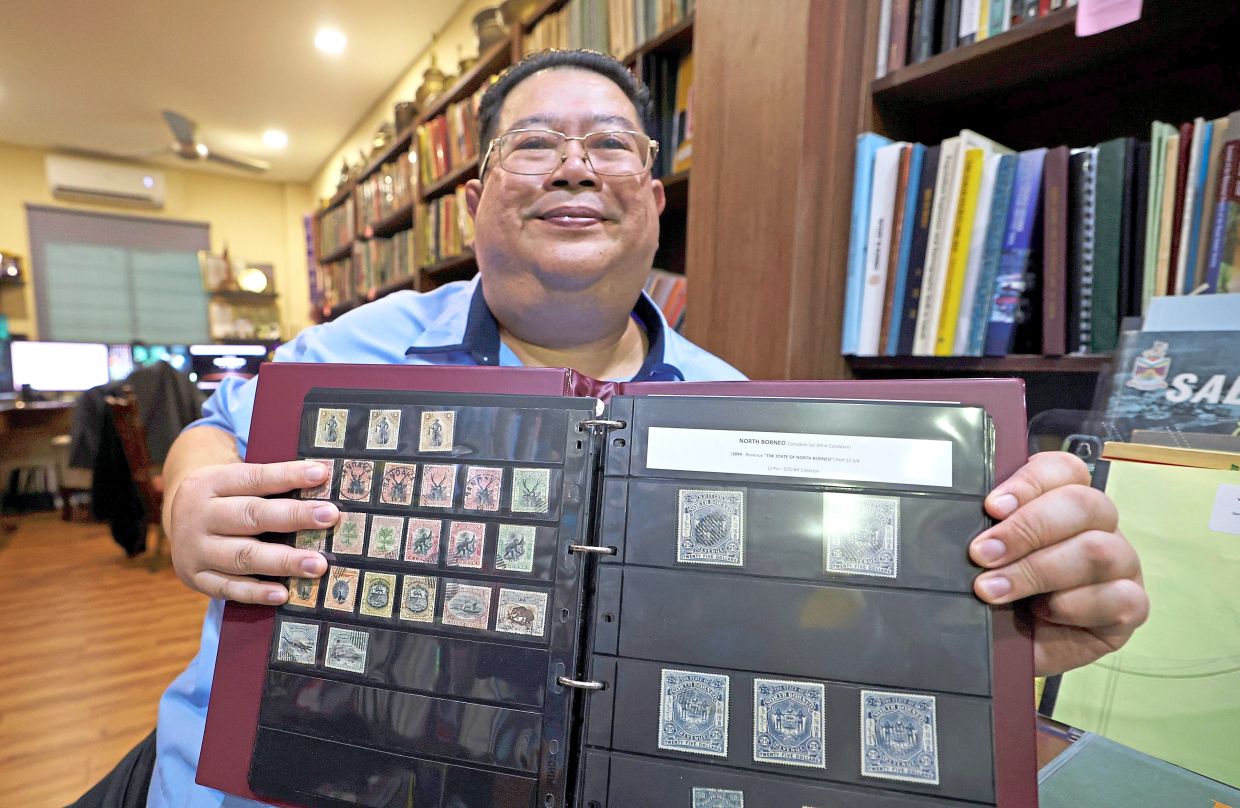
The small, colourful squares of paper that once carried messages across the British Empire are quietly disappearing from circulation, taking with them intimate records of Sabah's transformation over more than a century. North Borneo stamps, issued between 1883 and 1963, represent far more than proof of postage—they are historical documents that captured the territory's identity at critical moments in its development. Yet as digital communication has rendered the postal system largely obsolete, these rare artefacts have become increasingly scarce, prompting a handful of dedicated enthusiasts to champion their preservation as a safeguard against losing tangible evidence of the region's colonial and early post-colonial past.
Dr Shari Jeffri, the 56-year-old founder and president of the Borneo History Association, has emerged as one of Malaysia's most vocal advocates for philatelic conservation. He characterises the stamp collections from this era as a "living archive" that carries obligations for current custodians to maintain and transmit this heritage to future generations. His concern is rooted in observable reality: the community of serious stamp collectors has contracted significantly in recent decades, leaving fewer people with the knowledge, resources, and commitment necessary to properly care for these fragile artefacts. Where once stamp collecting formed a common hobby across social classes and age groups, today's younger generations have grown up in an era where communication bypasses physical media entirely, rendering the very concept of philately foreign to many.
A systematic survey of antique dealers operating in Kota Kinabalu revealed the extent of the scarcity problem. North Borneo stamps have become genuinely difficult to locate, with availability varying dramatically based on age, physical condition, and rarity. Among the specimens still circulating through the antique market are historically significant pieces such as a six-cent stamp issued between 1954 and 1961, notable for depicting Queen Elizabeth II alongside a Dusun woman—a design choice that reflected the Crown's engagement with Sabah's indigenous populations. Equally important are denomination stamps from the same period illustrating logging operations, which document the economic activities that shaped the territory's development during the mid-twentieth century. These individual stamps function as visual records of what colonial administrators considered noteworthy enough to publicise internationally.
Shari's own stewardship of his family's collection grew from a deeply personal beginning. His grandfather, employed at the Recreation Club Jesselton in Kota Kinabalu during the 1920s, had adopted stamp collecting after observing the hobby's popularity among British colonial officers. Rather than viewing philately as a mere diversion, his grandfather conceived of it as a mechanism for transmitting cultural appreciation and historical consciousness to descendants. Though Shari encountered stamps at age seven through his grandfather's influence, he did not emerge as an active and systematic collector until his secondary school years. His subsequent decades of careful preservation have yielded a collection that became the foundation for deeper historical and genealogical research into how North Borneo's official imagery evolved and what those visual choices revealed about the territory's self-conception at different historical junctures.
Among Shari's most treasured possessions are two two-cent stamps from the inaugural 1883 series, featuring a brown sailing boat motif and bearing complete postmarks from their original use. For serious philatelists, acquiring examples from this foundational issue represents a benchmark of collection completeness, as the 1883 release established the visual and administrative framework that subsequent issues would either honour or depart from. Each specimen transcends its functional purpose as evidence of paid postage; instead, it functions as a capsule containing specific information about how a particular society wished to represent itself to the outside world during a specific historical moment. The sailing boat imagery, paired with the Latin motto Pergo et Perago—"I undertake and I achieve"—constituted a deliberate statement about the territory's character and aspirations.
During his nearly four decades as a dedicated collector and researcher, Shari has traced the complex evolution of North Borneo stamp designs across eight decades. The British North Borneo Chartered Company inaugurated postal stamps in 1883 and maintained this system for approximately 52 years, during which design philosophy shifted noticeably. Early issues emphasised imperial symbolism, incorporating lions, boats, and tigers that conveyed power and territorial control. The 1935 series marked a significant philosophical departure, with designs that more authentically reflected Sabah's indigenous character and distributed across denominations ranging from two cents to one dollar. This transition from generic imperial iconography toward representations of local flora, fauna, and wildlife beginning in 1894 mirrors broader shifts in how colonial administrations sought to position their territories within the British Empire—increasingly emphasising the distinctive characteristics of each region rather than emphasising uniform imperial authority.
The technical challenges of preservation occupy much of Shari's practical attention. Stamps from this era are vulnerable to chemical degradation caused by exposure to acidic storage materials, a threat that demands specialised handling and housing in acid-free albums. Specimens bearing complete postal cancellations—those showing the date, post office location, and other markings from their original mailing—possess enhanced value because they provide verifiable postal records documenting when and from where correspondence travelled. The materials comprising each stamp function as authenticity markers; the specific papers and adhesives employed during different production periods serve as technical fingerprints that experts use to verify genuineness and establish provenance. Understanding these material characteristics requires sustained study and access to specialised reference materials.
To deepen his professional expertise, Shari pursued tutelage under respected Singapore-based philatelic specialists Voon Kyam Foh and Tan Chun Lim, practitioners with extensive knowledge of Commonwealth and British Empire postal history. His scholarship has been informed by consultation with authoritative references including the Commonwealth & British Empire Stamps catalogue, works that represent decades of accumulated knowledge about design variations, printing techniques, and historical contexts. This combination of hands-on mentorship and scholarly reference materials has equipped him with the critical apparatus necessary to interpret stamps not simply as objects but as historical documents whose details—ink colours, paper thickness, watermarks, perforations—carry significance for understanding the past.
The paradox confronting contemporary stamp preservation efforts is particularly acute in Malaysia and Southeast Asia, where rapid modernisation and generational discontinuity have severed many people from practices their grandparents took for granted. Letter writing, once a primary vehicle for personal and commercial communication, has been almost entirely displaced by electronic alternatives that leave no physical trace. This shift represents genuine progress in communication speed and efficiency, yet it has simultaneously eliminated the ordinary contexts through which people once encountered stamps and developed appreciation for their aesthetic and historical dimensions. Children no longer routinely handled and sorted mail, meaning they missed the informal education in geography, history, and visual culture that stamp collecting once provided across diverse social strata.
Yet stamps like those from North Borneo's 1883–1963 period retain enduring significance precisely because they constitute irreplaceable documentary evidence of how Sabah's inhabitants and administrators perceived their territory during a transformative historical epoch. The imagery selected for these stamps reflects deliberate choices about what aspects of the territory warranted international representation. The evolution from imperial symbols toward indigenous flora and fauna charts shifts in administrative ideology and cultural consciousness. Complete postal markings provide verifiable evidence of communication networks and commercial relationships. In an era when many historical records have been lost to neglect or deliberate destruction, these small objects persist as stubborn, tangible witnesses to the past.
The preservation imperative that animates Shari Jeffri's work extends beyond mere nostalgia or antiquarian sentiment. It reflects a recognition that historical understanding depends upon maintaining material connections to previous eras, and that contemporary choices about which artefacts to preserve will shape what future generations can know about the present moment. As fewer people actively collect stamps, the risk increases that valuable specimens will be dispersed, damaged, or lost entirely. The shrinking community of enthusiasts means that expertise required to properly care for and interpret these materials faces endangerment. Yet the very scarcity and fragility of these artefacts—their growing rarity in the antique market—underscores their historical importance and the urgency of ensuring their continued preservation within institutions and collections equipped to maintain them for centuries to come.

