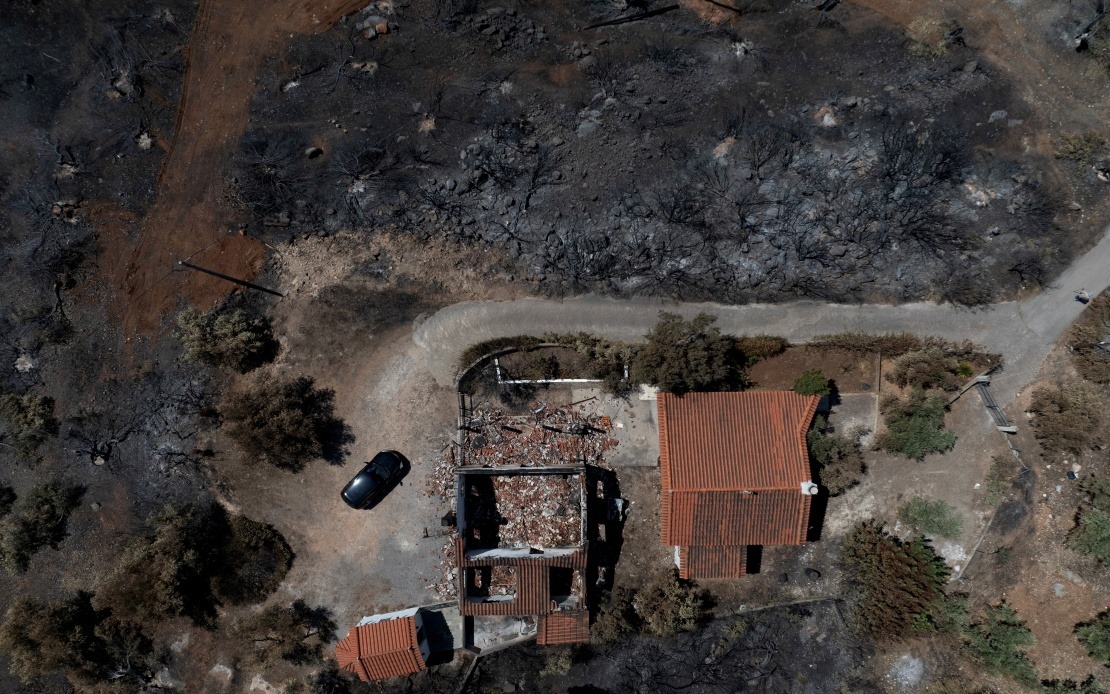
Greece's civil protection authorities have activated their most severe wildfire warning, issuing a red alert that affects three critical regions including the capital Athens and surrounding areas. The General Secretariat for Civil Protection, which operates under the Climate Crisis and Civil Protection Ministry, escalated the wildfire hazard to the highest classification—Category 4—for Thursday across Attica, Viotia and Evia as meteorological conditions create dangerous fire propagation potential.
The red alert designation carries immediate operational consequences throughout the threatened regions. The National Civil Protection Mechanism now functions at maximum deployment capacity, with coordinated teams from the fire service, police and armed forces simultaneously conducting surveillance across affected territories using both ground patrols and aerial reconnaissance assets. This multi-agency posture reflects the gravity that Greek authorities attach to the forecast conditions and their determination to detect emerging fires before they can establish.
Temporary restrictions on public access and vehicular movement have been implemented throughout forests and other fire-vulnerable landscapes to prevent human activity from igniting blazes during peak danger hours. Authorities have issued explicit guidance requesting residents and visitors to refrain from any actions that could generate sparks or flames, recognising that even minor incidents could rapidly escalate in the extreme atmospheric conditions expected. The preventive framework aims to eliminate controllable ignition sources while emergency services maintain heightened preparedness.
This alert emerges amid ongoing firefighting efforts against a substantial existing blaze. Late Wednesday, firefighting personnel successfully contained a separate wildfire outbreak that had erupted near Koropi, a community positioned southeast of Athens. The incident originated in low vegetation within the Driggia locality at approximately 1:45 pm local time, triggering a substantial emergency response that ultimately involved fifty-two firefighters including three specialised forest commando units, fourteen ground vehicles, four helicopters and two water-dropping fixed-wing aircraft. Thermal and optical drone surveillance assisted coordination efforts while local water tankers supplemented aerial resources.
The Koropi fire's cause remains under investigation following dispatch of a specialised arson investigation unit. However, this contained blaze represents only the most recent manifestation of a broader wildfire crisis affecting the region. Firefighting teams continue battling a significantly larger conflagration that ignited the previous week in Viotia before advancing into western Attica. According to monitoring data from the European Union's Copernicus satellite system, this major wildfire has consumed approximately 14,424 hectares of landscape—equivalent to roughly 35,642 acres—representing one of the season's most destructive incidents.
The human toll from firefighting operations has heightened public concern about the hazards confronting emergency responders. During aerial operations against the extensive Viotia-Attica blaze on Sunday, two helicopters engaged in wildfire suppression collided in mid-air, resulting in the deaths of a Danish pilot and a Greek aerial coordinator. This tragedy underscores the extreme risks inherent in intensive firefighting campaigns and has prompted renewed attention to operational safety protocols during crisis conditions.
For regional observers across Southeast Asia, Greece's intensifying wildfire season carries cautionary implications. The Mediterranean basin faces increasing fire pressure as climate patterns shift and extended heat events become more frequent. Greece's experience demonstrates how rapidly wildfire situations can escalate from contained incidents to multi-region crises, requiring comprehensive pre-positioned resources and rapid decision-making by civil protection institutions. The collision between firefighting helicopters particularly highlights the operational complexity when multiple agencies conduct simultaneous aerial missions under time pressure.
Malaysia and neighbouring countries maintain their own wildfire management frameworks, particularly during seasonal conditions when regional weather patterns create elevated fire risk. Greece's deployment of maximum-level civil protection resources provides instructive precedent for the scale of coordination required when extreme fire conditions materialise. The integration of satellite monitoring, drone surveillance, aerial assets and ground forces reflects international best practices increasingly adopted across fire-prone regions.
The red alert classification in Greece typically remains in effect until meteorological conditions moderate sufficiently to reduce fire propagation potential. Authorities continuously assess temperature, humidity, wind velocity and fuel moisture across affected regions to determine when alert levels can be downgraded. Until those threshold conditions are met, emergency services remain fully activated and the public restrictions on forest access and fire-risk activities persist. The intensive resource deployment during Category 4 conditions represents the apex of Greece's wildfire response capability, maintained only during periods when atmospheric conditions present genuine threat of rapid fire establishment and spread across populated or ecologically sensitive territories.

