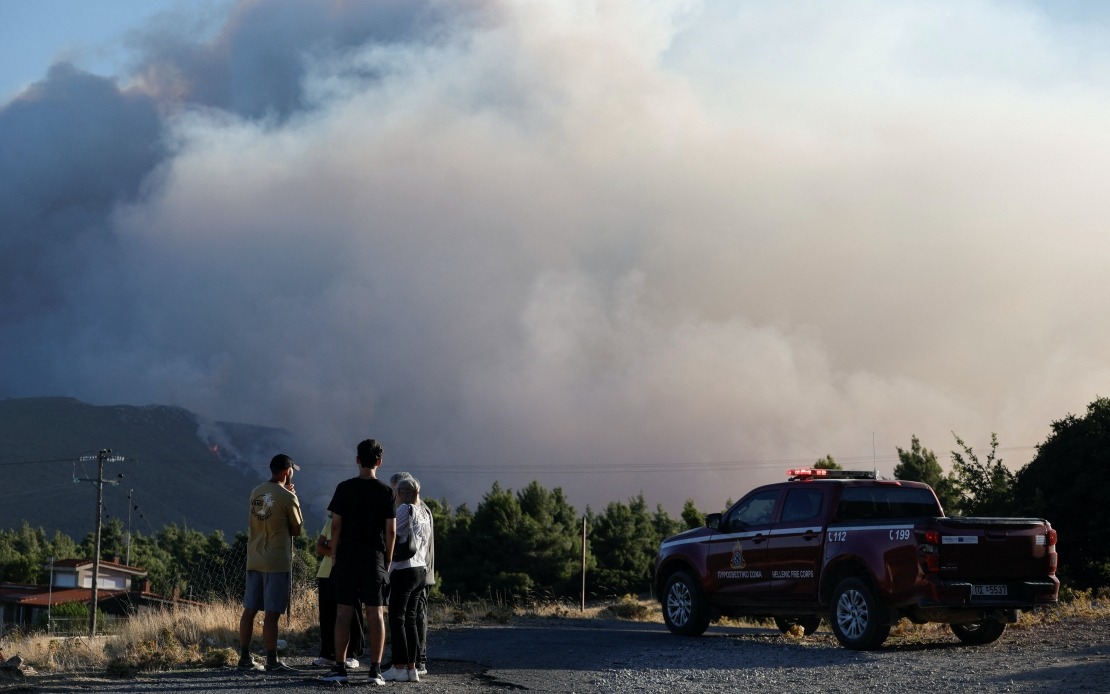
Firefighting crews across Greece are engaged in an intensive battle against a sprawling wildfire that has engulfed the Kithairon Mountains region west of Athens, with the catastrophic blaze now threatening to reach the city of Megara, located approximately 50 kilometres from the capital. The scale of the operation underscores the severity of the crisis, as authorities have mobilised no fewer than 500 firefighters to contain the rapidly advancing flames, supplemented by personnel from neighbouring Romania and France, alongside military vehicles, volunteer brigades, and specialised heavy equipment. Throughout Sunday night, emergency responders remained deployed across the fire zone, while at dawn the operation intensified as firefighting aircraft and helicopters resumed aerial bombardment and water-dropping missions coordinated by state broadcaster ERT.
The wildfire's progression has been particularly erratic and dangerous due to powerful wind currents that have periodically accelerated the flames' eastward movement, creating unpredictable fire fronts that challenge containment efforts. The regions of Veniza and Psatha have borne the brunt of the devastation, experiencing the most intense and destructive fire activity, though the broader pattern shows the blaze advancing steadily toward populated centres. The proximity of the flames to Megara represents a critical threshold for emergency authorities, as the city's population density and infrastructure make it substantially more vulnerable than the rural mountainous areas already consumed by fire.
The scale of environmental destruction is staggering, with meteorological estimates suggesting approximately 10,000 hectares of land in the north-western and western zones surrounding Athens have been completely destroyed. This acreage encompasses forests, agricultural land, and rural settlements, representing an ecological catastrophe that will require years of restoration and recovery efforts. The fire's progression demonstrates how Mediterranean climate conditions—characterised by intense summer heat, low humidity, and seasonal wind patterns—create ideal conditions for uncontrollable wildfire behaviour, a pattern that has become increasingly pronounced across Southern Europe in recent years.
Beyond the immediate Athens region, Greece faces additional fire emergencies on multiple fronts. The island of Cephalonia is currently experiencing a major wildfire of its own, though local authorities report that inhabited towns remain at a safe distance from the advancing flames at present. In contrast, wildfires that have devastated Crete appear to be substantially contained, with the situation there stabilising following significant destruction. Several communities on Crete were evacuated, and media reports suggest approximately 200 residential structures were destroyed, though official government confirmation of this figure has not yet been released, indicating the ongoing confusion and information challenges typical of large-scale emergency operations.
The investigation into fire origins has already yielded serious criminal charges, with authorities nationwide having arrested at least 13 individuals suspected of negligent arson. These arrests suggest that human activity—whether accidental or deliberate—contributed significantly to the outbreak and spread of the major conflagrations. For Malaysia and other Southeast Asian nations, the Greek experience provides sobering lessons about wildfire management, emergency response coordination, and the critical importance of international cooperation during environmental crises. The willingness of Romania and France to deploy personnel and resources demonstrates the necessity of pre-established mutual aid agreements and training protocols among neighbouring countries.
The implications for regional security in Southeast Asia are noteworthy, given that Indonesia, Malaysia, and surrounding nations regularly face transboundary haze and wildfire crises, particularly during dry seasons. Greece's activation of international firefighting resources and military support during this emergency reflects global best practices that might be adapted to strengthen ASEAN-wide disaster management frameworks. The coordination challenges evident in Greece's response—managing hundreds of personnel from multiple nations, establishing unified command structures, and maintaining real-time communication across language barriers—mirror difficulties that Southeast Asian nations confront during their own seasonal fire crises.
Matters of resource allocation and preparedness become especially acute when considering that Greece's firefighting infrastructure is substantially more developed than that of many Southeast Asian nations, yet the country still required external assistance to manage the Kithairon crisis. Malaysia, with its advanced emergency services and technological capabilities, has nonetheless experienced years of transboundary haze from Indonesian wildfires, raising questions about whether bilateral and multilateral firefighting arrangements are sufficiently robust. The Greek situation illustrates that even wealthy European nations with professional emergency services require rapid international mobilisation when fire reaches catastrophic proportions.
The environmental aftermath will extend far beyond immediate fire suppression. Burned forests in Greece will require reforestation initiatives spanning decades, while soil erosion from denuded slopes will create secondary hazards including flooding and mudslides during autumn and winter precipitation. The economic costs encompass not only suppression operations and property damage but also lost timber resources, agricultural productivity decline, and potential tourism disruption. For Southeast Asian policymakers observing Greece's experience, the message is clear: investment in fire prevention infrastructure, early warning systems, and vegetation management substantially reduces long-term costs compared to crisis-driven suppression spending.
The human dimension of the crisis remains paramount, as residents of Megara and surrounding communities face potential displacement and the trauma of mass evacuation. Unlike some historical European wildfires that affected sparsely populated regions, the proximity of the Kithairon fire to major population centres transforms the emergency from an environmental event into a potential humanitarian crisis. The coordination between local authorities, national government agencies, and international responders will determine whether communities can be effectively protected and rapidly restored following the emergency. For Malaysia, which has experienced significant urban-wildland interface development in recent decades, Greece's experience underscores the critical importance of integrating land-use planning with fire risk assessment and community resilience building.

