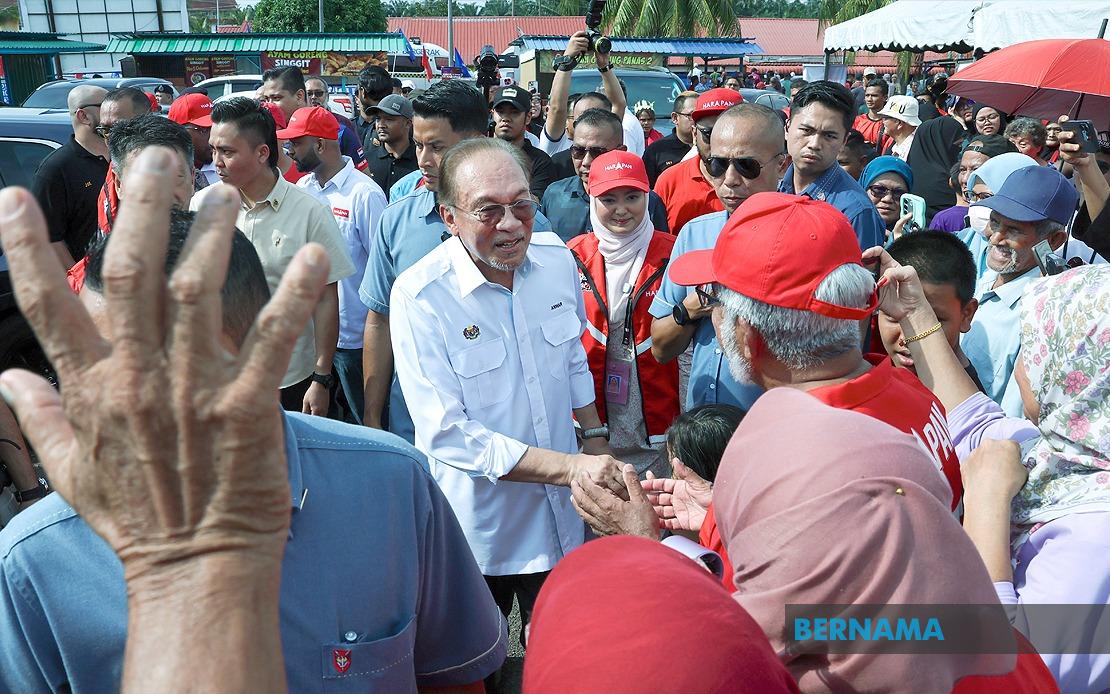
In an uplifting display of family determination and public recognition, a nine-year-old boy from Segamat achieved his long-held dream of meeting Prime Minister Datuk Seri Anwar Ibrahim, thanks to his grandmother's resourcefulness and dedication. Muhammad Afif Ikhwan's aspiration became reality during a public programme at Felda Palong Timur in Segamat on Sunday, where the encounter left an indelible mark on the child that continues to resonate in his daily life.
The journey began with modest means but extraordinary resolve. Rosimah Mohammad, 58, made the decision to transport her grandson by motorcycle from their home in Kampung Pudu, Segamat, to the venue where the Prime Minister would be appearing. This decision reflected the determination many Malaysian families exhibit when pursuing meaningful moments for their children, particularly in a context where access to national leaders remains a cherished opportunity for ordinary citizens.
Rosimah's account of the preparations reveals the emotional investment her grandson had placed in this meeting. Muhammad Afif experienced such anticipation that sleep eluded him the night before, his mind occupied entirely with the prospect of encountering his political idol in person. This kind of youthful admiration for political leadership demonstrates how figures in high office can inspire younger Malaysians, even when separated by significant social distance.
At the venue, the grandmother and grandson positioned themselves strategically along the pathway to the stage, seeking a vantage point that would allow the boy an unobstructed view of the Prime Minister. As Anwar made his way through the crowd, greeting constituents, Muhammad Afif summoned the courage to push forward and extend his hand toward the nation's leader. What transpired next exceeded all expectations—rather than a fleeting handshake, the Prime Minister invited the boy to accompany him onto the stage during his speech address.
The moment held profound significance for both child and grandmother. Rosimah articulated the emotional intensity of witnessing her grandson's joy and surprise as he stood beside the Prime Minister while Anwar delivered his remarks. For the boy, this was not merely a photograph opportunity or a passing encounter; it represented validation of his admiration and a tangible connection to the leadership of his nation. Such moments, though brief in chronological terms, often become foundational memories in a child's understanding of civic participation and national identity.
The encounter's impact became apparent in the weeks following, revealing how deeply the experience had etched itself into the child's consciousness. Rosimah shared with visitors that Muhammad Afif had developed a nightly ritual of embracing the shirt he wore on that significant day, using the garment as a tactile connection to his memorable experience. This detail illuminates how children process and preserve meaningful moments—through physical objects and repeated engagement rather than abstract recollection.
The Prime Minister's office took note of the story's emotional resonance and the genuine nature of the boy's admiration. Rather than allowing the encounter to conclude with the public event, Anwar Ibrahim instructed his team to make a follow-up visit to Muhammad Afif's home in Kampung Pudu. This decision reflected a recognition that personal connection with citizens, particularly younger Malaysians, carries political and social value beyond immediate campaign considerations.
Representing the Prime Minister during the home visit, PKR deputy information chief Siti Aishah Shaik Ismail conveyed Anwar's appreciation for the family's commitment to attending the Felda Palong Timur event. The visit transformed from a courtesy call into a gift-giving occasion, with the delegation presenting Muhammad Afif with a bicycle, school bag, and shoes—practical items that acknowledge the boy's everyday needs while reinforcing the symbolic importance of the encounter.
For Malaysian readers, this narrative encompasses several layers of contemporary significance. It demonstrates how political engagement can emerge organically at the grassroots level, with families making genuine efforts to participate in national events. The story also illustrates the accessibility of the nation's leadership, at least in the context of public programmes, reinforcing an inclusive vision of governance where ordinary Malaysians can still achieve direct contact with senior officials.
Within the broader context of Malaysian politics and society, the incident reveals persistent traditions of public deference toward national leadership, particularly among younger generations. While some observers might view such admiration as a holdover from earlier political eras, it continues to characterize Malaysian political culture, especially in regions like Johor where such grassroots enthusiasm remains evident.
The logistics of the journey itself—a grandmother navigating motorcycle travel through palm oil plantation areas to reach a public event—also speaks to the lived realities of Malaysian families outside major urban centres. Transportation infrastructure, distance, and resource constraints often shape how rural and semi-rural Malaysians participate in national civic moments, making Rosimah's effort a practical expression of commitment despite these material barriers.
The follow-up home visit, while generating positive headlines and social media engagement, represents an emerging political practice where leaders and their representatives formalize recognition of individual citizen stories that align with broader messaging about accessibility and public service. The gift-giving component, while modest in material value, symbolizes state acknowledgement of family-level achievement and aspiration.
Ultimately, Muhammad Afif Ikhwan's story encapsulates elements of Malaysian civic life that persist across generations—the significance of direct contact with national leaders, the role of family in facilitating such opportunities, and the lasting emotional impact of brief but meaningful encounters with figures of authority and national prominence.

