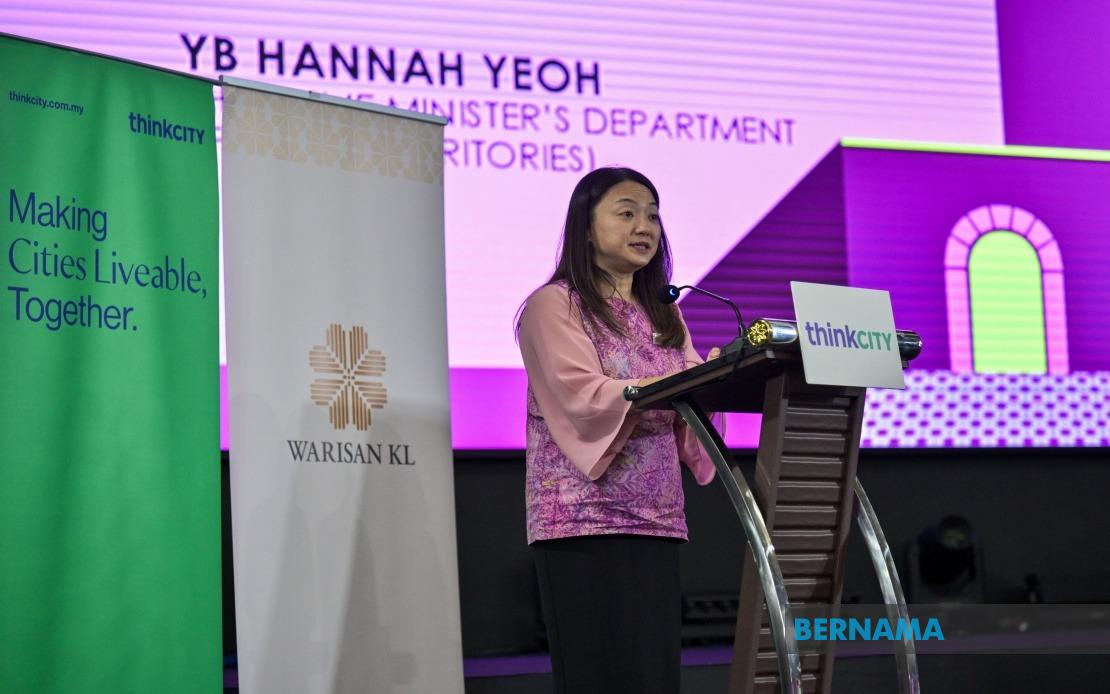
The federal government has taken a significant step towards urban renewal by launching a dedicated RM1 million grants scheme aimed at breathing fresh life into downtown Kuala Lumpur. Hannah Yeoh, Minister in the Prime Minister's Department overseeing Federal Territories affairs, unveiled the Downtown Kuala Lumpur Grants Programme 2026 on Tuesday, positioning it as a strategic initiative to marry historical preservation with contemporary economic development in Malaysia's capital city.
The scheme distributes funding in tranches ranging from RM30,000 to RM100,000 per approved project, casting a deliberately wide net to accommodate diverse applicants. Eligible beneficiaries include community groups, small business proprietors, and practitioners working in creative and artistic fields—a composition suggesting the government recognises that urban regeneration thrives when driven by grassroots participation rather than top-down intervention alone. This multi-stakeholder approach reflects broader Southeast Asian trends where cities increasingly leverage cultural assets as catalysts for inclusive economic activity.
Yeoh's framing of Kuala Lumpur as a city narrating two simultaneous stories—one rooted in heritage and another being collectively authored—reveals the philosophical underpinning of this programme. She contended that downtown renewal cannot be reduced to erecting new buildings or attracting foreign investment alone. Rather, true urban success materialises when residents choose to remain, when entrepreneurs find the environment conducive to enterprise, and when both local and external investors perceive genuine opportunity. This narrative resonates particularly in Malaysia, where rapid urbanisation has sometimes eroded the character of city centres, prompting recalibration toward more balanced development strategies.
The allocation of Ministry of Finance resources specifically toward arts, culture, and heritage signals an institutional acknowledgment that these domains constitute legitimate economic sectors rather than peripheral luxuries. By channelling funding through such mechanisms, the government effectively argues that cultural preservation generates tangible returns—employment, tax revenue, visitor spending—whilst simultaneously strengthening social cohesion and national identity. For Southeast Asian observers watching how other capitals navigate similar tensions between modernisation and heritage conservation, this represents a measured approach worth monitoring.
Kuala Lumpur's designation as a UNESCO Creative City amplifies the significance of this initiative. The international recognition carries weight beyond ceremonial value; it legitimises claims that the capital possesses distinctive cultural attributes worthy of investment and protection. Yeoh explicitly linked this status to economic opportunity, noting that cultural sectors create jobs, generate tourism revenue, and fortify the broader economy. This framing helps explain why federal resources are being deployed—culture becomes not merely a matter of preserving what exists, but of building prosperous futures grounded in authentic local character.
A notable dimension of Yeoh's remarks concerned institutional reform within the city administration itself. She expressed determination to transform the perception and operational reality of Kuala Lumpur City Hall (DBKL), which has historically occupied a complicated position in public consciousness—simultaneously the steward of urban planning and, in many accounts, an impediment to business activity. By characterising her vision for DBKL as becoming a facilitator rather than a barrier, she articulated frustration with bureaucratic obstruction and signalled intent to streamline processes affecting developers, entrepreneurs, and community organisations seeking to undertake projects downtown.
The involvement of Think City as the strategic partner coordinating programme administration introduces another layer worthy of analysis. Think City, a non-governmental organisation focused on urban sustainability and development in Southeast Asia, brings specialised expertise and networks to the initiative. Positioning an external partner as administrator rather than housing the function entirely within government bureaucracy potentially expedites decision-making, reduces perceptions of political favouritism in fund allocation, and injects professional credibility into the selection process. For Malaysian readers assessing government competence, such structural choices matter considerably.
Eligibility criteria and application procedures—to be articulated by Think City—will prove critical in determining whether this programme achieves inclusive participation or becomes captured by connected elites. Hannah's explicit appeal for applications from actors with novel ideas suggests openness to unconventional proposals, yet experience across the region demonstrates that funding accessibility depends substantially on how clearly information is communicated and how straightforward application processes become. The success or failure of this scheme may ultimately hinge as much on administrative implementation as on the generosity of the fund itself.
For Malaysian entrepreneurs and community leaders in downtown Kuala Lumpur, the programme represents a concrete opportunity to pursue projects that might otherwise lack financing pathways. Whether focusing on heritage restoration, cultural event programming, creative business incubation, or community-oriented initiatives, the availability of grants between RM30,000 and RM100,000 can meaningfully catalyse activities that incrementally reshape neighbourhoods. The cumulative effect of multiple such projects—if successfully implemented—could materially enhance the downtown experience, potentially reversing decades of commercial and residential migration to suburban areas.
Regionally, this initiative forms part of a broader Southeast Asian conversation about how post-industrial city cores maintain relevance and vitality. Bangkok, Singapore, and Ho Chi Minh City have each pursued variations on cultural-led regeneration strategies with mixed results. Kuala Lumpur's approach, emphasising grants distribution to distributed actors rather than monolithic development mega-projects, offers a potentially more adaptive pathway. Whether Malaysian policymakers will learn from both successes and missteps occurring elsewhere in the region remains an open question, particularly as subsequent phases of implementation unfold over coming months and years.

