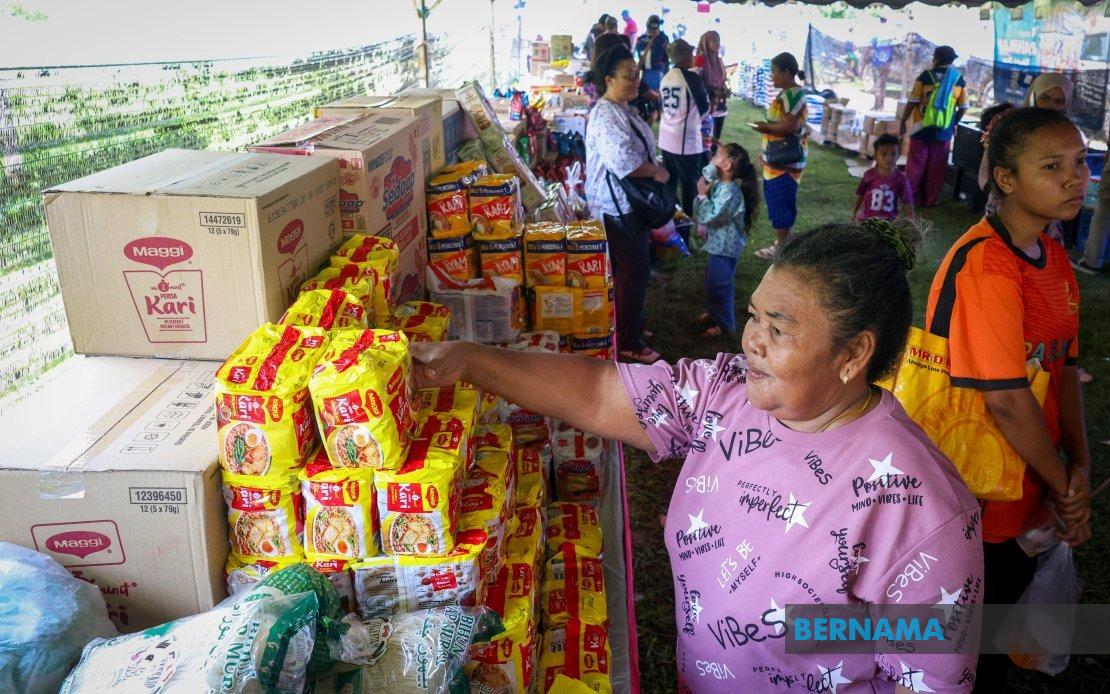
The Rahmah MADANI Sales Programme (PJRM) has brought affordable essential goods within reach of more than 1,000 Temiar Orang Asli residents living at the Pasik Resettlement Scheme in Gua Musang, Kelantan, fundamentally improving access to subsidised products for this isolated indigenous community. The initiative enables locals to redeem their government assistance through SARA credit balances held on their MyKad identification cards, eliminating the need for exhausting journeys to distant purchasing points.
For residents of Kampung Ayong like Ramli Chimbong, the convenience marks a transformative shift in household economics. Previously, obtaining subsidised goods required traveling to Kampung Jerek—a gruelling two-and-a-half-hour expedition that imposed substantial indirect costs on already stretched family budgets. Beyond the physical toll of the journey itself, each trip demanded approximately RM600 in combined expenditure for vehicle rental, meals, and miscellaneous expenses. This financial barrier meant many families rationed their use of the government subsidy programme, undermining its intended poverty-alleviation impact for communities living at the geographical margins of commercial networks.
The price differential between local retail outlets and the subsidised PJRM offerings underscores the market dysfunction affecting remote settlements. A nine-kilogramme bag of rice sold for RM40 at nearby village shops, yet the PJRM delivers the identical product at RM29—a 27.5 per cent reduction that compounds across monthly household purchases. When multiplied across essential items including cooking oil, sugar, and other staples, families can reallocate substantial portions of limited incomes toward education, healthcare, and investments in livelihood improvement. For communities where per capita income remains significantly below national averages, such pricing parity with urban consumers represents meaningful progress toward equitable access.
Operator SMS Maju Solution, led by Sabariah Mohamed Sayuti, deployed an impressive supply logistics operation to service initial demand at Pos Pasik. The inaugural consignment included 100 distinct essential goods varieties, with substantial quantities of high-demand items: 300 bags of rice, 300 trays of eggs, and 300 chickens. The early morning arrival of residents eager to make purchases—beginning at 9 am—reflected both pent-up demand and community awareness of the programme's value proposition. The operator's observation that most residents maintained substantial SARA balances, typically ranging between RM300 and RM800, indicates that the subsidy programme's credit allocation mechanism had successfully accumulated purchasing power within this community.
Logistical challenges encountered during implementation highlight the infrastructure deficits affecting rural development in Malaysia's northeastern region. A supply vehicle suffered a tyre failure traversable to the rocky and mud-covered road conditions surrounding Pasik RPS, exemplifying the transportation vulnerabilities that historically isolated indigenous communities from government services and commerce. These physical access barriers have traditionally forced residents to depend on local retail monopolies charging inflated prices, or undertake costly expeditions to urban centres. Infrastructure investment alongside social programme expansion thus becomes essential for achieving sustainable rural equity gains.
Nenggiri state assemblyman Mohd Azmawi Fikri Abdul Ghani positioned the PJRM expansion as a direct government response to escalating living costs pressuring rural households. The political framing emphasizes that pricing inflation affects indigenous communities with particular severity, given their limited income diversification and dependence on subsistence agriculture or irregular wage labour. Government assistance programmes like PJRM function as countermeasures to preserve household purchasing power amid broader economic pressures, preventing poverty deepening during periods of inflationary stress. For Kelantan—a state with significant Orang Asli populations—targeted subsidy delivery mechanisms represent practical tools for fulfilling constitutional commitments to indigenous welfare.
The assemblyman's articulated ambition to expand similar programming across all Orang Asli settlements nationwide reflects recognition that current geographical coverage remains incomplete. Malaysia's indigenous populations dispersed across multiple states and settlement types experience vastly different programme accessibility depending on population density and transport networks. Universalizing coverage would require systematic mapping of existing Orang Asli communities, assessment of their SARA credit utilization rates, and identification of suitable local intermediaries capable of managing supply logistics in challenging terrain. Such expansion demands coordinated effort across multiple government agencies and sustained budgetary commitment.
The SARA credit mechanism underlying PJRM participation functions as a targeted subsidy instrument distinct from universal price controls or blanket commodity subsidies. By anchoring assistance to individual identification and pre-allocated credit balances, the system prevents diversion to non-target populations while enabling government to quantify programme costs precisely. For Orang Asli communities, accumulated SARA balances represent purchasing power previously difficult to deploy effectively—cheques requiring travel or cash transfers vulnerable to informal taxation by middlemen. Converting credits into localized procurement opportunities optimizes subsidy delivery efficiency while improving household consumption outcomes.
From a Southeast Asian perspective, the Pasik RPS initiative exemplifies how middle-income nations increasingly tailor social protection mechanisms to accommodate geographical and demographic diversity within subsidy systems. Rather than uniform national programmes, governments increasingly deploy digitized assistance targeting specific populations identified through identity systems, enabling precision in allocating scarce budgetary resources. Malaysia's approach of moving services closer to beneficiaries represents a recognition that geographical distance functions as an effective tax on poor households, requiring policy compensation through service localization or enhanced transport provision.
The programme's success metrics extend beyond mere price comparisons to encompass broader livelihood implications. Families recovering RM600 from eliminated travel expenses can redirect resources toward children's education, healthcare access, or productive investments—catalysts for intergenerational poverty reduction. Community confidence in government service delivery improves when programmes demonstrate practical understanding of indigenous life circumstances. For the Temiar residents of Pasik RPS, PJRM represents tangible evidence that state institutions acknowledge their isolation and respond with genuine commitment to equitable access rather than rhetorical acknowledgment of marginalization.
Scaling this model across Malaysia's diverse Orang Asli communities will require addressing persistent supply chain vulnerabilities and infrastructure gaps. Road rehabilitation in settlement-proximate areas would reduce damage risk to supply vehicles and expand programme reliability. Identifying additional qualified operators willing to work with modest profit margins in challenging operating environments presents recruitment challenges that may constrain rapid expansion. Government may need to establish dedicated supply units or offer specific incentives to commercial operators accepting the operational burdens of remote-area retail provision.
Longer-term programme sustainability hinges on maintaining SARA credit adequacy and ensuring competitive pricing remains achievable without unsustainable operator losses. If demand accelerates beyond current supply logistics capacity, delays or stock-outs could undermine community confidence. Regular feedback mechanisms from beneficiary communities would enable programme adjustment in response to lived experience rather than administrative assumptions about indigenous needs and preferences.
Ultimately, the Pasik RPS expansion demonstrates that targeted subsidy programmes can function as effective tools for addressing rural inequality when coupled with deliberate service localization and attention to indigenous geography. For other Southeast Asian nations managing dispersed populations with limited market integration, Malaysia's experience offers instructive lessons about programme design for equitable impact across diverse demographic and territorial contexts.

