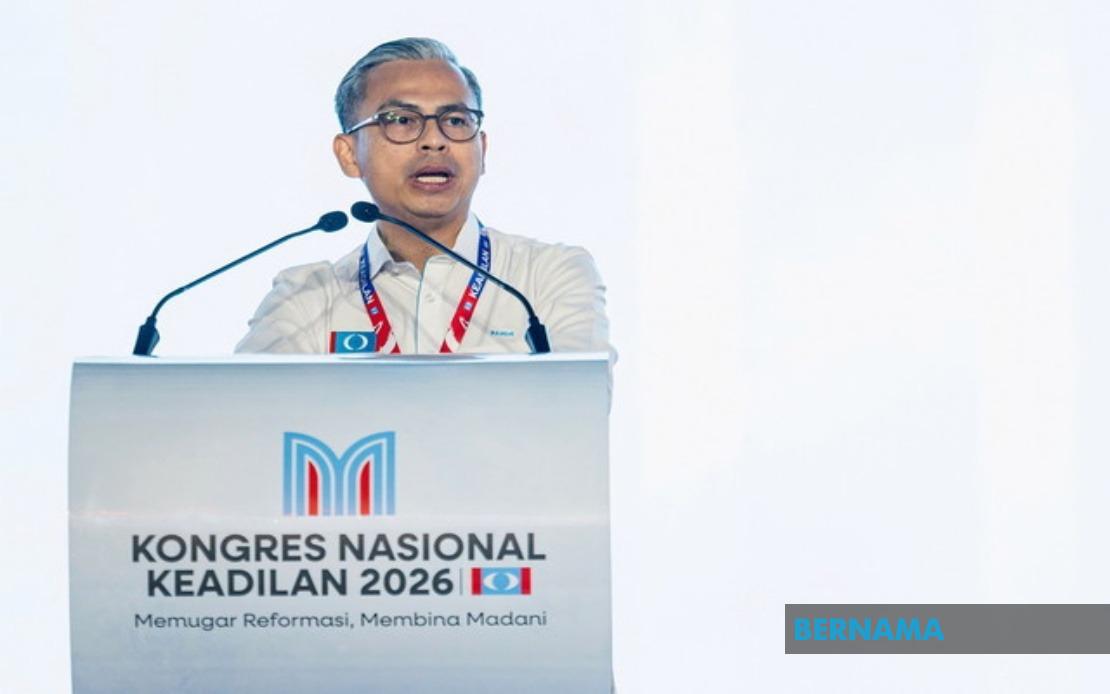
The Malaysian government faces a persistent perception problem: many of its economic and policy achievements remain poorly understood by ordinary citizens, despite measurable progress at the macroeconomic level. This disconnect between headline statistics and lived experience emerged as a central concern during the 2026 PKR National Congress in Melaka, where PKR information chief Datuk Seri Fahmi Fadzil outlined plans to fundamentally reshape how the administration communicates its record to voters.
Fahmi, who also serves as Communications Minister, framed the challenge in strikingly candid terms. The government's successes in macroeconomic management—what he termed the "pot economy"—have not adequately translated into tangible benefits that Malaysians can directly perceive in their daily lives. This gap between aggregate economic indicators and individual household sentiment represents a critical vulnerability for any administration seeking re-election. The PKR leadership recognises that winning policy battles in Parliament or achieving favourable financial ratios means little if voters do not experience or comprehend those victories.
The core issue, according to Fahmi's analysis, involves both the mechanics and psychology of government messaging. Current communication approaches have focused primarily on disseminating factual information about policies introduced under Prime Minister Datuk Seri Anwar Ibrahim's leadership. However, this informational approach overlooks what Fahmi identified as the "emotional dimension"—the need for government achievements to resonate not merely intellectually but emotionally with citizens. For a policy to gain traction in public perception, it must be felt as relevant and beneficial to everyday concerns like household budgets, employment security, and cost of living.
To address this shortcoming, PKR intends to strengthen its grassroots communication infrastructure. The party will deepen cooperation with division chiefs and other local party structures, recognising that ward-level activists often possess greater credibility and access to communities than centralised government media apparatus. This decentralisation of messaging reflects an acknowledgment that top-down announcements, no matter how polished, frequently fail to penetrate entrenched public scepticism or competing narratives spread through informal networks.
Fahmi specifically highlighted the expansion of smaller-scale, intimate public forums as a key tactical shift. These gatherings—town halls, community meetings, and organised discussions in neighbourhoods—create space for relaxed, contextualised explanations of complex policies. Crucially, they enable direct interaction between government representatives and citizens, allowing Malaysians to pose questions, voice concerns, and receive real-time clarification. This dialogical approach contrasts sharply with conventional press conferences or official announcements, which typically flow in a single direction and discourage genuine public participation.
Parallel to improving legitimate government communication, the administration is intensifying efforts to combat deliberate misinformation. In partnership with the Malaysian Communications and Multimedia Commission (MCMC), authorities have identified over 8,410 fake accounts spreading false narratives linked to sensitive 3R issues—religion, race, and the royal institution—since the recent Johor state election. These coordinated disinformation campaigns exploit emotionally charged topics to undermine public confidence in government initiatives and distract from policy achievements.
The scale of detected inauthentic activity suggests systematic, coordinated efforts to pollute the information environment and manipulate public sentiment. By requesting platforms to remove these accounts, the government aims to reduce noise that confuses voters and creates cynicism about official messaging. However, this defensive counter-misinformation strategy must be carefully calibrated. Heavy-handed suppression of online speech risks validating opposition claims of authoritarian intent, whereas insufficient action allows false narratives to metastasise unchecked.
Fahmi stressed that media criticism and accountability will continue through proper, respectful channels rather than heavy-handed control. This rhetorical positioning—distinguishing between correcting demonstrable falsehoods and suppressing legitimate dissent—reflects sensitivity to concerns about press freedom in Malaysia. The distinction between combating misinformation and censoring critical journalism remains contested territory in Malaysian politics, and Fahmi's framing attempts to navigate this minefield by asserting adherence to procedural respect even while exercising corrective influence.
The involvement of PKR's Wanita (women's) wing in revamped communication strategies signals recognition that female party members and activists often serve as trusted community voices, particularly on issues affecting families and household welfare. By formalising coordination with this constituency, PKR seeks to leverage existing networks of trust and cultural authority to disseminate messages about social policy, education initiatives, and economic programmes affecting women and families.
This communication overhaul must contend with fundamental challenges beyond messaging technique. Malaysian voters, conditioned by decades of political competition and electoral cycles, often discount official government claims regardless of factual merit. Building credibility requires sustained, consistent policy delivery alongside credible communication—a combination that proves elusive under pressure to demonstrate quick results. Additionally, the fragmentation of Malaysian media consumption, with different demographics trusting different sources, means no single communication strategy can efficiently reach all voter segments simultaneously.
For Southeast Asian observers and Malaysian political analysts, Fahmi's candid acknowledgment of communication deficiencies reveals underlying anxieties within the government coalition. When senior officials invest substantial rhetorical and institutional energy in explaining how successful policies are perceived as unsuccessful, it suggests that structural changes in voter sentiment cannot be easily remedied through better spin. The government appears to be betting that increased grassroots engagement, emotional resonance, and counter-misinformation efforts can narrow the perception gap before the next general election. Whether these tactical adjustments prove sufficient remains uncertain.

