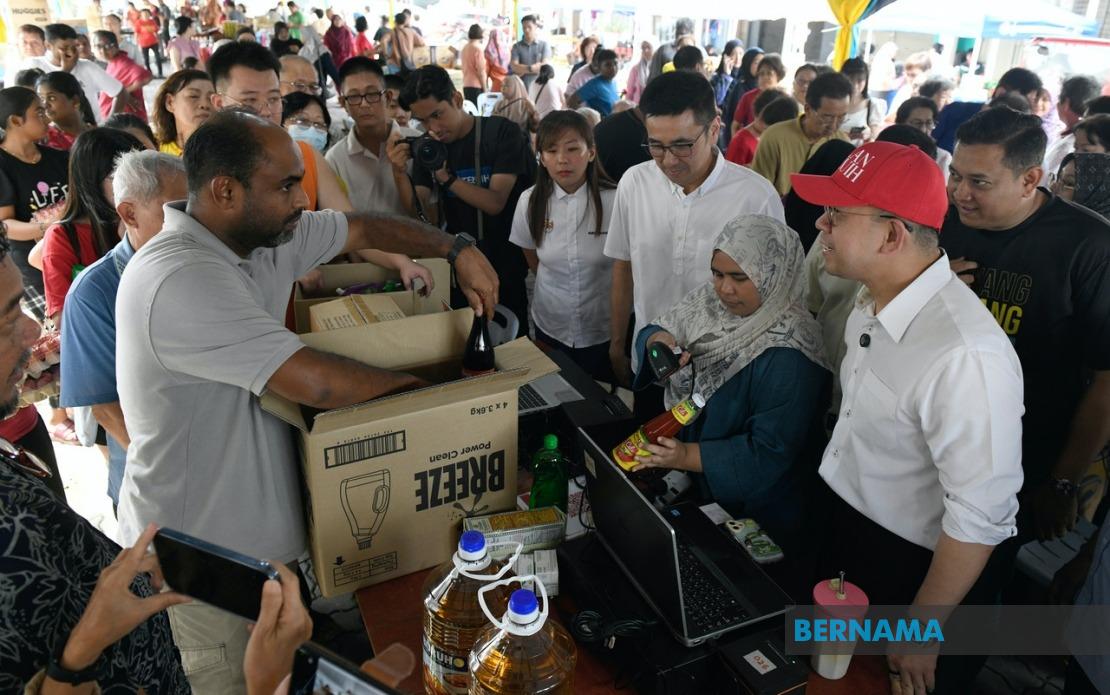
The government is doubling down on its commitment to empower micro, small and medium enterprises and cooperatives through targeted programmes designed to unlock opportunities in Malaysia's thriving wholesale and retail trade sectors. Speaking at a grassroots event in Nibong Tebal, Minister of Entrepreneur and Cooperatives Development Steven Sim Chee Keong unveiled plans to intensify KUSKOP's engagement with local business communities, signalling that Putrajaya views small-business development as central to sustaining nationwide economic momentum.
The timing of these initiatives reflects encouraging market fundamentals. Recent data from the Department of Statistics Malaysia reveals that the wholesale and retail sector achieved sales valued at nearly RM175 billion in April 2026, representing a robust year-on-year increase of 15.3 per cent. This sustained expansion underscores the sector's resilience and the abundance of commercial opportunities available to entrepreneurs willing to participate. For Malaysian MSMEs and cooperatives—many of which operate with limited capital and market reach—these figures suggest genuine potential for growth if proper support mechanisms are in place.
Simultaneously, the backdrop against which this growth has occurred deserves scrutiny. The global economy remains volatile, buffeted by trade tensions, tariff disputes and geopolitical friction that have unsettled markets worldwide. That Malaysia has maintained solid domestic expansion despite these headwinds speaks to the strength of consumer demand at home and the stabilising effect of coordinated government and private-sector measures aimed at controlling inflation and bolstering household purchasing power. Sim acknowledged these external pressures explicitly, framing domestic growth as the outcome of deliberate policy choices rather than mere luck.
The minister attributed the sector's expansion partly to successful government-private collaboration in reducing living costs and stabilising commodity prices, as well as initiatives to raise worker incomes. These elements form an interconnected policy ecosystem: lower prices and higher wages stimulate spending, which drives demand for goods through wholesale and retail channels. By extension, this creates a multiplier effect throughout supply chains, benefiting producers, distributors and retailers across the economy. For MSMEs and cooperatives—the backbone of Malaysia's informal and formal small-business economy—this environment represents a window of opportunity to expand operations and capture market share.
The Jualan MADANI KUSKOP programme exemplifies the grassroots approach government is adopting. Rather than confining support to formal channels or large-scale enterprises, KUSKOP is moving directly into communities to engage with local merchants, traders and cooperative members. This on-the-ground strategy acknowledges a fundamental truth: many MSMEs lack awareness of available programmes, struggle with bureaucratic procedures or operate in remote areas where information dissemination is poor. By bringing government initiatives to the grassroots level, KUSKOP aims to democratise access to support and ensure that geographical disadvantage does not prevent entrepreneurs from participating in sectoral growth.
Sim's emphasis on strengthening local entrepreneurs' participation in the economic value chain points to a deeper strategic objective. Rather than allowing growth to concentrate among established corporate players, the government is explicitly seeking to broaden the distribution of economic benefits. This reflects both an ideological commitment to inclusive growth and a pragmatic recognition that a thriving base of small businesses creates employment, tax revenue, community resilience and political stability. In the Malaysian context—where cooperatives have deep roots in rural and semi-urban communities—targeted support for these organisations carries particular significance for regional development and social cohesion.
The challenge facing KUSKOP and participating MSMEs is converting policy intention into tangible commercial outcomes. Retail and wholesale sectors are fiercely competitive, characterised by thin margins and constant pressure from e-commerce and large retail chains. Small traders and cooperatives must not only access growth opportunities but also acquire skills in digital marketing, supply-chain management and customer service to remain viable. Government programmes thus need to combine financial assistance with practical training and mentorship if they are to meaningfully improve survival rates and profitability among participants.
For Malaysian consumers and the broader economy, the expansion of a vibrant MSME and cooperative retail-wholesale base carries benefits beyond those captured in headline growth statistics. Healthy competition from small businesses can temper monopolistic pricing, preserve commercial diversity in towns and villages, and maintain cultural and commercial distinctiveness in the face of globalisation. Additionally, cooperatives often reinvest profits locally and provide employment to workers in their own communities, generating multiplier effects that benefit households and local economies more broadly than do large corporations with centralised profit-capture mechanisms.
Regional implications deserve consideration as well. Southeast Asia's MSME sector is increasingly viewed as a growth engine for the region, with neighbouring nations pursuing similar strategies to formalise and strengthen small-business ecosystems. Malaysia's experience with cooperative development and government-business collaboration models may offer lessons for regional peers, particularly those seeking to balance market-driven growth with social inclusion. Conversely, competitive pressures from better-resourced regional retailers mean Malaysian MSMEs must innovate and professionalise rapidly to maintain competitiveness.
Looking forward, the sustainability of current retail and wholesale growth will depend on whether demand remains robust as the economic cycle evolves. Consumer spending could falter if external shocks—currency fluctuations, regional conflicts or commodity-price swings—undermine household confidence or purchasing power. Against this uncertainty, KUSKOP's preventive approach of building stronger, more competitive MSMEs and cooperatives now appears strategically sound. By investing in foundational capacity and market access before conditions tighten, the government is positioning local entrepreneurs to weather future volatility.
The government's stated commitment to ensure that sectoral growth translates into broad-based prosperity hinges ultimately on execution. Programme design, funding adequacy, frontline staff capacity and the willingness of MSMEs to adopt modern business practices will determine whether rhetoric becomes reality. Minister Sim's public articulation of these goals signals political priority, but converting priority into sustained institutional action requires resources, coordination across multiple agencies and sustained engagement with the business community over an extended period.

