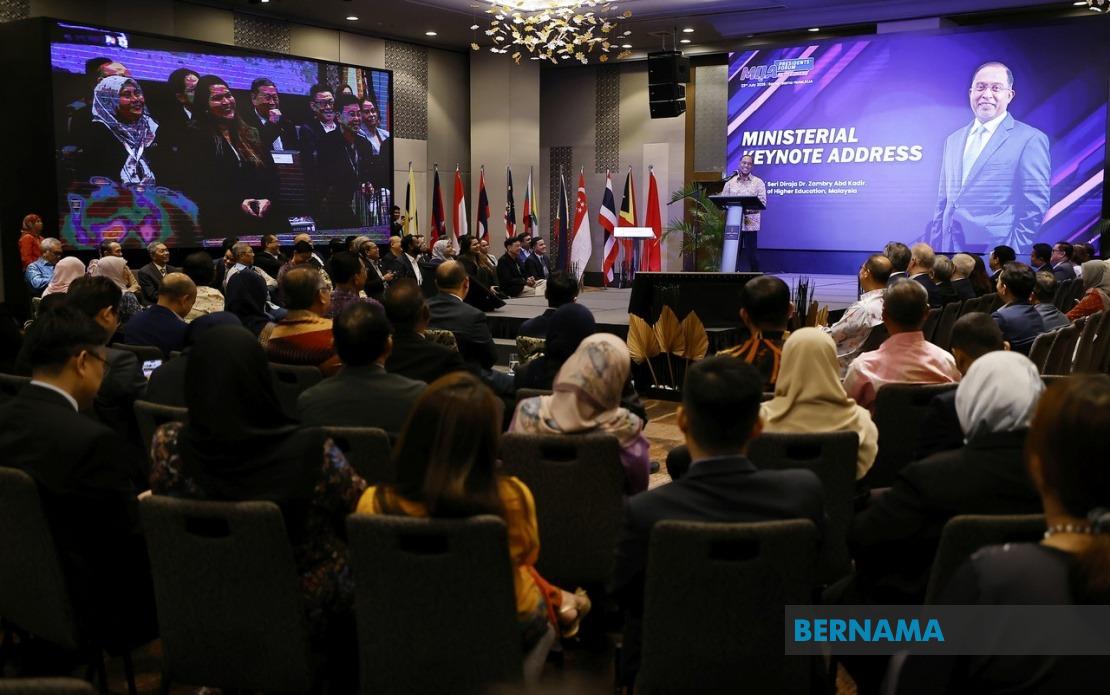
Malaysia's Higher Education Minister Datuk Seri Dr Zambry Abd Kadir has underscored the government's unwavering commitment to preserving academic freedom and nurturing intellectual dialogue within the nation's universities. Speaking at a public lecture in Putrajaya, he stressed that institutions of higher learning must continue functioning as bastions of open, respectful discourse where competing ideas can be examined rigorously and knowledge advanced through cross-border and cross-disciplinary exchange.
The minister's remarks came during a lecture by Columbia University's Prof Dr Joseph A. Massad on Muslim Identity in a Globalised World, highlighting the ministry's strategy of attracting world-class scholars to enrich Malaysia's academic landscape. By hosting such distinguished international speakers, the government seeks to position Malaysian universities as nodes within the global intellectual network, facilitating the circulation of ideas and best practices across continents.
Zambry articulated a nuanced vision of academic freedom that moves beyond permissiveness to encompass what he termed intellectual responsibility. This framing reflects an attempt to balance the openness necessary for genuine scholarly inquiry with the broader social cohesion concerns relevant to Malaysia's plural society. The minister emphasized that robust debate must be underpinned by civility, evidence-based reasoning, and genuine respect for alternative viewpoints rather than mere tolerance of disagreement.
The significance of this statement becomes apparent when considered against Malaysia's specific demographic and political context. As a multicultural nation with a Muslim majority and substantial non-Muslim minority communities, Malaysia navigates particularly complex terrain when attempting to foster inclusive academic discourse. Topics touching on religion, identity, ethnicity, and governance can easily become polarizing, yet genuine scholarly advancement requires precisely these discussions to occur within universities.
Zambry's invocation of Malaysia's longstanding tradition of pluralism carries particular weight. The minister suggested that Malaysians have historically embraced the philosophical principle of agreeing to disagree—finding common ground on fundamental issues while permitting legitimate disagreement on others. This characterization positions academic freedom not as a Western import but as consistent with Malaysian values and practices, potentially reducing resistance from those who might perceive international scholarly norms as culturally incompatible.
The minister's acknowledgment of contemporary challenges is notably candid. He recognized that differing opinions have become increasingly unavoidable in the age of artificial intelligence and social media, where information circulates rapidly and citizens encounter competing narratives constantly. Rather than retreating from debate, the government appears committed to channeling these inevitable disagreements into productive scholarly forums where they can be examined systematically rather than festering in unmediated online spaces.
The emphasis on informed dialogue and mutual understanding through scholarly engagement suggests the ministry recognizes that universities bear responsibility for modeling civil discourse for broader society. When academics engage substantively with ideas they oppose, when they ground arguments in evidence, and when they demonstrate respect for intellectual opponents, they provide templates for how disagreement can occur constructively. This becomes increasingly important as Malaysian society grapples with questions of national identity, development priorities, and global positioning.
Zambry's commitment to welcoming international scholars reflects strategic thinking about Malaysia's competitive position in the global knowledge economy. By creating an environment where established academics feel comfortable contributing to Malaysian intellectual life, the ministry aims to expose local students and researchers to international standards and methodologies. This exposure enhances the quality of Malaysian scholarship while potentially retaining talented individuals who might otherwise pursue opportunities abroad.
The stated dedication to academic freedom, however, must be understood within Malaysia's broader regulatory environment. Universities operate within frameworks that include provisions regarding sedition, national security, and religious sensitivity. How these frameworks interact with academic freedom in practice—particularly when scholars examine sensitive historical, religious, or political topics—remains an ongoing tension. The minister's framing suggests the government believes these concerns can be reconciled through responsible intellectual conduct rather than through restriction.
For regional observers, Malaysia's positioning on academic freedom carries significance beyond its borders. Southeast Asian nations are increasingly engaged in conversations about balancing development with openness, economic competitiveness with social stability, and global engagement with local values. Malaysia's approach—emphasizing intellectual responsibility alongside freedom, civility alongside robustness, and local tradition alongside international standards—offers one model for navigating these tensions.
The Higher Education Ministry's continued outreach to global scholars and commitment to hosting international intellectual dialogue suggests confidence in Malaysian universities' capacity to handle diverse ideas. Whether this optimism proves justified will depend partly on how faculty members engage with controversial topics and whether institutional practices consistently align with stated principles of openness.
Ultimately, Zambry's remarks represent a public reaffirmation that Malaysian higher education institutions should function as spaces where the full range of human knowledge and inquiry can be pursued. In a region where educational systems sometimes prioritize stability and predetermined outcomes over intellectual ferment, this emphasis on dialogue, evidence, and respect for difference positions Malaysia as comparatively committed to the broader mission of university education as both knowledge creation and citizenship development.

