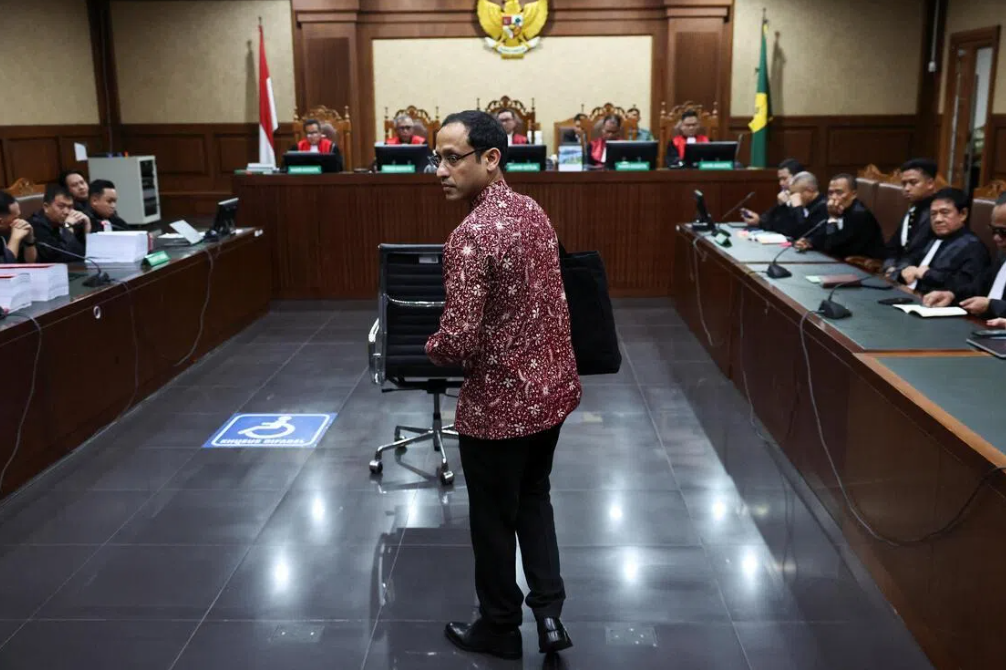
Indonesia's corruption courts have delivered a stunning verdict that sends shockwaves through the nation's technology and political establishments. Nadiem Makarim, the Harvard-educated entrepreneur who built Gojek into Southeast Asia's first unicorn and served as education minister under former president Joko Widodo, received a 10-year prison sentence on Tuesday for his role in a laptop procurement scheme that prosecutors say cost the state billions. The Jakarta Corruption Court also imposed a fine of 1 billion rupiah and ordered him to repay 809.6 billion rupiah in restitution, with an additional five-year sentence hanging over him should he fail to satisfy that financial obligation.
The case represents one of Indonesia's most consequential corruption trials in recent years, combining the elements that capture public imagination: a charismatic young technology billionaire, a controversial pandemic-era digitalisation initiative, and allegations of abuse of power to benefit private interests. Chief judge Purwanto's reading of the verdict laid bare the court's findings that Makarim had deliberately orchestrated a Chromebook procurement policy between 2020 and 2022 while schools closed across the archipelago, that his motivations centred on strengthening ties between Google and his company Gojek, and that these actions constituted a profound violation of ministerial duty. The five-judge panel concluded that the manner and purpose of the policy were designed to provide unlawful advantage to select parties, a characterisation that fundamentally contradicts the narrative that Makarim has maintained throughout the trial.
Makarim's trajectory before conviction read like a modern success story of Southeast Asian entrepreneurship. After founding Gojek in 2010 as a motorcycle courier service, he transformed it into a sprawling "super app" encompassing food delivery, digital payments through GoPay, and financial services. By 2019, when Joko Widodo invited him to serve as education minister, Gojek had achieved unicorn status with a valuation around US$10 billion, making Makarim an influential figure across Indonesia's startup ecosystem. His appointment was celebrated as a sign that the government was serious about injecting technology-driven thinking into the cabinet, bringing professional expertise from the private sector into policy-making. Yet the very digitalisation agenda that defined his ministerial tenure would become the foundation for the corruption accusations that followed.
At the heart of the prosecution's case lay a sprawling programme to purchase approximately 1.1 million Chromebook laptops during the initial years of pandemic-driven school closures. Prosecutors argued that this procurement strategy generated state losses exceeding 2.18 trillion rupiah and that Makarim personally benefited through transactions involving PT Aplikasi Karya Anak Bangsa, Gojek's parent company, to the tune of roughly 809 billion rupiah. Their theory centred on the notion that Google's investments in Gojek created a financial incentive for Makarim to channel enormous procurement volumes toward Chromebooks. The Attorney-General's Office further highlighted that ministry studies conducted in 2018, before Makarim assumed office, had identified serious limitations of Chromebook deployment in Indonesia's remote and rural regions where internet infrastructure remained inadequate. They referenced an August 2019 group chat as evidence that a Chromebook-focused digitalisation strategy had been under discussion even before his formal cabinet appointment.
Makarim and his legal team mounted a vigorous defence that centred on the reasonableness of pandemic-era decision-making and the good-faith implementation of their educational strategy. They maintained that he received no personal financial benefit from the procurement process and highlighted that approximately 97 per cent of the 1.1 million Chromebooks had been successfully distributed to 77,000 schools by 2023. The defence submitted that the government faced an extraordinary crisis during the pandemic and that Chromebooks represented a reasonable technological solution for enabling distance learning during one of Indonesia's most disruptive periods in modern memory. In their formal plea submitted in early June, they requested full acquittal, a position Makarim himself reinforced through public statements maintaining his unwavering belief in Indonesia's judicial institutions.
The trial itself became a remarkable cultural phenomenon that transcended typical legal proceedings and reflected deep divisions within Indonesian society about technology entrepreneurship, state service, and the relationship between the private sector and public administration. Gojek drivers attended hearings in displays of solidarity with the founder who had built their livelihoods, while Makarim consciously deployed symbolic gestures by wearing his company's driver jacket before changing into batik for courtroom sessions. The proceedings were livestreamed, attracting organised watch parties on social media platforms, while the court received amicus curiae briefs from supporters of Makarim's case. His prominent family background, including his father Nono Anwar Makarim's standing as a distinguished lawyer and his maternal grandfather's role in Indonesia's independence movement, added another layer of intrigue to a saga that gripped the nation's middle and upper classes.
The prosecutors' demand had been considerably harsher: an 18-year prison sentence, the same 1 billion rupiah fine, and 5.6 trillion rupiah in restitution. The court's reduction of the sentence suggests some judicial acknowledgement of Makarim's arguments, though the guilty verdict and substantial punishment leave no doubt about the judges' view of his conduct. The gap between prosecution demands and the delivered sentence indicates a court that found grounds for conviction while perhaps recognising the complexity of pandemic-era decision-making or the genuine difficulty in proving personal enrichment directly attributable to Makarim's actions. Nevertheless, the verdict carries unmistakable implications for Indonesian professionals contemplating transitions from private enterprise into government roles.
In his final defence plea delivered three days before sentencing, Makarim attempted to reframe the case as a question about Indonesia's capacity to welcome talented professionals from outside traditional politics into public service. He spoke directly to younger Indonesians and diaspora members, asking whether the country remained "safe to serve" for professionals willing to risk their reputations on government work. His emotional appeals underscored a broader anxiety within Indonesia's business and technology communities about whether the state could credibly recruit private-sector talent when legal exposure loomed so substantially. The symbolism mattered: a self-made billionaire asking whether Indonesia wanted entrepreneurial energy and technological expertise in government, or whether such efforts would be punished through corruption proceedings that conflated questionable procurement decisions with criminal abuse of power.
For Malaysia and other Southeast Asian economies, the Makarim case illuminates the treacherous intersection where public digitalisation initiatives, pandemic-era crisis management, and allegations of crony relationships collide. Malaysia's own experience with technology-driven governance initiatives and the relationship between government procurement and private companies offers uncomfortable parallels. The verdict raises challenging questions about how governments should balance ambition to deploy emerging technologies with vulnerability to accusations of favouritism toward particular vendors or companies with connections to decision-makers. It also demonstrates how former business leaders entering politics carry substantial legal risks if procurement decisions later become controversial or face political scrutiny from successor administrations or prosecutorial agencies.
The conviction's timing and nature also reflect Indonesia's complex anti-corruption landscape, where high-profile cases often attract intense public attention and serve symbolic purposes within broader political struggles. Joko Widodo's tenure has already ended, meaning the case cannot be construed as protecting a sitting president's interests, yet it arrives at a moment when questioning the track record of his administration becomes politically safer. Whether similar scrutiny would have been applied to procurement decisions made during the pandemic under different ministers, or whether Makarim's high profile and business empire made him a more tempting prosecution target, remains an unresolved question that observers will continue debating.
Makarim's path forward now involves multiple legal uncertainties. His conviction will likely face appeals, where higher courts may reconsider the evidence regarding personal enrichment and the necessity of procurement decisions made under extraordinary circumstances. If the conviction stands and he cannot satisfy the substantial restitution demand, an additional five-year sentence would follow. Yet beyond legal proceedings, the case has already damaged his reputation within Indonesian technology circles and among international investors who viewed him as a symbol of the region's entrepreneurial dynamism. The broader impact extends to Indonesia's ability to recruit global talent into public administration at a moment when other Southeast Asian economies are competing intensely for professional expertise and international credibility. For a nation seeking to position itself as technologically sophisticated and attractive to ambitious professionals, the message embodied in Makarim's conviction carries costs that will reverberate through Indonesia's governance challenges for years to come.

