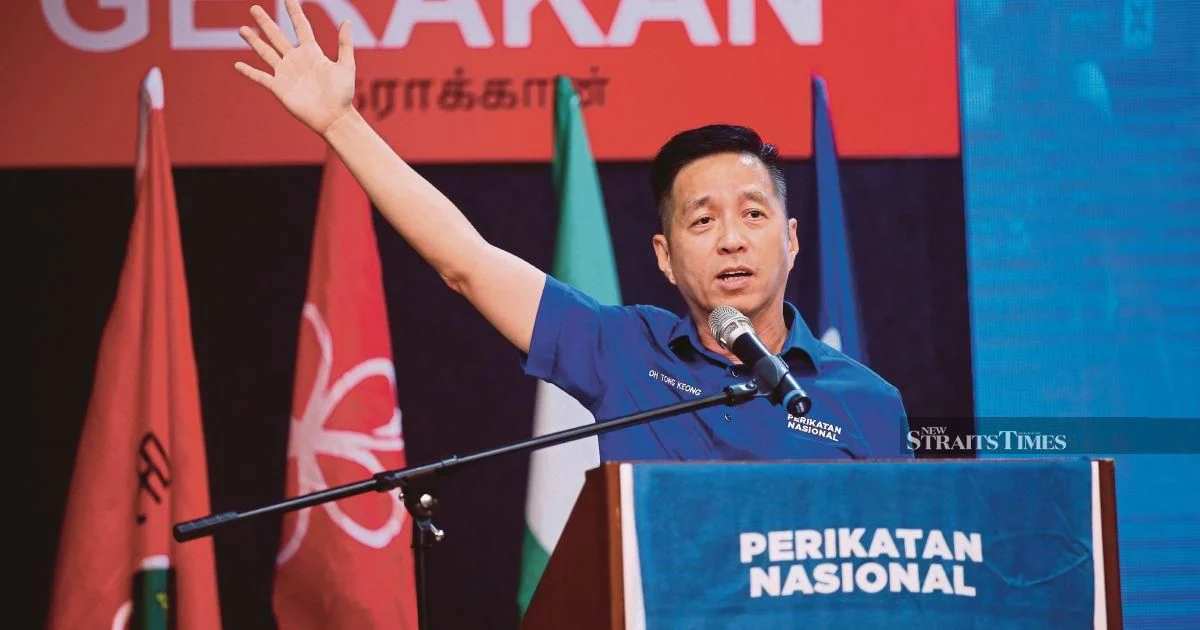
The Malaysian Democratic Party, commonly known as Gerakan, has announced its withdrawal from upcoming electoral contests in Johor, pivoting instead to concentrate its organisational resources on promoting fellow members of the Perikatan Nasional coalition, according to party election director Oh Tong Keong. This strategic repositioning marks a significant shift in how the historically influential party intends to contribute to the opposition alliance's broader campaign objectives in Malaysia's southern state.
The decision reflects broader calculations within the Perikatan Nasional framework, which has worked to consolidate its presence across multiple states following the 2022 general election. Rather than pursuing separate candidacies that might fragment the opposition vote or create complications within coalition ranks, Gerakan has opted to become an active supporter of other PN component parties, including PAS and Bersatu, which maintain more substantial organisational infrastructures in Johor.
This approach addresses a persistent challenge facing Malaysia's political coalitions: managing internal competition while maximising electoral efficiency. By stepping back from direct participation, Gerakan essentially acknowledges the practical reality that smaller parties often struggle to secure parliamentary seats while potentially weakening coalition partners through vote-splitting. The party's decision suggests a pragmatic acceptance of its reduced electoral footprint compared to its dominant position during the Barisan Nasional era.
Johor remains a strategically crucial territory for Malaysian politics, representing one of the nation's economically significant states and traditionally a BN stronghold. The Perikatan Nasional's ability to build competitive strength there carries implications for how opposition forces might challenge the incumbent coalition's dominance. Gerakan's willingness to support rather than compete indicates the PN is attempting to present a unified electoral front in the state, potentially learning from previous contests where fractionalised opposition presence handed seats to the government coalition.
Historically, Gerakan occupied a prominent position within BN, holding significant ministerial portfolios and state government responsibilities, particularly in Penang. The party's evolution toward a supporting role within the PN alliance reflects the broader reshuffling of Malaysia's political landscape following Barisan Nasional's loss of federal power in 2018 and its subsequent internal fragmentation. Once a major player in national politics, Gerakan now operates within a landscape where several newer entities have gained traction, particularly among younger voters and those seeking alternatives to established institutions.
The implications of this strategic shift extend beyond Johor's borders. Malaysian political observers have noted that coalition management remains one of the most consequential determinants of electoral outcomes. When smaller parties voluntarily restrain their ambitions to serve larger coalition partners, they implicitly accept reduced parliamentary representation in exchange for what they perceive as greater coalition viability. For Gerakan, this calculus suggests leadership believes supporting a stronger PN presence in Johor serves the party's long-term interests better than pursuing isolated candidacies.
Oh Tong Keong's announcement also signals how contemporary Malaysian political parties approach resource allocation. Campaign organisations, volunteer networks, and funds represent finite assets. A party with limited financial capacity and membership base, choosing to concentrate these resources on supporting allied parties rather than spreading them across multiple contests, demonstrates sophisticated strategic thinking about competitive disadvantage and coalition dynamics.
The Perikatan Nasional coalition encompasses diverse political traditions, from PAS's Islamist roots to Bersatu's more recent formation and various splinter groups. Successfully maintaining cohesion among such disparate elements requires regular negotiation and mutual concessions. Gerakan's decision represents one such concession, wherein the party subordinates its electoral presence to broader coalition objectives. Such arrangements typically come with understandings regarding ministerial appointments, policy influence, or other forms of political recognition when coalitions assume power.
For Malaysian voters, particularly those in Johor, this development means the electoral landscape will feature clearer delineation between Perikatan Nasional and its rivals, rather than fragmented opposition candidacies. Whether this benefits opposition prospects depends substantially on how effectively the consolidated PN strategy performs against Barisan Nasional's entrenched machinery and PH's competing opposition movement. The state has historically been a contested territory, suggesting that unified opposition could prove competitive, though BN's traditional dominance there remains formidable.
Gerakan's shift also reflects broader trends across Southeast Asia and the global political spectrum, where smaller coalition members increasingly adopt supporting roles rather than pursuing autonomous electoral strategies. This reflects recognition that fragmented opposition frequently enables incumbent governments to retain power through vote-splitting among competing challengers. By voluntarily constraining its own ambitions, Gerakan positions itself as a coalition partner prioritising collective success over individual party advancement.
The party's focus on supporting PN components suggests Gerakan leadership believes the coalition's overall performance in Johor represents the most consequential political battle for the party's relevance and influence. By contributing organisational efforts to parties that retain greater electoral viability, Gerakan indirectly strengthens its own coalition position and potential claim to political relevance should the Perikatan Nasional improve its electoral standing in the state or federally.

