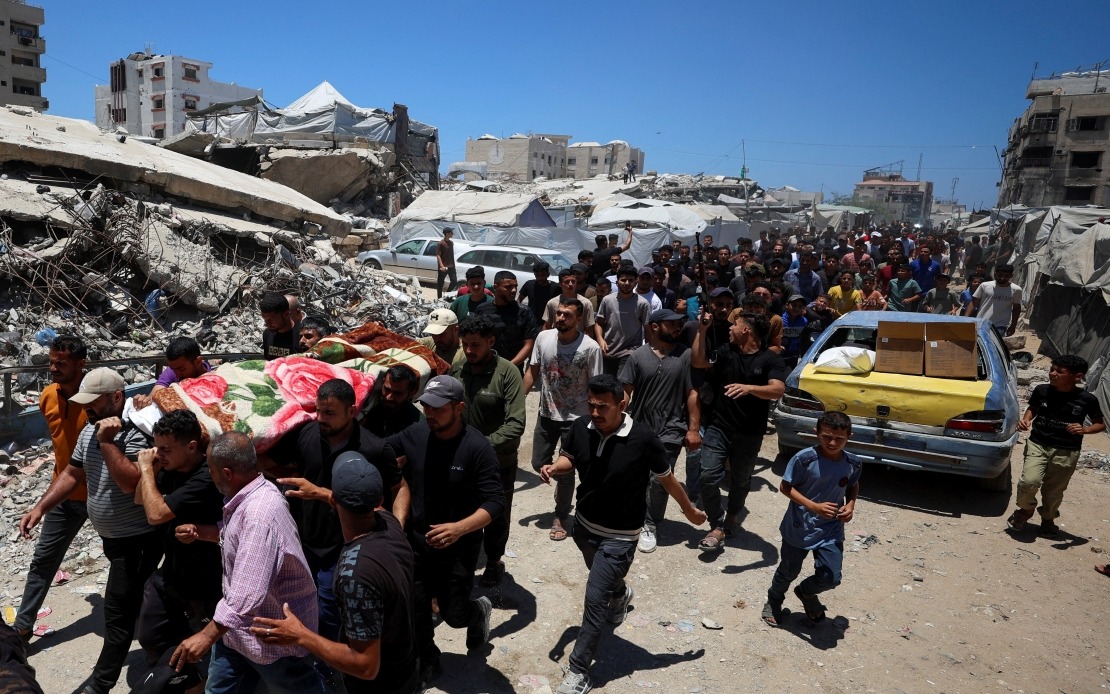
The humanitarian catastrophe unfolding in Gaza shows no signs of abating despite a ceasefire agreement. According to the Palestinian Prime Minister's Office, military operations have claimed 1,021 Palestinian lives since the ceasefire took effect, bringing the cumulative death toll since the outbreak of conflict in October 2023 to 73,032. These figures, released in the government's latest situation report, underscore the ongoing toll even as international mediators work to maintain the fragile ceasefire agreement between Israeli forces and Palestinian armed groups.
The scale of physical destruction across Gaza has fundamentally transformed the daily reality for its population. Israeli military operations have destroyed or damaged approximately 76.6 percent of the enclave's housing stock, leaving nearly one million Palestinians with no choice but to shelter in tent camps. The Government Communication Centre emphasises that this displacement remains ongoing, with families continuing to lose access to stable housing despite the nominal ceasefire. The destruction extends beyond residential structures, encompassing critical infrastructure that previously supported civilian life, from medical facilities to water distribution systems.
The humanitarian access situation presents one of the most pressing concerns for aid organisations operating in the territory. Israeli restrictions continue to obstruct the delivery of essential supplies, according to reports submitted to the United Nations Security Council by international organisations including Oxfam. Beyond the political restrictions, severe shortages of clean water have become particularly acute, forcing the majority of Gaza's population to depend almost entirely on limited supplies distributed through humanitarian channels. This water scarcity carries profound public health implications, creating conditions conducive to disease outbreaks and further deteriorating the health status of an already vulnerable population.
Children represent a disproportionately affected segment of the Gaza population. United Nations Children's Fund data reveals that since the ceasefire announcement, 265 Palestinian children have lost their lives whilst more than 400 others have sustained injuries. These figures reflect the persistent danger posed by continued military operations, including air and drone strikes, across population centres including Nuseirat, Al-Mawasi, Khan Younis and Gaza City. The targeting of civilian areas during the ceasefire period raises questions about the operational parameters and enforcement mechanisms governing military conduct within the enclave.
The situation across the West Bank presents a parallel humanitarian crisis that frequently receives less international attention than Gaza. The Office of the United Nations High Commissioner for Human Rights has documented a significant acceleration in the forced displacement of Palestinians throughout the occupied West Bank, including East Jerusalem. This displacement results from multiple drivers: coordinated settler attacks, government-authorised home demolitions, movement restrictions imposed through checkpoint systems, and forced evictions. The geographic scope of this displacement extends across the territory, affecting communities from refugee camps to rural villages dependent on agricultural livelihoods.
Agricultural destruction has inflicted severe economic damage on Palestinian communities, particularly those in rural areas relying on farming for survival. The Palestinian Ministry of Agriculture has documented the destruction of 7,258 trees across the West Bank, including 1,270 olive trees that often represent generational family assets. The estimated financial losses from these agricultural attacks amount to approximately US$5.17 million, a significant sum for an economy already fractured by conflict and blockade. Beyond crop destruction, separate arson attacks have targeted religious sites, including two mosques in the villages of Jiljilya and Mazra' al-Nubani, indicating a campaign affecting both economic and cultural infrastructure.
Refugee camps have become focal points for displacement operations. Israeli military operations concentrated in the Jenin, Tulkarem and Nour Shams refugee camps have displaced more than 33,000 Palestinians since the beginning of 2025 alone. These camps, which host some of the territory's most vulnerable populations, have endured repeated incursions and operations that have destroyed homes and forced residents into further displacement. The cumulative effect of successive operations creates a pattern of chronic instability for families with limited economic resources and few options for relocation.
Conditions within Israeli detention facilities have become increasingly concerning according to prisoners' rights institutions monitoring the system. Reports highlight severe overcrowding, deteriorating sanitary conditions, and the spread of infectious diseases within detention facilities holding Palestinian prisoners. The combination of overcrowding and inadequate medical provision creates an environment conducive to disease transmission and raises humanitarian concerns about the treatment of detainees, matters that fall within the purview of international humanitarian law.
The Israeli government's assertion of control over planning and construction decisions at the Ibrahimi Mosque in Hebron has triggered international legal concerns. According to Palestinian authorities, this assertion undermines the arrangements previously established under the 1997 Hebron Agreement, which provided for specified governance arrangements at this significant religious site. The Palestinian government contends that this unilateral action violates international law and represents a breach of previous commitments regarding the status and management of the mosque. The incident illustrates how localised administrative decisions can carry broader implications for implementation of existing agreements and international legal obligations.
Despite the extraordinarily challenging circumstances, Palestinian educational institutions continue functioning at a basic level. The Palestinian government has completed preparations for this year's General Secondary Education Examination, which encompasses approximately 91,000 students across the territories. Within Gaza specifically, approximately 37,000 students are participating in examinations delivered through electronic systems for the third consecutive year. This continuation of educational activities, adapted to the constraints imposed by conflict and displacement, represents an effort to maintain institutional continuity and provide young Palestinians with qualification pathways despite the profound disruptions to normal life.
For Malaysian observers and policymakers, the Gaza and West Bank situations carry several implications. The humanitarian scale of this crisis—with casualty figures now exceeding 73,000—represents one of the most significant displacement and casualty events in recent years. The documented patterns of civilian harm during the ceasefire period raise questions about the sustainability and enforceability of such agreements when military operations continue. Southeast Asian nations, which have maintained diplomatic engagement across the region's religious and political spectrum, may find themselves navigating increasingly difficult questions about humanitarian aid, accountability, and the protection of civilian populations in conflict situations.
The intersection of military operations, humanitarian access restrictions, and civilian suffering illustrated in these reports reflects the profound complexity of the Israeli-Palestinian conflict and the challenges facing international efforts to contain violence and protect vulnerable populations. The continuation of deaths and displacement even after a ceasefire announcement suggests that documented agreements may require stronger international enforcement mechanisms and clearer operational constraints to meaningfully reduce civilian harm. As regional and international actors consider next steps, the accumulating humanitarian toll documented by Palestinian authorities, United Nations agencies, and international organisations provides a sobering baseline for evaluating progress toward genuine civilian protection and conflict resolution.