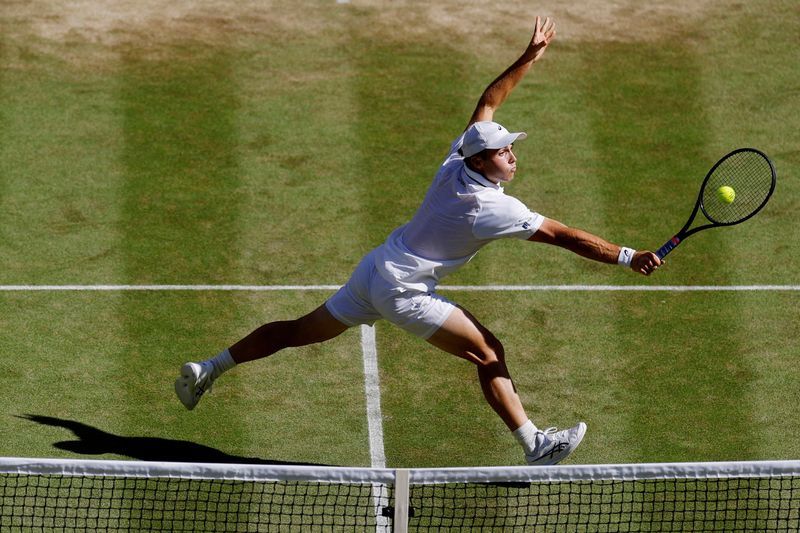
Arthur Fery's Wimbledon journey has taken on an almost storybook quality that transcends the sport itself. The 23-year-old British wildcard will celebrate his 24th birthday on Sunday—the same day as the men's singles final—and there remains a genuine possibility he could be playing on Centre Court to mark the occasion. His improbable run has captured the imagination of both tennis enthusiasts and casual sports fans, transforming a qualifier with modest rankings into the tournament's most compelling narrative.
Fery's path to the quarterfinals represents a remarkable feat of resilience and skill that has virtually no parallel among his fellow British competitors. Making his Centre Court debut only four days ago, the Franco-British player has already claimed two extraordinary five-set matches to advance deeper into the draw than anyone could have reasonably predicted. His progression stands in stark contrast to the disastrous opening round that saw 15 of the 19 British singles representatives eliminated at the first hurdle, a collective performance that underscored just how dire the home nation's depth in tennis has become.
The nature of Fery's victories cannot be understated. Against Zizou Bergs in the third round, he recovered from a devastating position, trailing by two sets with a double break deficit in the fourth set. Yet somehow, despite battling successive nosebleeds that could have derailed his concentration entirely, he persevered through what became the longest match of the entire tournament. The physical and mental toll of such encounters would have broken many players, yet Fery arrived on Monday visibly refreshed and ready for another examination against former world number three Grigor Dimitrov.
The fourth-round clash with Dimitrov unfolded as pure theatrical drama, especially in the context of England's simultaneous World Cup triumph against Mexico in the early hours of the morning, London time. The crowd that descended upon Centre Court carried an electric atmosphere more typical of football than tennis, their collective energy still reverberating from the national sporting victory across the Atlantic. When Dimitrov, playing with the experience that comes from 35 years and a pedigree few can match, appeared to seize control at 4-3 with a break in the fourth set, it seemed Fery's adventure might conclude in respectable defeat.
Instead, Fery summoned reserves of competitive spirit that produced one of the most memorable comebacks Centre Court has witnessed in recent memory. His stunning fightback against Dimitrov ultimately concluded with a 7-5, 3-6, 4-6, 6-4, 7-6(7) scoreline that saw him triumph in a tiebreak so thrilling that the roar which erupted when he clinched match point had not been heard at Wimbledon for years. The decibel levels more closely resembled a football stadium than the traditionally dignified tennis cathedral, a testament to how thoroughly Fery had captivated the audience.
Fery's quarterfinal opponent will be Italian world number 10 Flavio Cobolli, a meeting that carries additional intrigue given that Fery defeated the same player at this year's Australian Open. The Stanford University graduate brings an impressive baseline skill set and a serve of remarkable pace relative to his stature, attributes that American sixth seed Taylor Fritz witnessed firsthand during warm-up sessions before the 2024 World Tour Finals. Fritz provided remarkably prescient analysis following his practice sessions with Fery, noting that the British player had simply overwhelmed him with his consistency and shot-making during baseline exchanges.
The trajectory of Fery's rankings tells part of the story of his ascent. Arriving at Wimbledon ranked 114th in the world, he has already climbed inside the top 70 through his performances this week, with further advancement virtually assured regardless of the quarterfinal outcome. For a player who entered as a wildcard—essentially a gift entry that typically produces early departures—such rapid accumulation of ranking points represents a transformative week that will reshape his professional trajectory for years to come.
When asked about the significance of his performances amid the broader context of British sporting success on that extraordinary Monday, Fery demonstrated an awareness that transcends mere tennis statistics. He acknowledged the powerful resonance of competing on such a stage while his nation celebrated sporting achievement elsewhere, recognizing that the convergence of these moments creates memories that define careers. His reflection that he might never again experience such an atmosphere carries a poignant realism; wildcards do not habitually return to challenge rounds at Wimbledon, and reaching the quarterfinals once in a career represents an achievement that eludes the vast majority of professional players.
For Malaysian and Southeast Asian observers, Fery's emergence offers perspective on the unpredictability of professional sport at the highest level. While the Commonwealth connection binds cricket followers across the region, tennis has traditionally lacked the grassroots passion that produces consistent tournament successes. Fery's story, though distinctly British, illustrates how individual brilliance, mental fortitude, and circumstantial opportunity can converge to produce outcomes that defy conventional expectations and bracket predictions.
The narrative extending from Fery's journey extends beyond simple sporting achievement into broader observations about talent development and competitive excellence. His university education at Stanford, rather than pursuing early professionalization, has apparently provided him with both technical foundations and psychological maturity that are now bearing remarkable fruit. As British tennis continues wrestling with systemic issues that produced such a dismal first-round outcome for the home contingent, Fery's persistence offers at least temporary respite from that broader conversation and a reminder that individual excellence can flourish even when institutional support proves insufficient.

