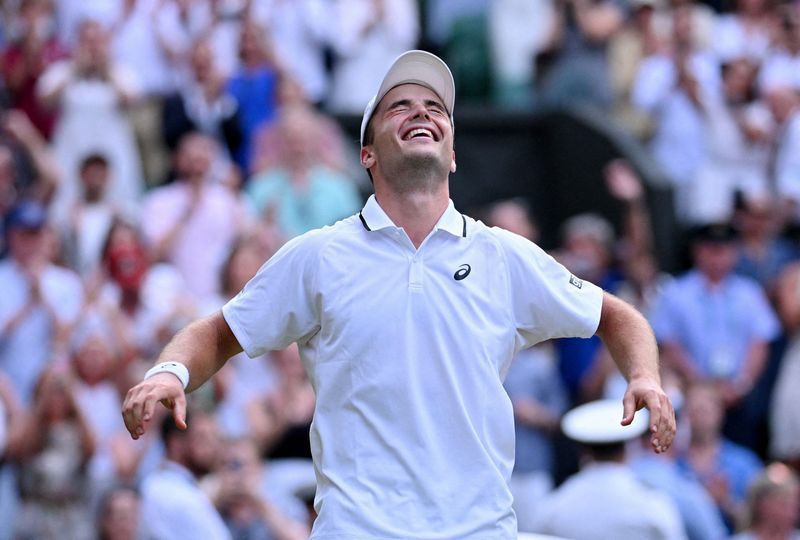
Arthur Fery's journey through Wimbledon reads more like Hollywood fiction than sporting reality, yet the 23-year-old British wildcard has transformed the improbable into concrete achievement by securing a place in the semi-finals. Having ranked 114th globally and entering the tournament on a wildcard berth with just two previous Grand Slam match victories to his name, Fery has become only the fifth British man in the professional era to reach this stage of the championship. His progression has captivated spectators and caught the attention of the sport's most prominent figures, drawing comparisons to legendary moments that have defined tennis history.
The scale of Fery's accomplishment becomes apparent when considering the calibre of opposition he has overcome. Playing on Centre Court on Wednesday in suffocating heat, he dismantled Italian ninth seed Flavio Cobolli with clinical precision, winning 6-4 7-6(4) 6-0 in a performance that belied his ranking and experience. Observers noted that Fery seemed to transcend his modest 5ft 9in stature, retrieving impossible balls and constructing points with the maturity of a seasoned professional. The Centre Court crowd's energy appeared to elevate his game further, creating a symbiotic relationship between player and support that proved decisive in his dominance.
Fery's next obstacle is significantly more daunting. He faces second-seeded Alexander Zverev, the French Open champion and one of tennis's elite performers, in Friday's semi-final. Should Fery prevail, he would not only reach the final on his 24th birthday but would have the extraordinary opportunity to emulate Goran Ivanisevic, the last wildcard to win the Wimbledon singles title, an achievement now two decades old. The magnitude of that prospect underscores the unlikelihood of Fery's continued progression, yet nothing in his tournament performance suggests he will be overawed by the challenge.
The young Briton has already earned plaudits from the highest echelons of both tennis and British society. Queen Camilla watched his quarter-final victory from the Royal Box and personally congratulated him afterwards, while Princess Kate attended his earlier match against Otto Virtanen. Eight-time Wimbledon champion Roger Federer nodded approvingly during Fery's five-set thriller against Grigor Dimitrov in the fourth round, lending his silent endorsement to a player embodying the spirit of competitive tennis at its finest. These moments of recognition have accompanied Fery's rise without appearing to distract him from his singular focus on the next match.
Fery's temperament and composure during this whirlwind period reveal a competitor shaped by deliberate life choices rather than mere chance. He opted for the American college route, studying science, technology and society at Stanford University, where he became the nation's top-ranked college player. This educational detour allowed him to mature intellectually whilst developing his game systematically, rather than pursuing the traditional European junior circuit intensively. His measured responses to media questioning and his tendency to compartmentalise each match within its own bubble suggest someone comfortable managing pressure through structure and perspective.
Despite his current status as the unlikely standard-bearer for British tennis following a disappointing opening round that eliminated 15 of the home nation's 19 singles players, Fery's background carries an intriguing international dimension. Born in Sèvres, a Parisian suburb near Roland Garros, he comes from an accomplished French sporting family. His father Loic is a multi-millionaire hedge fund manager who owns French soccer club Lorient, whilst his mother Olivia competed professionally in tennis herself. The French tennis authorities might harbour some regret having briefly represented him as a junior, yet Fery's credentials as a British player are unquestionable.
Fery relocated to London during childhood and attended King's College in Wimbledon, placing him literally within walking distance of the All England Club where his extraordinary tournament has unfolded. He progressed through the British tennis system and has consistently maintained that his British identity was never in question. His father recently told French sports publication L'Equipe that his son remains fundamentally a Wimbledon boy, having grown up minutes from the club and integrated himself completely into the local community. This deeply rooted connection to the tournament venue adds another layer to an already remarkable narrative.
The contrast between Fery's calm demeanour and the external drama swirling around his run cannot be overstated. Asked about the compressed schedule that saw rapid successive matches, he responded by noting that quick turnarounds actually suited him, keeping him focused on the present rather than permitting anxious reflection. His repeated references to remaining "in his bubble" and simply "carrying on" suggest a professional who understands that emotional stability and mental discipline often prove as decisive as technical ability when facing world-class opposition. This psychological resilience may ultimately prove as valuable as his improving tennis on Centre Court.
The British establishment has embraced Fery's breakthrough with enthusiasm that reflects the desperate hunger for homegrown Wimbledon success. Following a particularly barren period for British men's singles tennis, the emergence of a genuine contender has reignited passion among supporters and stakeholders alike. However, the burden of representing national hopes sits lightly on Fery's shoulders, perhaps because his personal journey has never been defined by desperate pursuit of validation or commercial success. His measured approach to fame and his systematic preparation through education suggest someone equipped to handle whatever emotional turbulence may accompany deeper tournament progression.
As Fery prepares to face Zverev, the semi-final encounter will test not merely his tactical nous and technical execution but also his capacity to sustain the extraordinary performances that have characterised his fortnight. Victory would represent an achievement almost incomprehensible given his starting point, yet the manner of his previous victories provides reason to believe he possesses the mental fortitude to compete at the highest level. For Malaysian and Southeast Asian tennis enthusiasts, Fery's run demonstrates that Wimbledon's narrative space remains large enough for genuinely surprising stories, reminding viewers that the sport's appeal partly derives from its capacity to produce the unexpected alongside its established hierarchy of excellence.

