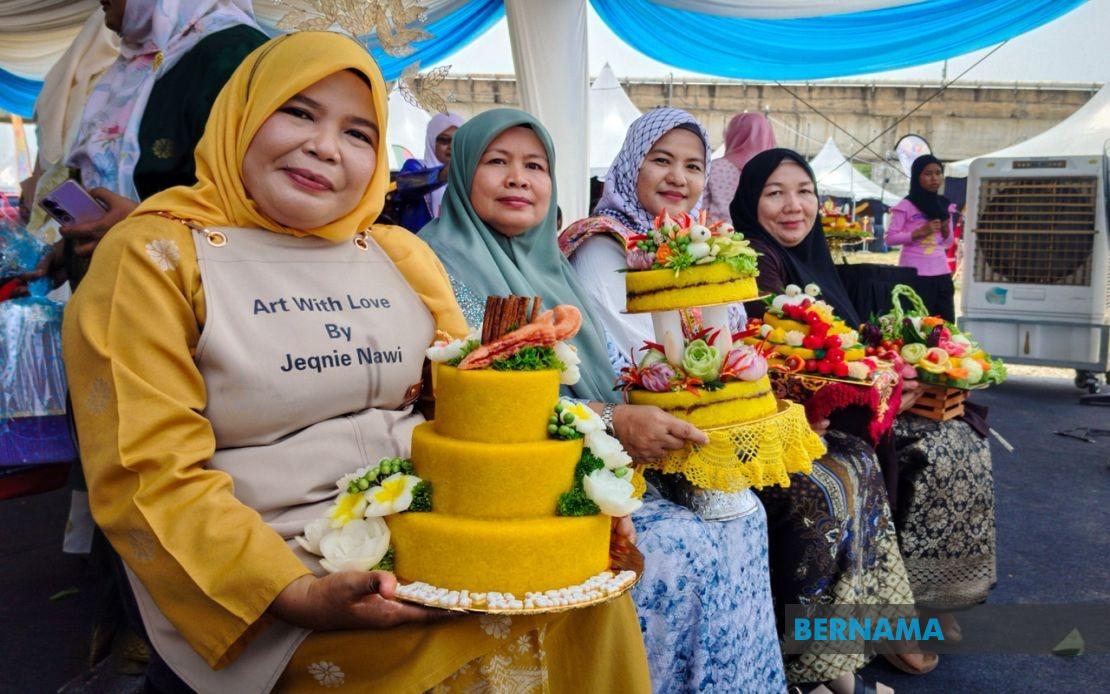
Nortiny Nawi's decision to quit her job as a resort marketing officer four years ago has proven remarkably prescient. What began as a personal hobby centred on preparing and artistically arranging turmeric-infused glutinous rice has blossomed into a full-fledged livelihood that now sustains her from her home in Kampung Gong Cokoh, Pasir Puteh. At 46 years old, she has become emblematic of a broader Malaysian trend where traditional culinary skills are being repositioned as viable commercial enterprises, particularly in rural areas where formal employment opportunities remain constrained.
The market response to her creations has been notably strong. Nortiny now receives booking inquiries on an almost daily basis, with customers spanning individual households, educational institutions, and government agencies throughout Kelantan. This consistent demand reflects a cultural appetite for these labour-intensive delicacies that extend far beyond routine consumption. Pulut kuning, traditionally associated with festive occasions and community celebrations, has found new commercial expression through her decorative interpretations, which command prices ranging from RM100 to RM280 per arrangement depending on both the quantity of glutinous rice used and the artistic complexity involved.
Her competitive credentials were validated recently when her work earned top honours at the Kelantan Folk Arts Festival held in Tok Bali. The winning entry featured an eight-kilogramme pulut kuning arrangement adorned with elaborate floral carvings fashioned from white radish, demonstrating the sophisticated visual presentation that distinguishes her product offerings from conventional preparations. This recognition underscores how culinary artistry, when combined with traditional ingredients and techniques, can elevate humble staple foods into luxury items commanding premium pricing within local and regional markets.
Nortiny's path to entrepreneurship was neither accidental nor impulsive. Her fascination with culinary preparation took root during her adolescent years, but remained largely dormant during her career in the hospitality sector. Working as a marketing officer at a resort provided her with proximity to professional kitchen operations, and she capitalised on her free time by observing the techniques and methodologies employed by experienced chefs. This period of informal apprenticeship, conducted without formal training structures, gradually deepened her technical knowledge and refined her understanding of food preparation principles that would eventually distinguish her commercial offerings.
The operational realities of her business reveal the demanding nature of artisanal food production. Unlike baked confections that can be prepared during convenient hours and preserved through refrigeration, pulut kuning requires immediate preparation for each individual order. Nortiny typically commences work between 2 and 3 in the morning, steaming the glutinous rice before proceeding through the labour-intensive stages of kneading, cooling, and sculpting into the desired decorative forms. Depending on the complexity of customer specifications, she can manage up to six orders daily, a capacity ceiling that reflects both the time investment required for each arrangement and the physical demands of the work itself.
What sustains her commitment to this gruelling schedule is a genuine passion for the craft rather than pure commercial calculation. She explicitly acknowledges that the routine work can be exhausting, yet finds motivation through positive customer feedback and the opportunity for continuous creative refinement. This psychological dimension—where personal satisfaction and professional validation reinforce labour commitment—represents an important factor often overlooked in purely economic analyses of small business sustainability. For entrepreneurs operating in traditional food sectors across Southeast Asia, emotional investment in preserving and developing culinary practices frequently proves as significant as profit margins in determining business longevity.
The customer base she has cultivated demonstrates the diverse applications for her product within contemporary Malaysian society. Individual households seek her arrangements for thanksgiving ceremonies and birthday celebrations, while bridal table dinners represent another significant market segment where elaborate food presentations carry both gustatory and aesthetic significance. Educational institutions and government departments constitute an additional revenue stream, suggesting that her work has achieved recognition as appropriate for formal official functions. This multifaceted demand profile indicates that traditional foods, when presented through modern commercial frameworks and quality standards, retain considerable cultural relevance and market viability.
Nortiny's business model operates entirely from her residential premises, eliminating overhead costs associated with commercial rental space. This geographic and infrastructural flexibility has allowed her to achieve profitability while maintaining relatively modest price points that remain accessible to ordinary Malaysian consumers. However, her explicit intention to eventually relocate to larger commercial premises reflects an understanding that growth limitations may eventually constrain expansion. The transition from home-based operations to dedicated commercial facilities would presumably enable increased production capacity while maintaining the handcrafted quality that currently differentiates her offerings from mass-produced alternatives.
For Malaysian policymakers and development practitioners, Nortiny's trajectory illustrates how cultural preservation and economic development need not represent contradictory objectives. Her entrepreneurial success has been built entirely upon techniques and ingredients deeply embedded within Kelantanese culinary heritage. Yet rather than viewing traditional knowledge as a museum piece, she has repositioned it as a contemporary commercial asset. This alignment of cultural conservation with income generation offers a potential model for rural economic development strategies that avoid the trap of attempting to mechanically transplant urban employment sectors into regional contexts where local competitive advantages lie elsewhere.
The scalability of her model merits consideration for potential replication. The training requirements, equipment investments, and ingredient costs for pulut kuning preparation remain relatively modest compared to many contemporary small business ventures. Raw materials are locally sourced and affordable, while the technical knowledge required can be acquired through experiential learning combined with family or community transmission rather than formal institutional training. These characteristics suggest that similar food-based artisanal enterprises could potentially provide sustainable income pathways for other entrepreneurs across Kelantan and neighbouring states seeking alternatives to conventional wage employment.
Looking forward, Nortiny's growth trajectory will likely depend on her capacity to balance increased production volumes with quality maintenance and her willingness to invest in commercial infrastructure. The durability of her business success will serve as a meaningful test of whether premium-priced, artisanally produced traditional foods can sustain viable commercial operations within competitive contemporary markets. Her determination to expand operations while remaining rooted in her community and committed to her craft suggests she approaches these challenges with clear-eyed pragmatism rather than unbounded commercial ambition, positioning her venture as both a personal success story and a potential template for culturally-grounded rural entrepreneurship across the region.

