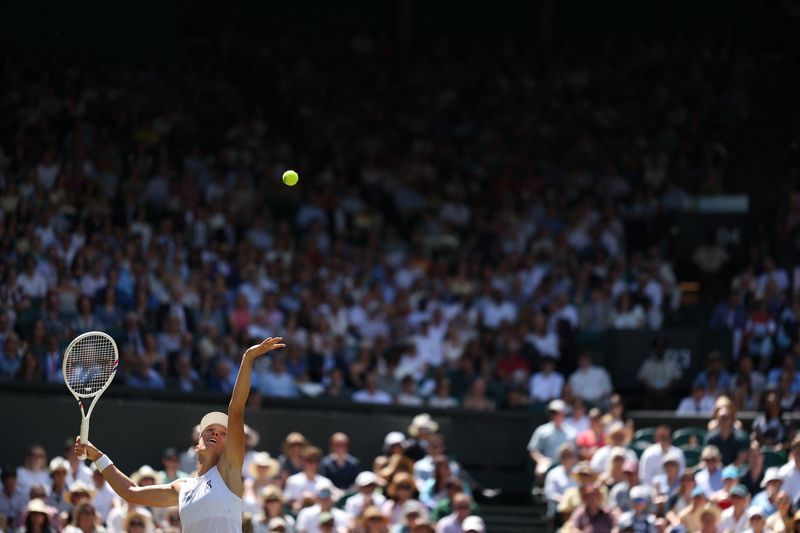
Alexandra Eala's Wimbledon campaign has taken a remarkable turn after the rising Filipino player dispatched defending champion Iga Swiatek in a compelling third-round encounter at the All England Club on Saturday. The 25-year-old Polish third seed suffered a 7-6(9) 6-2 defeat in what proved to be a closely contested opening set before Eala seized control with commanding tennis in the second frame. The victory marks a significant milestone for Eala, propelling her into the second week of a Grand Slam tournament and setting up a fourth-round clash against 2024 runner-up Jasmine Paolini.
Swiatek arrived at Wimbledon seeking to build on last year's maiden grass-court triumph, a breakthrough that finally silenced persistent doubts about her ability to perform on the sport's quickest surface. However, her preparation proved uneven, with an early exit at the Bad Homburg warm-up event raising questions about her readiness for the tournament's demands. Nevertheless, the Pole had navigated her way past Taylor Townsend and Karolina Pliskova in successive rounds, demonstrating the technical prowess that has made her a multiple Grand Slam champion. Against Eala, however, Swiatek encountered an opponent operating at the peak of her powers and unwilling to concede the Centre Court stage.
The opening set crystallised the intensity of their confrontation, with both players exhibiting the kind of baseline artillery that has become the hallmark of modern professional tennis. Eala's powerful shot-making from the back of the court troubled Swiatek from the outset, forcing the champion into defensive positions and limiting her ability to dictate rallies. The left-hander's aggressive approach created the tiebreak situation, where the pressure mounted with each point. When Eala eventually claimed the set at 9-7 in the breaker, the crowd's enthusiasm visibly lifted, sensing that they were witnessing something special unfold on the iconic court.
Swiatek's reactions told the story of a player struggling to find her rhythm. The Polish champion smiled ruefully at the conclusion of the first set, but her demeanour quickly shifted as frustration mounted. She was soon gesticulating at her entourage in the player's box and, in a moment of exasperation, struck her racket against a chair. These visible displays of frustration contrasted sharply with Eala's composed demeanour, even as the Filipino player soaked in the growing roar of encouragement from the crowd.
The second set saw Eala accelerate her intensity, capitalising on Swiatek's apparent loss of momentum. The Filipino broke serve twice in succession to establish a commanding 3-0 advantage, putting the defending champion in a precarious position. Although Swiatek staged a brief recovery, retrieving one of those breaks, Eala proved unmoved by the resurgence. When the American-based player earned another break to consolidate her position, the writing was clearly on the wall. Eala finished matters with a striking forehand winner, a shot that symbolised her dominance throughout the encounter and silenced any lingering doubts about the outcome.
Eala's emotional response in the immediate aftermath of victory offered a poignant perspective on what this achievement means beyond the confines of professional sport. She acknowledged Swiatek's standing in the game, recognising that for multiple Grand Slam champions, advancing through rounds at major tournaments represents routine progress. Yet for Eala, the significance runs far deeper, rooted in a childhood journey that took her from the Philippines to the world's most prestigious courts. Her reference to training in ruffled socks and light-up shoes with her brother and grandfather encapsulated the modest beginnings that shaped her tennis ambitions, contrasting starkly with the glamour and resources typically associated with elite-level professional tennis.
The contrast between Eala's journey and her achievement on Saturday underscores broader narratives about talent development in emerging tennis markets. Philippine tennis has historically struggled to produce players capable of competing consistently at the highest levels, making Eala's breakthrough particularly significant for the country's sporting aspirations. Her presence on Centre Court represented not just personal accomplishment but also vindication of the grassroots approach that her family had cultivated throughout her formative years as a player.
This particular matchup held additional resonance given their recent history. Eala had shocked Swiatek at Miami the previous year, only to see the Pole gain revenge on the clay courts of Madrid. The Wimbledon encounter, taking place on grass, presented an entirely different set of variables. Where Madrid's slower surface had favoured Swiatek's methodical baseline game, the faster pace of Centre Court's grass suited Eala's aggressive shot-making perfectly. The left-hander's willingness to attack from the baseline, combined with her powerful serve, proved too much for Swiatek to manage over the course of two sets.
Eala's measured response after victory, despite her evident emotion, revealed a player with realistic ambitions and understanding of the challenge that lay ahead. She expressed gratitude towards the Centre Court crowd, who had clearly taken her under their wing during the match. Yet she was careful not to allow sentiment to distract from the immediate task: her upcoming fourth-round encounter with Paolini. This professional mindset, combined with her demonstrated ability to perform under pressure against top-ranked opponents, suggests that her Wimbledon run could extend considerably further than most observers anticipated when the tournament began.
The implications for Asian tennis, and Filipino tennis in particular, extend beyond the immediate tournament context. Eala's success comes at a moment when Southeast Asian players are beginning to make deeper impressions at major tournaments. Her victory over Swiatek demonstrates that geographic isolation or limited access to world-class training facilities no longer automatically preclude success at the highest levels. Instead, Eala's journey—combining family support, training discipline, and natural talent—offers a blueprint for how emerging markets can develop competitive players.
Swiatek's defeat, meanwhile, represents a cautionary tale about the challenges of defending major tournament titles, particularly on surfaces that don't perfectly suit a player's strengths. Whilst her previous year's Wimbledon triumph suggested a breakthrough on grass, this result indicates that consistency on the surface remains elusive. For the Polish champion, regrouping and rebuilding confidence will become priorities as the season progresses. However, her defeat also highlights the depth of talent now competing at the Grand Slam level, where any momentary lapse or suboptimal preparation can prove costly against hungry opponents hungry to announce themselves on tennis's biggest stages.

