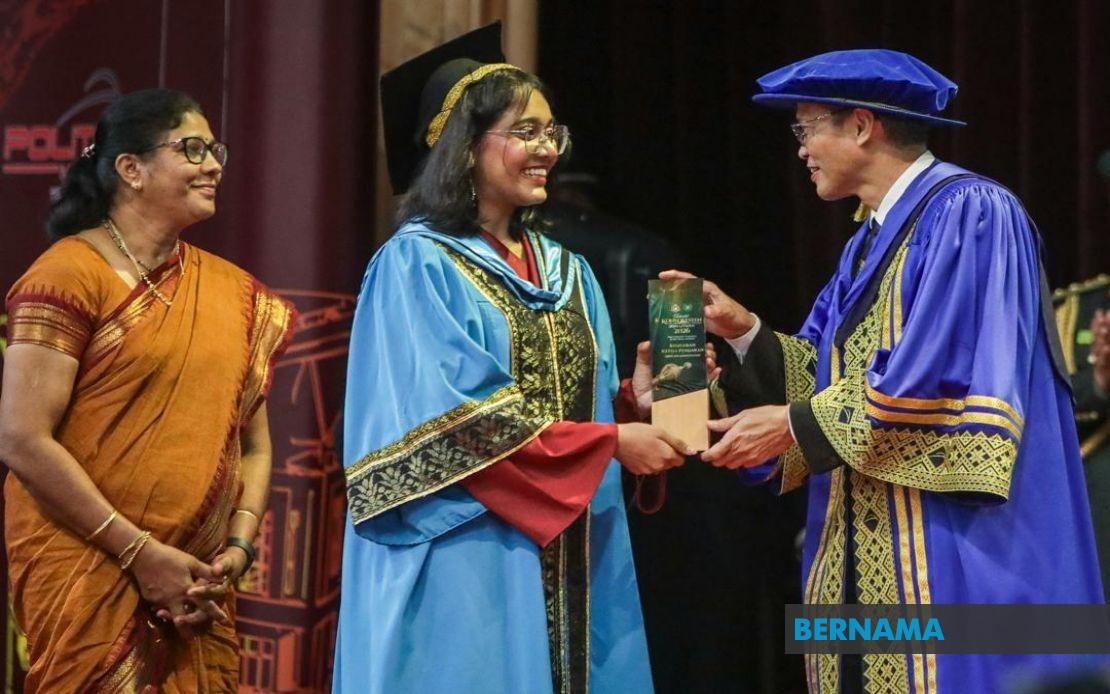
Teerti Ganapathi Rao's achievement at Politeknik Tuanku Syed Sirajuddin (PTSS) represents more than academic recognition—it stands as testament to personal resilience in the face of profound loss. The 22-year-old Diploma in Digital Technology graduate earned the Director-General's Award and the Academic and Co-Curricular Excellence Award at the 2026 Northern Zone Polytechnic and Community College Convocation Ceremony, which opened today at the institution's campus in Arau. Her accomplishment is particularly poignant given that she lost her father during the second semester examination period in 2023, a tragedy that could have derailed her educational journey entirely.
With a cumulative grade point average of 3.61, Teerti's performance reflects sustained dedication across her three-year programme at PTSS. When informed of her selection for the prestigious awards, the Perlis-born graduate expressed both shock and gratitude, acknowledging that she had harboured doubts about receiving such recognition given the emotional turbulence she endured during her studies. Her reaction underscores how personal adversity can cloud one's sense of self-worth, even when objective measures of achievement tell a different story. The convocation ceremony, graced by Tuanku Syed Sirajuddin Jamalullail, the Raja of Perlis, is honouring 6,104 graduates from polytechnics and community colleges across Perlis, Kedah and Penang through sessions running until 9 August.
The foundation of Teerti's perseverance lay in the legacy of her late father's encouragement. As the youngest of four siblings, she had contemplated abandoning her diploma programme to pursue a foundation degree instead—a less demanding pathway that might have seemed attractive during her period of mourning. Her father's consistent advice, however, became the ballast that kept her on course. Even after his death, she maintained her focus on completing the diploma, treating his words as an invisible hand steadying her through the darkest moments of her academic life. This parental influence, extending beyond death itself, illustrates how family values can become internalized sources of motivation that help young people navigate unforeseen crises.
Beyond her core academic performance, Teerti demonstrated consistent excellence throughout her studies at PTSS. She received the Head of Department's Award for the first, third and fourth semesters, establishing a pattern of high achievement that culminated in her Director-General's Award. Beyond the classroom, she served as a member of the Student Representative Council (MPP), where she developed practical skills in leadership, communication and collaboration. These co-curricular involvements transformed her from a purely academically-focused student into a more well-rounded individual capable of navigating professional environments that increasingly demand soft skills alongside technical competence.
Teerti's reach extended beyond her own institution when she represented PTSS in a collaborative programme and seminar paper presentation at Universiti Putra Indonesia, exposing her to international academic contexts and regional educational networks. Her capstone project, the Koop Printing System, demonstrated applied learning that bridged theory and practice—a system designed to enhance operational efficiency in cooperative printing service management. Such final-year projects offer polytechnic students the chance to create tangible solutions to real-world problems, a feature that distinguishes polytechnic education from purely theoretical university-based learning and prepares graduates for immediate workplace contribution.
Language proficiency constitutes another dimension of Teerti's intellectual ambition. Beyond fluency in Bahasa Melayu and English, she commands Mandarin, Tamil and Telugu, reflecting her multicultural Malaysian heritage and intellectual curiosity. She additionally possesses basic competency in French, Japanese and Korean. This linguistic versatility positions her advantageously in a globalised knowledge economy where technical specialists increasingly operate across cultural and linguistic boundaries, particularly in Southeast Asia's increasingly interconnected technology sector. Her language skills signal openness to international collaboration and adaptability—qualities that technology employers actively seek.
Teerti's passion for information technology germinated relatively recently but with genuine intensity. She traces her interest in IT to age 16, when friends introduced her to computers and coding through online gaming communities. This origin story—embedding technical education within recreational leisure—reflects how digital natives often encounter programming and systems thinking through informal channels before formal education. Rather than viewing gaming as distraction, she recognised it as a gateway to deeper technical knowledge. Her assessment that IT is challenging but navigable with methodical learning and conceptual understanding reflects intellectual maturity beyond her 22 years and suggests strong self-awareness about how she learns effectively.
Looking forward, Teerti is currently awaiting application results for a Bachelor's degree in Information Technology, with Universiti Malaya listed as her first preference. Her ambition extends further—she aims eventually to pursue doctoral studies (PhD) in her field, a trajectory that would position her not merely as a practitioner but as a researcher and innovator within technology sectors. This extended educational vision demonstrates that polytechnic qualifications increasingly serve as springboards to university-level study rather than terminal points, a structural change reflecting Malaysia's broader commitment to developing high-skilled talent pipelines in STEM fields.
For Malaysian policymakers and educators, Teerti's journey offers multiple lessons. Her success demonstrates that polytechnic education can produce graduates of genuine excellence when institutional support systems and individual determination align. The recognition she received validates PTSS's commitment to holistic student development encompassing academic, co-curricular and leadership dimensions. Furthermore, her example illustrates that personal tragedy need not truncate educational achievement—indeed, adversity navigated successfully can deepen resilience and determination. In the Southeast Asian context, where polytechnic systems continue evolving to meet growing demand for skilled workers, Teerti represents the calibre of graduate these institutions can reliably produce.
The implications extend beyond individual achievement to workforce development strategy. Malaysia's technology sector faces persistent skills shortages, particularly in IT and digital fields. When polytechnic graduates like Teerti transition to university degree programmes and potentially doctoral research, they bring practical experience and maturity to higher education that purely school-leaver students may lack. Her multilingual capability and demonstrated adaptability to international academic environments (evidenced by her Universiti Putra Indonesia presentation) suggest she will likely contribute to regional knowledge networks and potentially return value to Malaysian institutions through international exposure and collaborative research.
Teerti's story also resonates across Southeast Asia's developing economies, where polytechnic education serves millions seeking practical pathways to professional employment. Her ability to convert personal tragedy into focused achievement, to balance technical excellence with soft skills development, and to maintain ambition across multiple educational levels provides a template that young people across the region might reference. The institutional recognition she received—awards from both the Director-General and the Department—signals that Malaysian polytechnics actively identify and celebrate exceptional talent, creating positive feedback loops that encourage further excellence among student communities.

