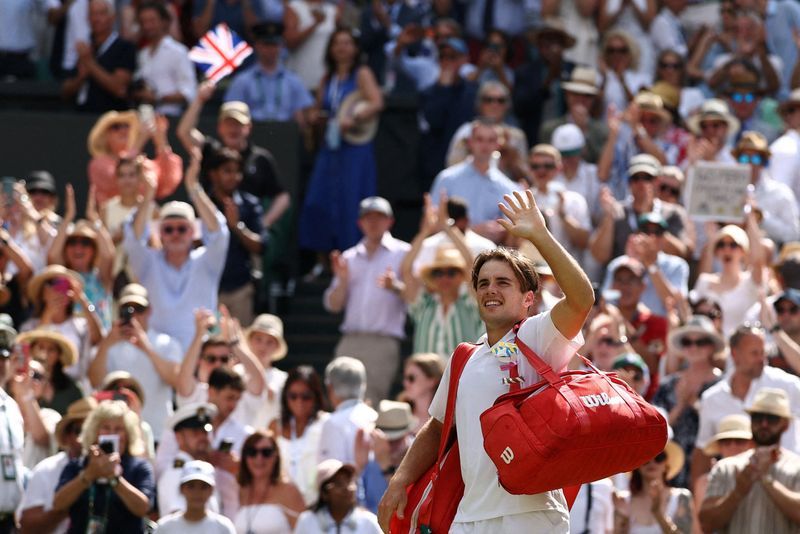
Arthur Fery's improbable Wimbledon journey came to an end on Friday when German top seed Alexander Zverev defeated the British wildcard in straight sets at the semi-final stage, but not before the 23-year-old had already rewritten the narrative of one of tennis's most prestigious tournaments. When Fery accepted his wildcard invitation for the grasscourt major, his ranking of 114th suggested he would be a footnote in the draw, a player whose brief appearance would quickly fade from memory. Instead, he became the first wildcard to reach the men's semi-finals at Wimbledon in 25 years, a milestone that captured the imagination of British sports fans and transcended the boundaries of professional tennis.
The scale of Fery's unlikely run becomes apparent when considering where he had planned to be during this tournament week. Having booked a holiday to Greece with friends before receiving his wildcard opportunity, the French-born player found himself trading sandy beaches and Mediterranean breezes for the intense pressure cooker of Centre Court in London's summer heatwave. His path through the draw proved unexpectedly straightforward, as he dismantled five successive opponents to secure his place among the tournament's final four competitors. What had seemed an amusing possibility—that he might have to abandon his vacation plans—became an increasingly plausible scenario with each passing round, ultimately forcing the cancellation of his getaway entirely.
Fery's candid reflections on the situation reveal both the surreal nature of his achievement and the genuine uncertainty that had surrounded his prospects entering the tournament. He acknowledged that one friend, so convinced of his early exit, had departed for Greece ahead of him only to return two days later as his performances began to generate headlines. This humorous anecdote underscores just how unexpected his progression proved to be, even among those closest to him. The player who had won merely two matches across all major championships before this fortnight was hardly expected to compete at the business end of Wimbledon, let alone captivate an entire nation with his performances.
Beyond the statistics and rankings, what truly distinguished Fery's run was the groundswell of public support that materialised as his story unfolded. The backing extended far beyond traditional tennis circles, encompassing the broader landscape of British celebrity and high society. A video message of encouragement from England's World Cup football team demonstrated how his achievement resonated across different sporting constituencies. Yet perhaps most symbolically significant was the presence of Queen Camilla and Princess Kate in the stands, their attendance lending an almost fairy-tale quality to proceedings and elevating Fery's tournament beyond mere sporting competition into a moment of genuine national pride.
For Malaysian and Southeast Asian readers, Fery's story carries particular resonance in the context of regional ambitions in professional tennis. His breakthrough demonstrates that wildcards and lower-ranked players can still script memorable narratives at the sport's highest level, a lesson relevant to emerging talents across Asia seeking their own paths into major tournament draws. The emphasis on belief, consistency, and seizing opportunity when presented—themes central to Fery's run—resonate with the aspirational nature of sports development across the region.
The immediate financial windfall from his semi-final berth cannot be overlooked in assessing the tangible impact of his achievement. Fery earned £900,000 (approximately $1.21 million) simply for reaching the last four, a sum that dwarfs what he might have earned through conventional tournament progression at his previous ranking level. This substantial prize money provides him with both financial security and the flexibility to focus entirely on his professional development without the constraints that had previously limited his tournament schedule.
More significantly, Fery's ranking is projected to rise to the mid-30s following his Wimbledon performances, a transformation that will fundamentally alter his access to professional tennis opportunities. At his previous 114th ranking, he had been relegated to qualifying rounds and secondary tour events, barely accumulating enough ranking points to maintain his position. The new ranking will grant him direct entry into most tour events and a guaranteed spot in major championship draws for at least the next twelve months, effectively removing the precarious financial and competitive uncertainty that had characterised his career to date.
Fery himself recognised the profound implications of this shift, acknowledging that the transformation will require significant psychological adjustment. The transition from fringe player to established tour competitor brings heightened expectations both from himself and from the public, a burden that cannot be underestimated. He articulated the challenge with refreshing candour, understanding that maintaining momentum and navigating the pressures of elevated status will demand considerable mental fortitude alongside technical excellence.
Looking forward, Fery has identified the North American hardcourt swing as his immediate priority once he has recovered from the rigours of his extended Wimbledon campaign. The lead-up to the US Open, where he will make his major championship debut in the main draw proper, represents an ideal testing ground for consolidating his newfound confidence and assessing whether his grasscourt success translates to other surfaces. Many breakthrough players experience difficulty replicating success across different conditions, yet Fery's apparent comfort on the major stage suggests he possesses the mental resilience to compete effectively regardless of surface.
The broader implications of Fery's achievement extend beyond individual accolades. His success validates the wildcard system itself, a mechanism often criticised as providing unmeritorious access to prestigious tournaments. Yet Fery's run demonstrates that the system, when utilised appropriately, can unearth genuine talent and create compelling narratives that enhance rather than diminish tournament prestige. His story will likely influence how tournaments view wildcard selections, potentially encouraging more aggressive gambles on young British players in future years.
As Fery contemplates his transformed circumstances, the contrast between his pre-tournament expectations and his actual achievement cannot be more stark. The Greek holiday has been indefinitely postponed, replaced by the considerable challenge of sustaining excellence under the bright glare of professional tennis's highest echelon. Yet few would argue that the substitution was anything other than worthwhile, for Fery has secured his place in British tennis history and established himself as a legitimate fixture on the professional tour. The question now is whether he can build upon this foundation or whether his Wimbledon fortnight will remain a glorious anomaly. Based on his evident mental strength and competitive hunger, expectations should remain cautiously optimistic that his breakthrough represents the beginning of an enduring career rather than a fleeting moment of glory.

