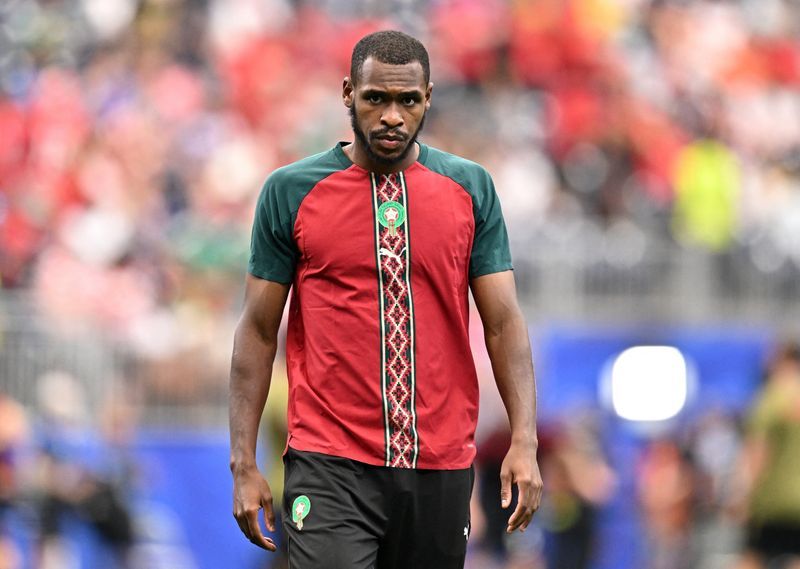
Morocco's centre-back Issa Diop finds himself in an extraordinary position as his adopted country prepares to face France in Thursday's World Cup quarter-final in Boston—a scenario that seemed inconceivable just months ago when the 29-year-old Toulouse-born defender was adamant about his exclusive commitment to the French national team. The irony of his current circumstances reflects the unpredictable nature of international football, where personal conviction can give way to pragmatic opportunity and where national pride sometimes trumps childhood aspiration.
Diop's journey to this crossroads began with deep ancestral roots in West Africa. His Senegalese father and Moroccan mother provided him with multiple pathways to international representation, yet the defender was resolute in his preference for France, the country of his birth. Seven years before his dramatic shift in 2023, while representing France's Under-21 squad, he articulated his reasoning to Canal Plus with striking clarity: he viewed himself as fundamentally French, a product of French society and French opportunity, and he rejected the notion of joining another nation simply because the French senior team had passed him over. His words reflected a principled stance that would resonate through his career until circumstances dramatically altered his trajectory.
The decision to represent Morocco, announced in March this year ahead of the World Cup, triggered considerable social media backlash from those who recalled his earlier declarations. Critics questioned his authenticity and accused him of opportunism, suggesting that continental competition had become his consolation prize after failing to secure a permanent role in the French setup. The reputational damage appeared significant, and many observers wondered whether Diop would be welcomed by Moroccan supporters and teammates who remembered his previous rejections of their entreaties. Yet Mohamed Ouahbi, Morocco's coach at the time, saw beyond the controversy and recognized something more compelling in Diop's character.
Ouahbi's assessment of Diop's suitability for the Moroccan project proved prescient. The coach observed in the player a genuine connection to Moroccan culture and lifestyle—not merely administrative eligibility but authentic engagement with the nation he would represent. Diop's family ties and his regular visits to Morocco suggested a deeper bond than the surface-level mercenary arrangement critics feared. Ouahbi welcomed him unreservedly, establishing a framework within which past declarations could be recontextualized as youthful certainty rather than permanent conviction. This managerial backing proved crucial in facilitating Diop's integration into a squad that might otherwise have remained skeptical.
Diop's Premier League pedigree—eight seasons spanning West Ham United and currently Fulham—provided Morocco with defensive credentials precisely when the team needed them most. The departure of captain Romain Saiss following the Africa Cup of Nations in January, combined with Nayef Aguerd's March injury, created a significant gap in Morocco's defensive architecture heading into the tournament. Diop represented not merely an available option but a seasoned performer accustomed to the intensity of English football's uncompromising defensive standards. His experience against some of Europe's most sophisticated attacking units made him invaluable to a Moroccan side seeking to compete at the tournament's highest level.
His competitive debut for Morocco against Ecuador in a March friendly provided a low-pressure introduction to his new international role, yet his swift establishment alongside Crystal Palace's Chadi Riad as first-choice centre-backs demonstrated both his capability and Morocco's confidence in his integration. The partnership coalesced quickly, suggesting that tactical familiarity and professional understanding could overcome the emotional complications of his recent switch. Diop threw himself into the role with apparent thoroughness, his physical presence and reading of the game offering Morocco defensive solidity in early tournament matches.
The defining moment in Diop's Moroccan narrative arrived in the round of 32 against the Netherlands, where his stoppage-time header from Chemsdine Talbi's cross equalized the match in the ninety-first minute, rescuing Morocco from what appeared to be certain elimination. The intervention was both physically powerful and dramatically significant—a goal that transcended mere sporting achievement to become symbolic of his commitment to his adopted nation. Reflecting afterward with characteristic humility, Diop acknowledged the almost surreal nature of his forward position at such a late stage, suggesting he had ventured upfield more by circumstance than design. Yet his presence of mind to capitalize on the opportunity demonstrated the clinical finishing that occasionally supplements defensive work at the highest international level.
For Malaysian and Southeast Asian audiences, Diop's story illuminates broader patterns in contemporary international football where players possess multiple national eligibility pathways and must navigate complex decisions about allegiance and opportunity. Similar scenarios have emerged with players of mixed heritage throughout the region, where cultural identity and sporting aspiration sometimes create tension. His trajectory also reflects the increasing professionalization of international football recruitment, where established coaches like Ouahbi pursue targeted acquisitions to address specific tactical gaps rather than relying solely on domestically developed talent.
The Thursday matchup against France presents a final examination of Diop's commitment to his recent choice. No split loyalties can complicate his focus now—the immediate challenge demands complete concentration on nullifying Kylian Mbappé's formidable attacking prowess and the broader French offensive threat. Morocco's ambition of reaching a second consecutive World Cup semi-final depends substantially on their defensive organization, where Diop will shoulder critical responsibility. Whether viewed as redemption, vindication, or opportunistic vindication, his performance will ultimately define how his World Cup story is remembered and whether his March commitment to Morocco transcends its controversial origins to become an uncomplicated narrative of national service.

