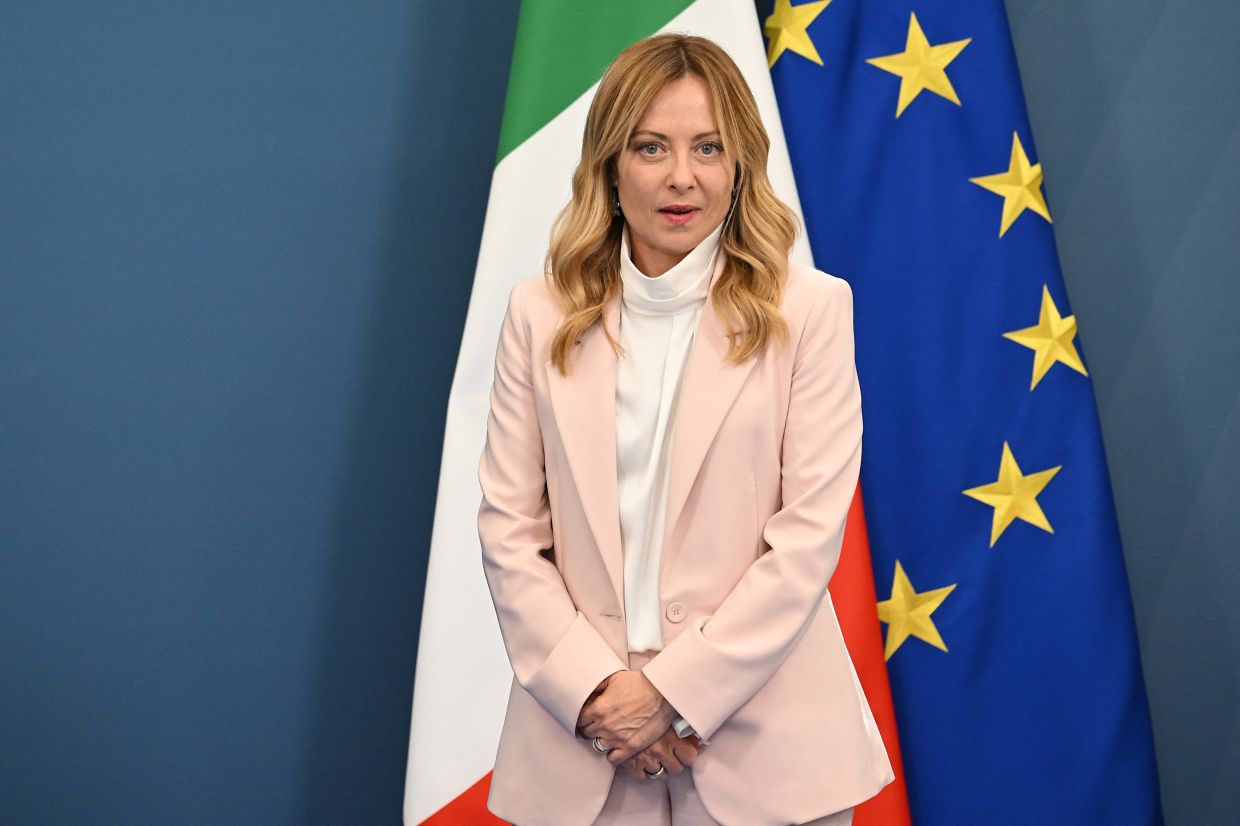
Italian Prime Minister Giorgia Meloni's sartorial choices have undergone a carefully calibrated transformation that tracks precisely with her political evolution from firebrand populist to pragmatic European statesman. When she assumed office in October 2022, Meloni arrived in dark formal suits paired with heavy black boots—visual proclamations of her emergence from Italy's right-wing political fringe. Today, as she approaches the threshold of becoming Italy's longest-serving postwar premier, her wardrobe has shifted dramatically toward pastel-coloured tailored suits with flowing wide-legged trousers that conceal her heels. Fashion analysts and political observers suggest this aesthetic recalibration serves a calculated purpose: projecting executive competence and measured authority whilst discarding the confrontational visual language that defined her earlier political identity.
The strategic employment of clothing as nonverbal political communication represents a sophisticated understanding of how leaders shape public perception beyond words alone. Antonio Mancinelli, instructor at Rome's prestigious Costume and Fashion Academy, notes that Meloni demonstrates acute awareness of clothing's communicative power in political contexts. This is particularly significant for a woman leading a nation synonymous with haute couture and fashion excellence. Stella Jean, the Italian-Haitian designer, emphasizes that when a female politician represents a country where fashion constitutes an economic pillar, wardrobe choices transcend personal preference and become matters of substantial political consequence. For Meloni, who arrived in power amid international skepticism about her post-fascist party's intentions, clothing became an accessible medium for reshaping narrative before policy debates even commenced.
Meloni's early years in politics were characterized by unambiguous extremism. At nineteen, she appeared on French television dressed almost entirely in black, coordinating members of a right-wing youth organization and defending Benito Mussolini—comments that would persistently haunt her subsequent political trajectory. The all-black aesthetic of her youth connected her visually to Italy's fascist history, a burden she has spent decades attempting to shed. When Silvio Berlusconi appointed her youth minister in 2008, she began transitioning toward more conventional formal wear, predominantly dark suits paired with white shirts. This wasn't mere fashion evolution but deliberate image rehabilitation, each wardrobe adjustment corresponding to her incremental attempts to mainstream her political brand and distance herself from extremism.
When Meloni won Italy's 2022 election, she had already begun the patient work of broadening her electoral coalition. Her campaign included a widely shared speech in which she emotionally identified herself as "a woman, a mother, a Christian"—language deliberately calibrated to appeal to conservative centrists uncomfortable with her party's historical baggage. This messaging, which spawned a viral remix, signalled her intent to transcend her base and establish legitimacy across broader Italian society. The wardrobe adjustments that followed her election victory should be understood within this context of strategic repositioning. No longer could she afford to project radical otherness; instead, she required visual markers suggesting competence, stability, and integration within Europe's establishment order.
The shift toward lighter colours and softer silhouettes carries specific psychological messaging. Michela Bonafoni, fashion instructor at Florence's Unicollege, explains that lighter colour palettes communicate loyalty, gentleness, and approachability—qualities essential for a leader seeking to consolidate power within traditionally conservative centrist circles. Soon after assuming office, Meloni began wearing increasingly muted tones and elegantly tailored suits, a transformation that fashion observers interpreted as conveying simultaneous seriousness and accessibility. Her appearance in these refined garments during high-profile international engagements projected an image of Italy's leader as thoughtful and measured rather than confrontational. The wide-legged trousers that now characterize her typical ensemble—hiding her previously visible heels—represent a deliberate de-emphasis of the provocative visual signals that once defined her political presentation.
Meloni's governance has indeed diverged substantially from the trajectory many feared when she took office. Whilst pursuing domestically conservative policies including restrictive migration stances, she has adopted pragmatism toward the European Union that confounded predictions of an antagonistic relationship. She emerged as one of Ukraine's most vocal supporters in its resistance to Russian aggression, positioning Italy as a reliable NATO ally rather than a Eurosceptic troublemaker. Her willingness to challenge American President Donald Trump—despite his ideological proximity to her party's right-wing orientation—earned respect from European counterparts who questioned her reliability. Political analyst Riccardo Alcaro of Italy's Institute for International Affairs observes that as leader of a minor party, Meloni could afford an uncompromising posture for her narrow electorate; leading a major EU nation demands projecting herself as a credible, ideas-oriented statesman deserving serious engagement.
The visual transformation serves this political repositioning strategy effectively. The progression from all-black militant aesthetic to pastel-toned establishment formality mirrors her transition from fringe agitator to mainstream leader. Fashion functions here not as superficial ornamentation but as accessible language communicating complex political messages to international audiences and domestic constituencies simultaneously. Meloni's office has declined to comment on her wardrobe choices or identify fashion advisors, maintaining strategic ambiguity about whether these adjustments represent calculated branding or organic evolution. Either interpretation underscores the sophistication with which contemporary leaders understand that appearance communicates authority, ideology, and intention as powerfully as policy positions themselves.
Meloni's trajectory illuminates how female leaders navigate additional scrutiny regarding appearance that male counterparts typically escape. Whilst Ukrainian President Volodymyr Zelenskyy's military-style clothing and Mexican President Claudia Sheinbaum's Indigenous-embroidered attire receive commentary, Meloni's wardrobe changes face particular intensity given Italy's fashion prominence and her party's historical associations. UK Prime Minister Andy Burnham's deliberate informality through jeans and t-shirts can emphasize working-class connection without historical baggage; Meloni's every sartorial choice invokes her past and tests her ability to transcend it. Her pastel suits represent not merely fashion preference but a calculated statement about her repositioning within Europe's political mainstream and her commitment to moving beyond the extremism that defined her youth.
As Meloni enters the final year of her mandate facing mounting challenges from rival right-wing politicians seeking to portray her as insufficiently committed to their shared movement, wardrobe will continue signalling her political choices. The transformation from combative outsider to pragmatic establishment figure that her clothing documents remains incomplete in the minds of political opponents who question her ideological authenticity. Yet her sustained presentation through refined tailoring and muted colours maintains the visual consistency required for consolidating support among centrists and European allies. Fashion, in Meloni's case, becomes neither trivial vanity nor cynical manipulation but rather a language through which she communicates her conviction that Italy's interests lie within Europe's institutional framework rather than against it—a message her wardrobe reinforces daily.

