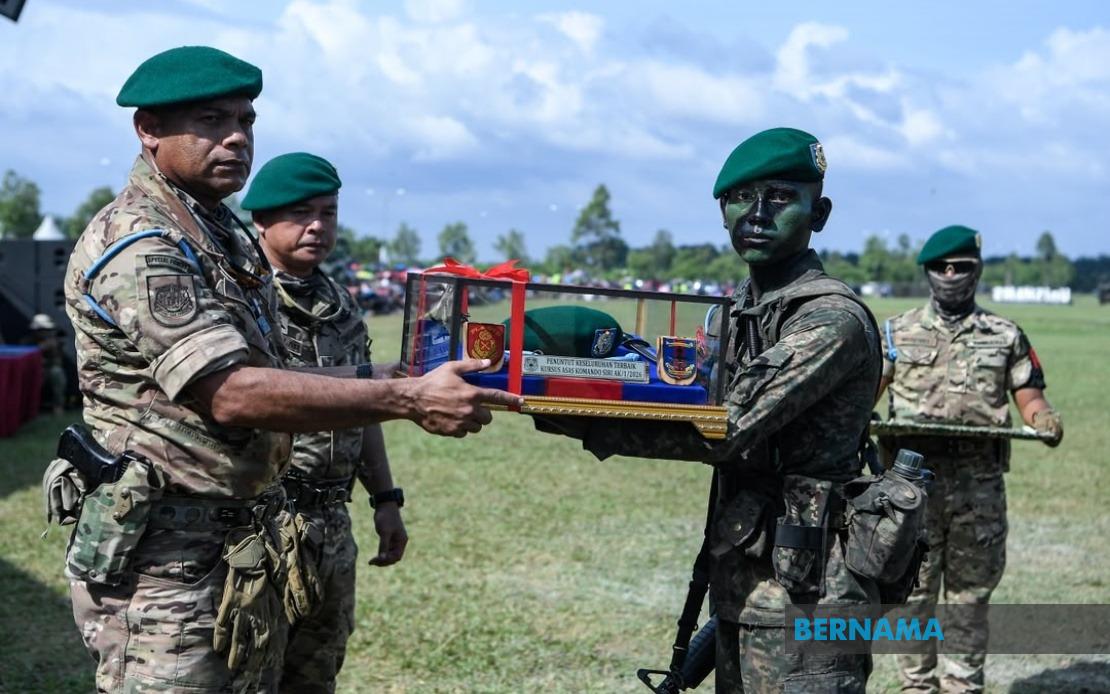
Second Lieutenant Muhammad Fadli Jamalluddin's journey to becoming Malaysia's elite commando forces' top trainee was marked by adversity that might have broken lesser spirits. The 24-year-old officer from Ampang, Kuala Lumpur, successfully completed the demanding Basic Commando Course Series AK/1/26 and earned the coveted Best Overall Trainee award, capping a remarkable comeback after failing to finish his initial attempt at the prestigious certification.
The path to this achievement began with disappointment. Muhammad Fadli's failure to complete the Basic Commando Course Series 3/2024 tested his commitment to military service early on, yet rather than deterring him, the setback crystallised his determination to earn the distinctive green beret worn by Malaysia's commando forces. His resilience proved instrumental when faced with another critical moment during the recent course—a stumble during week eight threatened to derail his entire training programme and force repetition of the gruelling three-month cycle.
In reflecting on his military aspirations, Muhammad Fadli traced his ambitions back to his secondary school years, long before he formally pursued a career in uniform. His academic foundation came through the National Defence University of Malaysia (UPNM), from which he graduated with a Bachelor's degree in Global Policing and Intelligence with Honours. He enlisted with the Royal Malay Regiment in 2024, but his sights quickly turned toward the most demanding specialisation available—joining the ranks of the 21st Special Service Group (21 GGK) and pursuing commando qualifications.
The officer's motivations extend beyond personal achievement. Speaking after the closing ceremony held at Universiti Sultan Abdul Halim Mu'adzam Shah (UniSHAMS) in Kuala Ketil, Muhammad Fadli acknowledged his family's influence on his decisions, particularly his drive to make his father proud. As the third of five siblings, he carries family expectations into his military career. His father's health challenges—suffering a stroke more than a year ago—added emotional weight to his pursuit, transforming the commando course from a professional milestone into a deeply personal mission.
The eighth-week crisis proved pivotal in testing not merely physical capability but psychological fortitude. After completing over 100 kilometres of endurance marching as part of the land training component, Muhammad Fadli fell short of standards in one critical exercise. The moment devastated him emotionally. "I cried when I failed because I had already come so far in the training," he recalled to reporters, articulating the psychological toll of elite military preparation. The prospect of restarting from the beginning loomed as a real possibility, one that would have tested even the most committed candidate.
Peers and mentors encouraged him to abandon the pursuit, citing the extraordinary physical and mental demands inherent in commando training. The marine and land components of the three-month course push candidates beyond conventional limits, requiring not just muscular endurance but profound mental resilience. Yet Muhammad Fadli rejected counsel to quit. His philosophy reflected a maturity beyond his years: he reframed failure not as terminal defeat but as opportunity for renewed commitment. This perspective proved transformative, allowing him to push through the remaining weeks of training with renewed purpose.
The commando officer track represents one of Malaysia's most challenging military career paths. The distinction between enlisted commandos and commando officers carries additional complexity, as officers must demonstrate not only exceptional physical capacity but strategic and tactical acumen. "People say it is difficult enough to become a commando, let alone a commando officer," Muhammad Fadli noted. "You need not only physical strength but also a sharp mind, as many special operations require careful planning and sound decision-making." This insight reflects understanding that elite military roles demand intellectual sophistication alongside combat readiness—a recognition increasingly important in modern special operations environments where precision, planning, and adaptive thinking often determine mission success.
The Basic Commando Course Series AK/1/26 cohort represented Malaysia's latest generation of special operations personnel. Five officers and thirty-three other ranks successfully completed the programme, suggesting a completion rate that underscores the course's selectivity and rigour. Muhammad Fadli's recognition as the overall top performer among this group of proven operators carries particular significance, indicating not merely competence but demonstrable excellence across the full spectrum of training domains.
The award presentation by Colonel Nordin Abu, Commandant of the Special Warfare Training Centre (PULPAK), formalised recognition of Muhammad Fadli's achievement within Malaysia's military hierarchy. PULPAK's role in developing elite personnel for the armed forces places such recognition within an institutional context of military excellence and operational readiness. His honour reflects not only personal accomplishment but validation through the institution responsible for cultivating Malaysia's most specialised military capabilities.
Muhammad Fadli's achievement resonates beyond individual triumph. His journey exemplifies qualities increasingly valued in professional military contexts globally—resilience through failure, psychological adaptability under extreme stress, and commitment to excellence despite setbacks. For Malaysia's defence establishment, his success represents successful development of officer-level talent within the commando pipeline, ensuring continuity of specialised capability. Equally, his story offers instructive example to younger personnel considering commando careers: elite achievement remains accessible to those willing to persist through initial failure.
The personal dimension adds emotional depth to institutional accomplishment. Muhammad Fadli's stated hope that his achievement would provide strength to his father—unable to attend the ceremony due to health limitations—transforms the commando course completion from purely military metrics into expression of familial devotion and filial respect. This human element illustrates how military service operates within broader family and personal contexts, particularly within Malaysian culture where family honour and intergenerational pride remain profound motivators.
Looking forward, Muhammad Fadli enters specialised commando operations with credentials that distinguish him among his generation of officers. His demonstrated resilience through failure, combined with technical excellence and strategic thinking, positions him to contribute meaningfully to Malaysia's special operations capacity. The green beret he earned through perseverance signals not merely completion of a challenging course, but induction into a professional community demanding the highest standards of commitment and capability.

