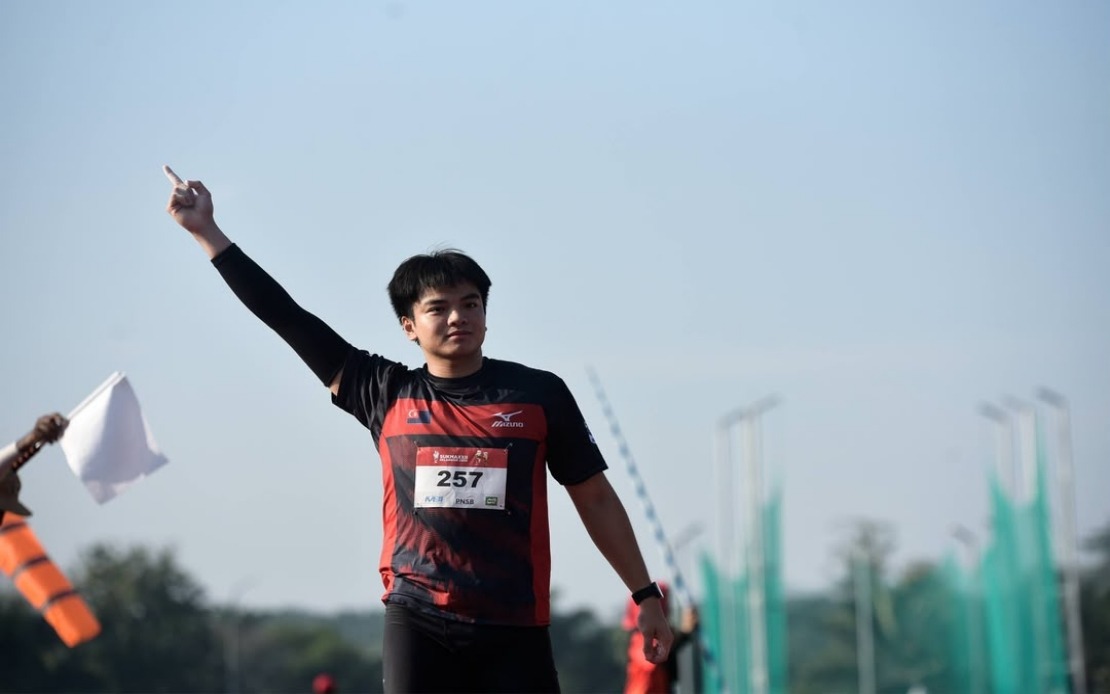
Johor javelin thrower Chai Kai Le has rewritten the Malaysia Games record books at the Selangor 2026 edition, becoming the unlikely face of a sporting journey that began not on the track but on the badminton court. The 18-year-old sent the javelin soaring to 64.44 metres on his second attempt at the Universiti Putra Malaysia Sports Centre, obliterating the previous mark of 62.33 metres that Sarawak's Kho Mei Kuan established at the 2000 Penang Games—a benchmark that had stood undisturbed for more than a quarter-century.
Kai Le's path to the podium reveals how keen observation and a willingness to explore new horizons can transform a young athlete's trajectory. During his Standard Six years, while excelling in badminton, a perceptive teacher noticed something distinctive about the way the student released the shuttlecock. That split-second observation—recognising the speed and precision in his arm mechanics—prompted a suggestion that would ultimately reshape his sporting ambitions. Transitioning from the confines of the badminton court to the open field, Kai Le discovered in javelin a discipline that allowed his natural gifts to flourish in unexpected ways.
The teenager's ascent has been underpinned by consistent exposure to elite competition. After taking up javelin formally, he immersed himself in open tournaments and spent hours studying senior athletes at work, absorbing their techniques and mentally rehearsing the distances they achieved. Those formative observations crystallised into a personal vision: to one day match and surpass the performances he witnessed. This combination of mentorship, self-directed learning, and deliberate practice constructed the foundation upon which today's record stands.
Beyond coaching and training regimes, however, lies a more intimate story of familial commitment. Chai Kai Le's father, Chai Yin Huan, has proven instrumental in sustaining his son's journey through both triumph and tribulation. Financial constraints that might have derailed many young athletes never materialised as obstacles in Kai Le's case. His father has consistently absorbed the costs of physiotherapy and rehabilitation whenever injury struck, replaced worn equipment without hesitation, and maintained an unwavering presence throughout the athletic calendar. Crucially, the elder Chai positioned his support not around winning medals but around enabling his son to pursue excellence while safeguarding his health—a philosophy that transcends the transactional nature of sporting investment.
The past twelve months have tested this resolve considerably. As a pre-university scholar at Bukit Jalil Sports School, Kai Le has navigated a minefield of physical setbacks, contending with recurrent back pain and persistent shoulder and elbow injuries that remain incompletely healed. The cumulative strain of pushing a young body to elite performance thresholds, combined with the psychological burden of managing chronic discomfort, would have discouraged many. Yet rather than retreating into cautious rehabilitation, Kai Le maintained his competitive schedule, even venturing internationally to the Indonesia Open earlier this year, where he established a personal best and national under-20 record of 65.65 metres.
That Indonesia performance takes on added significance as context for today's SUKMA achievement. By clearing 64.44 metres in a domestic championship setting, Kai Le has demonstrated consistency at the highest level whilst nursing injuries that have not fully resolved. For Malaysian athletics, this suggests a competitor still operating below his ceiling—a prospect that carries tantalising implications for Southeast Asian and international competition ahead. The gap between his personal best and today's record serves as a reminder that youth, recovery, and focused preparation could yield even more impressive metrics in coming seasons.
With the SUKMA crown now secured, Kai Le has already pivoted his gaze toward the next summit. He has publicly committed to achieving a 70-metre throw within the next year, a threshold he views as instrumental to qualifying for the 2027 SEA Games. That ambition will be pursued with renewed intensity through a planned month-long training expedition to Japan early next year, signalling both the seriousness of his preparation and the recognition that cutting-edge coaching environments abroad can accelerate elite development.
For Malaysian sports, Kai Le's emergence carries broader significance. At eighteen, he represents a generation of young athletes benefiting from structured sports schools, improved facility infrastructure, and systematic talent identification programmes. His trajectory also underscores the vital role of early intervention and observation—the badminton teacher's casual remark proved more consequential than years of conventional coaching might have been. As Southeast Asian nations compete fiercely for regional dominance in athletics, identifying athletes with raw potential and matching them to disciplines where their physiology and temperament align remains a critical competitive advantage.
The teenager's narrative additionally highlights the often-invisible ecosystem supporting elite performance: devoted parents absorbing costs, teachers maintaining vigilant attention to student potential, and schools providing both facilities and flexible schedules that permit serious athletic development. In economies where family resources determine access to training, equipment, and medical care, Kai Le's trajectory cannot be entirely separated from his father's capacity to invest continuously. This reality underscores ongoing debates in Malaysian sports about funding equity, talent identification across socioeconomic strata, and ensuring that undiscovered potential in less affluent communities receives equivalent opportunities.
Looking forward, Kai Le's confidence—articulated through his simple assertion that commitment yields results—reflects the psychological resilience required to excel under pressure and injury. His willingness to project ambition beyond the immediate achievement, to visualise himself throwing seventy metres and competing at the SEA Games, demonstrates a maturity beyond his years. Whether he achieves those targets will depend on continued discipline, judicious injury management, and the sustained support systems that have already proven their worth.
The record he set today belongs not solely to Kai Le but to the ecosystem that nurtured his potential: a teacher's keen eye, a father's steadfast investment, a school's infrastructure, and a young athlete's willingness to embrace pain and uncertainty in pursuit of excellence. As Malaysia seeks to establish itself as a sporting powerhouse within Southeast Asia, stories like his offer both inspiration and instruction about how records are built.

