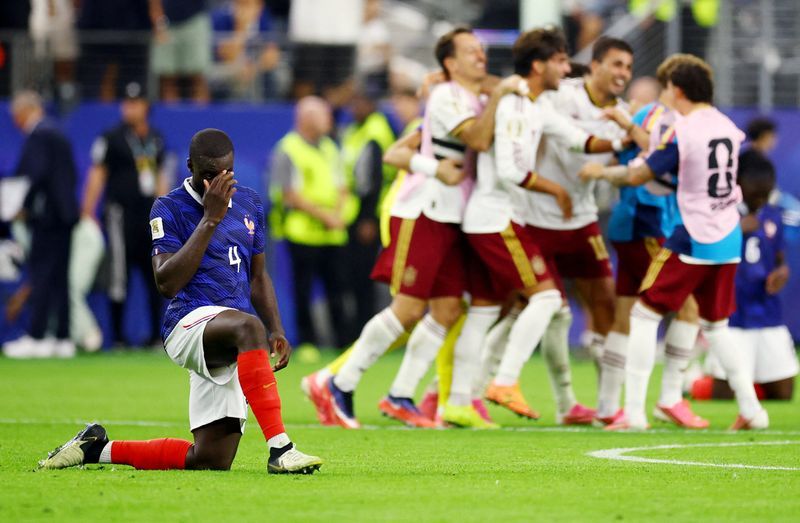
France's World Cup campaign collapsed in stunning fashion on Tuesday evening when they fell to a 2-0 semi-final defeat against Spain in Arlington, Texas, a loss that marked a dramatic reversal of fortune for the tournament favourites. The European powerhouse, which had been installed as strong contenders for the crown, was systematically dismantled by a Spanish side that demonstrated superior tactical discipline and execution, offering no serious resistance once the match began to slip away.
The scale of France's disappointment was magnified by the contrast with their previous elimination. In the 2022 World Cup final against Argentina, despite a sluggish opening performance, the French team had fought back into the contest and nearly prevailed through extra time before falling on penalties. That defeat, while bitter, came with the consolation of having participated in one of the tournament's most memorable finals. This semi-final offered no such silver lining; instead, it represented a complete capitulation against an opponent that controlled virtually every aspect of play. France were reduced to passive observers of a Spanish exhibition, unable to impose their will or generate meaningful attacking opportunities.
Coach Didier Deschamps offered a candid assessment in the aftermath, acknowledging that his side had fundamentally failed to match Spain's technical and tactical proficiency. His admission that France were "second best" technically underscored the gulf between the teams' respective performances. The pre-match narrative had suggested France would be the ones Spain should fear, yet the reality proved starkly different. Those who had forecast a French victory appeared to have misread the balance of power entirely, a miscalculation that extended to the players themselves, who seemed unprepared for the intensity and organisation Spain would bring to the contest.
The most telling symbol of France's collapse was the performance of Michael Olise, the playmaker who had been elevated into Ballon d'Or discussions and was expected to unlock Spain's defensive structure. On the pitch at Dallas Stadium, Olise appeared utterly bereft of confidence and space, losing possession with alarming frequency—twenty times across the ninety minutes—while failing to complete even a single dribble. For a player tasked with creating attacking momentum, his statistical profile was damning. Meanwhile, Rodri, Spain's midfield anchor, glided through the same contest with balletic authority, dictating tempo and controlling proceedings with ruthless efficiency.
Olise's struggles were symptomatic of a broader offensive malaise that infected the entire French attacking contingent. Ousmane Dembélé generated minimal threat from the wing, while Bradley Barcola and his replacement Désiré Doucé proved equally blunt in their approach play. Even Kylian Mbappé, widely regarded as one of world football's most electrifying talents, failed to produce the moment of individual brilliance that has so often defined his career. The supposed strength of France's forward line—a unit that had been celebrated throughout the tournament—suddenly appeared powerless and disjointed, unable to generate either quality chances or the sort of penetrating movements that had characterised their earlier performances.
Spain's control of midfield exposed fundamental weaknesses in France's defensive architecture. Deschamps' double pivot of Adrien Rabiot and Aurélien Tchouaméni was swiftly overrun as the match progressed. Rabiot's early yellow card forced him to operate with reduced aggression, a constraint that diminished his usual impact, while Tchouaméni, struggling both physically and rhythmically after missing the previous two matches through hamstring injury, proved unable to maintain the required pace against Spain's dynamic midfield runners. This vulnerability at the centre of the pitch left the entire French defensive line exposed and susceptible to penetrating passes.
The consequences of these midfield deficiencies were immediate and severe. Spain converted their attacking advantages with clinical precision, first through Mikel Oyarzabal's penalty conversion in the twenty-second minute and subsequently via Pedro Porro's goal delivered just before the hour mark. Each goal represented not merely the capitalisation of a chance but the culmination of sustained Spanish superiority—football executed at the highest level against opponents who appeared to lack either the tactical acuity or the individual quality to mount a coherent response.
France's pre-match emphasis on team cohesion and unity suddenly rang hollow in the aftermath. The emotional state of the players as the final whistle sounded told its own story: Mbappé stood alone on the pitch, several teammates dropped to their knees in dejection, while others buried their faces in their hands—the physical manifestation of a squad that had invested considerable belief in their World Cup prospects and watched those aspirations crumble in ninety minutes. The contrast between their pre-match confidence and post-match devastation could scarcely have been more acute.
For regional observers in Southeast Asia, this result underscores broader lessons about tournament football in elite sporting competitions. France's experience demonstrates that favouritism and pre-tournament hype offer no protection against superior tactical preparation and execution. The manner of their exit—through comprehensive defeat rather than narrow elimination—suggests that Spain had developed a comprehensive gameplan specifically designed to neutralise France's attacking threats while simultaneously exploiting defensive vulnerabilities. Such methodical dismantling of tournament favourites remains comparatively rare in international football, making Spain's performance all the more impressive and France's collapse all the more complete. The semi-final also highlighted how individual underperformances at crucial moments, particularly from players expected to deliver on the biggest stages, can amplify team-wide shortcomings. For France, the consolation of reaching the semi-finals will likely feel inadequate given the scale of pre-tournament expectations.

