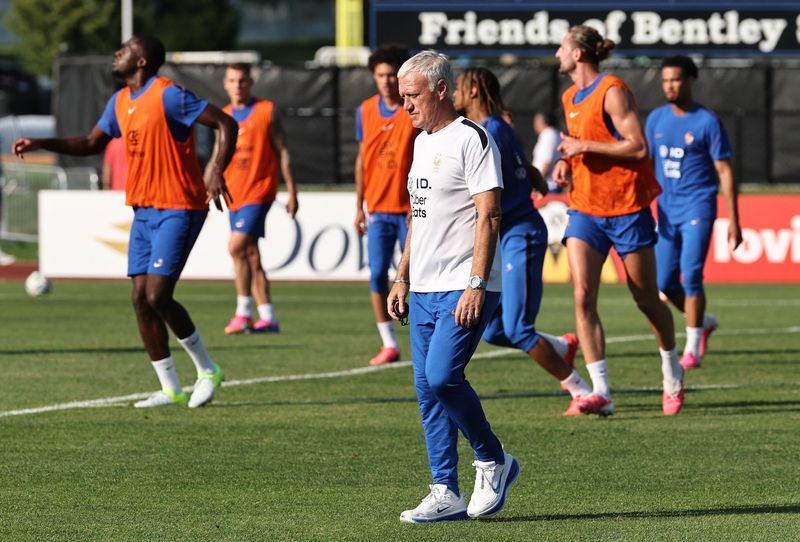
France enters their World Cup Round of 32 encounter against Sweden on Tuesday as overwhelming favourites, armed with an attacking unit that has left observers searching for superlatives. The French side topped Group I with a flawless record, demolishing Senegal, Iraq and Norway to accumulate ten goals and establish themselves as one of the tournament's most dangerous teams. Yet beneath the glittering surface of their offensive prowess, coach Didier Deschamps recognises that weaknesses on the left side of his defence require urgent remedial attention before facing the Swedish challenge.
The attacking triumvirate of Kylian Mbappe, Ousmane Dembele and Michael Olise has formed what many consider the most formidable striking combination in the entire tournament. Mbappe has once again positioned himself as France's focal point, while Dembele announced his credentials with a hat-trick against Norway, and Olise's creative orchestration from the right flank has provided the team with multiple avenues to breach opposing defences. This concentration of talent represents attacking depth that few nations can replicate, let alone match.
Deschamps faces a delicate balancing act in preparations for the Swedish test. Theo Hernandez, tasked with defending the left-back position throughout the group stage, has failed to convince the coaching staff that he provides the necessary stability at a critical defensive juncture. The anticipated introduction of Lucas Digne promises greater solidity in what has been an uncertain area, while his delivery from wide positions should offer more precision than his predecessor's contributions. This adjustment reflects not a fundamental tactical overhaul but rather fine-tuning designed to eliminate vulnerabilities that more astute opponents might exploit.
Further up the left flank, Bradley Barcola is expected to replace Desire Doue, with Deschamps seeking a player who can deliver direct running, explosive pace in transition, and genuine width to balance the right-sided dominance of Olise and Mbappe. The young talent's aggressive approach and capacity to stretch defences horizontally should create space for France's midfield and central attacking players to operate more freely. Such strategic tweaking preserves France's overall system while addressing specific concerns about coherence on the flank that has appeared most susceptible to disorganisation.
Sweden, by contrast, represents the type of opponent that presents logistical rather than qualitative challenges. The Swedes finished as runners-up in Group F behind the Netherlands, their tournament narrative marked by extreme variance rather than consistency. They demolished Tunisia 5-1 in their opening match, suggesting formidable capabilities, only to suffer an identical 5-1 defeat to the Dutch before stumbling to a 1-1 draw with Japan. Such oscillation indicates a team with sufficient quality to inflict damage on distracted opponents but fundamentally lacking the structured excellence that France has demonstrated throughout their campaign.
Sweden possesses adequate organisational discipline and physical robustness that could generate discomfort for France should the French squad become impatient or attempt to overwhelm their opponents through superior individual quality alone. The Swedes' preference for defensive depth and set-piece vulnerability hunting represents a time-honoured formula for disrupting more talented sides, yet few would seriously contend that they possess the attacking ammunition to punish France comprehensively. Alexander Isak, Viktor Gyokeres and Anthony Elanga constitute respectable attacking credentials, but their combined impact falls dramatically short of what France can assemble.
The return of William Saliba to central defence provides additional reassurance for Deschamps, restoring stability at the heart of the French rearguard after defensive inconsistencies marked the group phase. Yet the deeper narrative surrounding France's knockout prospects extends beyond individual personnel adjustments. The transition from group-stage football, where superior talent can overwhelm defensive frailty, to knockout competition where single-goal margins decide outcomes, presents a distinct tactical examination.
France's track record in knockout scenarios at the World Cup provides substantial grounds for confidence. Beyond their 2022 final loss to Argentina, the French have navigated knockout football successfully since 2014, establishing a pattern of advancement when stakes escalate. The bench strength available to Deschamps—encompassing Bradley Barcola, Desire Doue, Rayan Cherki, Jean-Philippe Mateta and Marcus Thuram—represents a degree of reserve attacking firepower that no rival nation can approximate. This capacity to introduce fresh offensive options without sacrificing quality provides France with flexibility that most opponents cannot mirror.
French football punditry and international observers acknowledge the arithmetic underlying this encounter. Former England defender Gary Lineker, speaking to L'Equipe, succinctly captured the prevailing sentiment: France's firepower substantially exceeds Sweden's defensive capacity, even accounting for occasional French vulnerabilities in transition that Norway briefly exposed during the group stage. The potential vulnerability of deploying four genuine forwards exists, yes, but France's superior scoring capacity almost certainly ensures they will accumulate more goals than the opposition can generate.
Victory would propel France into the Round of 16 against the winner of the Germany versus Paraguay fixture, positioning them favourably in their pursuit of another World Cup crown. The tactical adjustments Deschamps implements—particularly the left-flank refinements—should eliminate the minor defensively vulnerable areas that have occasionally allowed opponents glimpses of exploitable space. Sweden, though a competent and physically imposing side, simply lacks the sustained attacking threat required to punish such lapses sufficiently.
The fundamental mathematics of this encounter favour France overwhelmingly. While football's capacity to deliver unexpected outcomes remains inviolable, the gulf in attacking sophistication between these nations appears almost unbridgeable. Deschamps' tweaks suggest a coach managing expectations appropriately and ensuring his team enters the knockout stage with optimal defensive configuration, yet the genuine tournament threat to France emanates not from Sweden but from deeper rounds where opponents of comparable calibre await.

