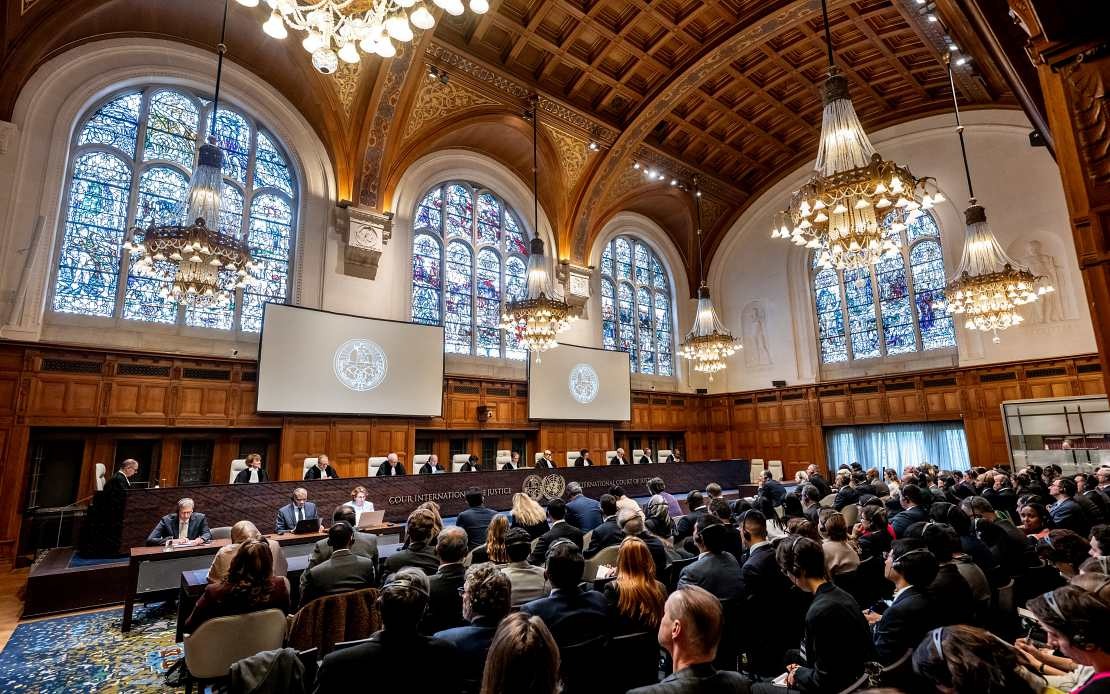
Paris has reinforced its backing for the International Criminal Court following sharp criticism from Washington, signalling that European nations remain committed to the multilateral justice system despite mounting American pressure. Foreign Ministry spokesman Pascal Confavreux made clear on Thursday that France views the ICC not as a threat to state sovereignty but as a legitimate institution focused on holding individuals accountable for humanity's gravest crimes, thereby distinguishing between prosecuting persons and prosecuting nations themselves.
The French government's reassertion comes at a pivotal moment when the United States under Secretary of State Marco Rubio has launched a coordinated campaign against the Hague-based court. Rubio has characterised the ICC as an existential threat to American sovereignty and has publicly announced Washington's intention to persuade other nations to withdraw from the institution entirely. Simultaneously, the State Department has established a formal initiative specifically designed to curb what American officials describe as the ICC's overreach into matters of American national interest.
The underlying tension reflects fundamentally different approaches to international accountability. France and its European allies view the ICC as an essential guardrail against impunity for genocide, war crimes, crimes against humanity and aggression—categories of offences established when the court was formally created in 2002. The United States, by contrast, has historically resisted ICC jurisdiction, citing concerns that the court could pursue American military personnel or officials on politically motivated grounds. Notably, the US has never ratified the Rome Statute and remains outside the court's membership, giving Washington considerable distance from direct ICC authority while also limiting its influence over the institution's governance.
Confavreux's statement emphasised another dimension of the dispute: the safety and security of ICC staff, judges, and personnel. He condemned what he characterised as unacceptable attacks and threats directed at those working within the court system, implying that the American pressure campaign, whether directly or indirectly, may be contributing to an atmosphere of intimidation surrounding the institution. This concern underscores the broader geopolitical reality that the ICC operates in an increasingly polarised environment where major powers question its legitimacy and independence.
For Southeast Asian nations, this transatlantic dispute carries particular significance. Several countries in the region, including Cambodia and the Philippines, have grappled with questions about ICC involvement in their domestic affairs. The Philippines withdrew from the court in 2019 under President Rodrigo Duterte, partly over concerns about investigations into extrajudicial killings during his drug war. Malaysia itself has not ratified the Rome Statute, maintaining strategic ambiguity on the institution's role. The US campaign to weaken the ICC may embolden other reluctant states to distance themselves further, potentially eroding the court's credibility as a venue for addressing atrocities in conflict zones where major powers have geopolitical interests.
France's reaffirmation of support carries weight beyond diplomatic symbolism. As a permanent member of the UN Security Council and a major European military power, France's backing lends institutional legitimacy to the ICC at a moment when American hostility threatens to delegitimise it in the eyes of allied nations. The French position also reflects the European Union's collective commitment to the rules-based international order, even when that order creates constraints on powerful states. By explicitly distinguishing between individual criminal liability and state responsibility, Confavreux articulated a principle that underpins much of international law: accountability for gross violations need not entail collective punishment of nations.
The American strategy of encouraging other countries to withdraw from the ICC represents a relatively novel form of pressure within the post-Cold War order. Rather than simply ignoring the court or refusing to cooperate with it—strategies the US has employed in the past—the current administration is actively working to dismantle support for the institution itself. This approach suggests a more confrontational posture toward multilateral institutions generally, signalling that the Trump administration views international courts and treaties as constraints on American power that must be actively undermined rather than passively resisted.
For France and allied nations, the challenge lies in sustaining the ICC's legitimacy and operational capacity while major powers attack it. The court has already struggled with questions about selective prosecution, with critics noting that it has focused disproportionately on African cases while declining to investigate alleged crimes by Western powers. American pressure, ironically, may provide the ICC with an opportunity to demonstrate independence by pursuing investigations impartially regardless of which state is involved, though the institution's resource constraints and diplomatic isolation make such vindication difficult to achieve in practice.
The French response also reflects broader European concerns about American reliability as a partner in global governance structures. France and the EU have increasingly questioned whether the United States views international institutions as tools to advance shared democratic values or merely as obstacles to unilateral action. By reaffirming support for the ICC at this juncture, Paris is signalling that Europe intends to maintain its own approach to international justice, potentially creating a transatlantic divide on fundamental questions of global accountability and rule of law.

