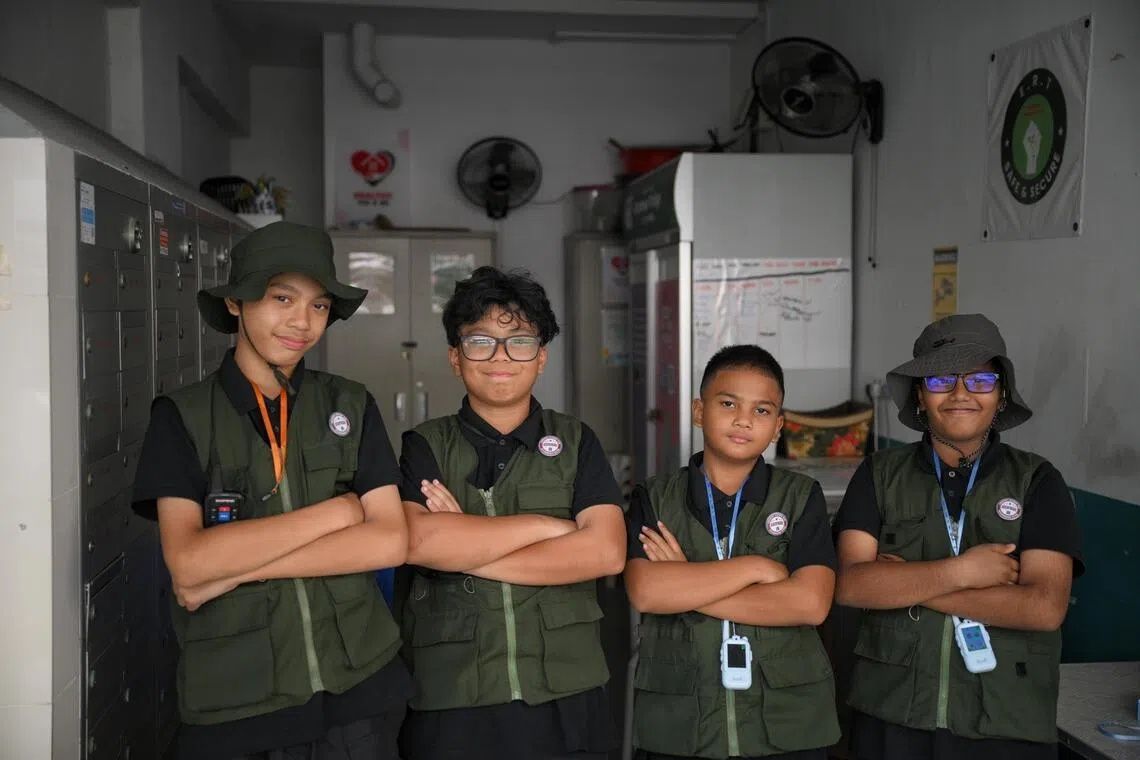
When 12-year-old Rafieq Sahin Rafizal witnessed a community fridge repeatedly depleted by residents taking far more than a fair share of its free milk and drinks, meant primarily for children from struggling households, he recognised something beyond mere inconvenience. The theft represented a breach of trust in shared community resources designed to support the most vulnerable. Rather than accepting the situation as inevitable, Rafieq resolved to take action—a decision that would evolve into something far more significant than guarding refrigerated provisions.
Today, Rafieq works alongside three schoolmates, all between 11 and 14 years old, as members of the Emergency Response Team LB (Lengkok Bahru), conducting daily patrols through their public housing estate. Operating with the formality of an actual civic body, the four young volunteers systematically survey their neighbourhood for hazards and infractions. They document issues ranging from illegal dumping of furniture and bulky items, graffiti and vandalism, to dangerously placed personal mobility devices charging in shared corridors—a particular fire risk in densely packed residential blocks. Upon identifying problems, they photograph evidence and report to Rafieq's mother, Marlina Yased, who then escalates findings to estate management for remediation.
The initiative began formally in August 2025, and since then has accumulated a compelling record of community impact. Beyond their surveillance duties, the boys have actively intervened in neighbourhood life, assisting an elderly resident with mobility challenges to transport groceries, and mediating disputes between younger children to prevent escalation. Their most sobering achievement came earlier this year when they detected a disturbing odour emanating from a residential unit. After alerting Marlina and triggering a response from cleaners and police, authorities discovered the decomposed remains of an elderly man inside—a tragic discovery that nonetheless underscored the genuine value of attentive neighbourhood watch systems, particularly in detecting cases of isolated or vulnerable residents in distress.
The origins of the patrol trace back to 2023, when Marlina established the community fridge system using sponsorships to assist financially struggling neighbours. Operating from the void deck of her two-room rental flat at Block 59 Lengkok Bahru, the initiative maintains locked storage for grocery items while maintaining an unlocked refrigerator stocked with milk and beverages for schoolchildren during morning departure times. Marlina observed, somewhat philosophically, that while individual residents consuming items intended for families was acceptable, systematic depletion by the same people contradicted the project's fundamental purpose. Rather than position her son as a passive guardian of the appliance, she devised a more ambitious alternative: mobilise him and his peers as active agents of neighbourhood stewardship, creating a visible community presence that residents could approach for assistance while simultaneously monitoring for safety violations and maintenance issues.
Operationally, the four pupils from Gan Eng Seng Primary School maintain a disciplined structure. Upon completing school, they don matching vests displaying their names and group insignia before departing in pairs to survey up to six residential blocks. They maintain constant communication with Marlina and fellow volunteer Fahmidah Farihullah, 21, via walkie-talkies. The current four-member roster represents attrition from an initial seven volunteers, suggesting that sustained commitment to daily evening patrols presents challenges for developing adolescents juggling schoolwork, recreation, and family obligations. Rafieq drew inspiration for the group's nomenclature from Singapore's police Emergency Response Team, whose officers address high-risk incidents—a somewhat aspirational naming choice for primary school children that nonetheless reflects their ambitions for purposeful neighbourhood engagement.
The recognition accorded to this youthful initiative appears to resonate with broader societal appreciation for youth civic participation. In August, all four boys will march in Singapore's National Day Parade as featured participants within a segment honouring Singaporeans contributing to the nation's collective wellbeing. For each member—this will constitute their inaugural experience participating in the country's premier annual civic ceremony, an honour typically reserved for established community organisations or prominent individuals. The inclusion of schoolchildren engaged in unglamorous, routine neighbourhood maintenance and social care within the NDP framework signals evolving national attitudes toward recognising quiet, persistent civic work, particularly when initiated by younger generations.
The demographic and socioeconomic context enriches understanding of this initiative. Lengkok Bahru represents a cluster of public housing occupied predominantly by lower-income families, many experiencing genuine economic precarity. Marlina's original fridge concept addressed tangible nutritional insecurity affecting children; the patrol system subsequently broadened this mission toward comprehensive neighbourhood stewardship. For residents like Nasha Asrin, 27, a mother of five, the patrol's visible presence constituted welcome reassurance that young people were channelling energy toward constructive community purpose rather than drifting into antisocial behaviour—a persistent concern within public housing estates globally.
Motivational diversity characterises the four volunteers. Rafieq articulated commitment grounded in temporal sacrifice: willingness to dedicate one hour daily to community service despite alternatives of unrestricted play. Didie Andiqa Muhaimin, 14, approached participation pragmatically, describing initial motivation as addressing personal aimlessness before discovering meaningful purpose. Aaron Sarandev, 11, identified pedagogical benefits, noting how consistent evening patrols cultivated responsibility and perseverance, particularly on occasions when reluctance tested his commitment. These varying entry points reflect the reality that sustained community volunteerism rarely emerges from purely altruistic impulses, particularly among developing adolescents; rather, it develops through accumulated satisfactions—perceived purposefulness, peer affiliation, adult recognition, and individual growth narratives.
Marlina's supervision provided crucial structural support often overlooked in discussions of youth-initiated community projects. Her role extended beyond logistical coordination; she functioned as disciplinary guide and mentor, facilitating development of responsibility and perseverance. Feedback from participants' mothers suggested measurable improvements in school attendance and academic concentration—evidence that consistent community engagement, properly scaffolded by attentive adults, correlated with broader developmental benefits. This dynamic inverted conventional assumptions about youth requiring discipline to prevent misbehaviour; instead, constructively channelled activity and meaningful adult relationships appeared to generate improvements in educational commitment and focus independently.
The implications for Southeast Asia merit consideration. Public housing estates across Malaysia, Indonesia, and the Philippines face comparable challenges regarding maintenance, safety, and social cohesion. Community-based patrol initiatives require minimal financial investment compared to expanded formal security infrastructure, yet potentially generate significant benefits through enhanced surveillance, early intervention in safety hazards, and strengthened social networks. The Lengkok Bahru model demonstrates that primary school-aged children, provided appropriate adult mentorship and clear operational frameworks, can execute sophisticated community monitoring tasks while simultaneously experiencing developmental benefits. Rather than conceptualising youth as problems requiring external solutions, this approach recognises younger residents as potential assets within neighbourhood governance systems.
The broader narrative transcends typical feel-good journalism about precocious children. The Emergency Response Team LB fundamentally reflects an approach to urban governance emphasising hyper-local, community-generated solutions to maintenance and safety challenges. Within resource-constrained public housing contexts across Southeast Asia, such initiatives offer scalable alternatives to formal bureaucratic mechanisms. That four primary school pupils could identify genuine problems—fire hazards, elderly isolation, unchecked vandalism—and mobilise sustained collective response demonstrated both the severity of gaps in formal estate management and the efficacy of distributed, resident-centred oversight. As Singapore fetes these four boys at its National Day Parade, their modest yet consequential model warrants serious consideration by urban planners and housing administrators throughout the region confronting analogous challenges.

