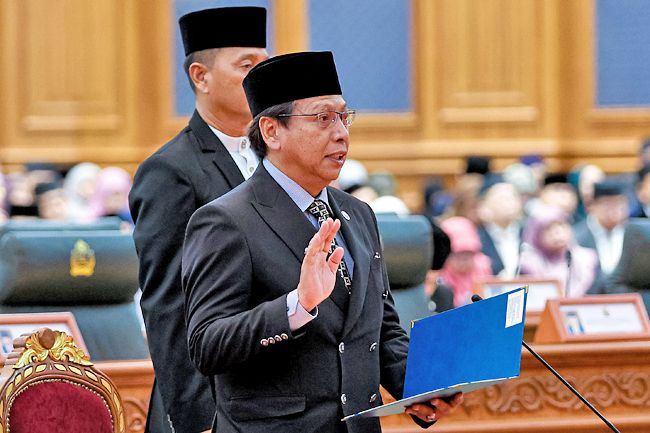
Brunei formally integrated four senior Cabinet ministers into its Legislative Council on Monday, reinforcing the institutional link between the executive and legislative branches under the sultanate's constitutional framework. The swearing-in ceremony took place at the opening of the Second Meeting of the 22nd Legislative Council Session in Bandar Seri Begawan, following procedures enshrined in the 1959 Brunei Constitution. The event underscores how Southeast Asian monarchical systems, particularly in Brunei, maintain formal mechanisms that blend executive authority with legislative participation.
The four ministers elevated to ex-officio membership represent critical portfolios within Brunei's governance structure. Datuk Seri Setia Awang Sufian Sabtu assumed the dual responsibilities of the Prime Minister's Office, specifically overseeing security and law matters. His appointment signals the continued prioritisation of internal security and legal frameworks within Brunei's administrative hierarchy. Meanwhile, Datuk Seri Setia Awang Mohamad Azmi Mohd Hanifah took on energy sector responsibilities within the Prime Minister's Office, handling both upstream and downstream petroleum operations—a portfolio of singular importance given Brunei's economic dependence on hydrocarbon exports.
Religious governance also featured prominently in the ministerial appointments, with Pengiran Datuk Seri Setia Mohammad Tashim Pengiran Hassan assuming the Religious Affairs portfolio. This appointment carries particular significance in Brunei, where Islam occupies a constitutionally entrenched position and religious administration intertwines with state legitimacy. The fourth appointee, Datuk Seri Setia Awang Mohammed Riza Datuk Paduka Mohammed Yunos, received responsibility for Transport and InfoCommunications—sectors increasingly vital as Brunei seeks economic diversification beyond petroleum revenues. These transport and digital infrastructure portfolios reflect regional priorities shared across ASEAN nations grappling with connectivity, logistics, and technological integration.
The ceremony itself adhered strictly to constitutional protocols established over six decades ago, demonstrating Brunei's commitment to procedural regularity within its governance system. The 1959 Constitution, predating Brunei's independence by several years, established the foundation for this integration of executive ministers into legislative proceedings. This constitutional approach differs substantially from Westminster systems where ministers typically retain separate legislative seats, instead reflecting a hybrid model where executive officers participate in deliberation without necessarily holding independent electoral mandates. The formality and adherence to constitutional procedure indicate Brunei's emphasis on legal legitimacy and institutional continuity.
Presiding over the ceremony was Pehin Orang Kaya Seri Lela Datuk Seri Setia Awang Abdul Rahman Datuk Setia Mohamed Taib in his capacity as Legislative Council Speaker. His presence lent institutional gravitas to the proceedings and symbolised the separation between legislative leadership and executive authority, even as the newly sworn ministers brought executive perspectives into the chamber. The Speaker's role in overseeing this integration highlights how Brunei's legislative institution maintains formal autonomy while accommodating executive participation.
For Malaysian observers, Brunei's legislative arrangement offers comparative perspective on how neighbouring monarchical systems structure executive-legislative relations. While Malaysia's Parliament includes ministerial representation through constitutional allocation, Brunei's mechanism emphasises the ex-officio principle—appointment by virtue of office rather than electoral selection. This distinction reflects differing constitutional philosophies regarding democratic legitimacy and governance models within ASEAN. Understanding these institutional variations helps clarify how different Southeast Asian nations balance centralised authority with consultative processes.
The timing of these appointments at the opening of a new legislative session suggests strategic planning around ministerial responsibilities and legislative priorities. Brunei's Second Meeting of the 22nd Legislative Council Session would address pending legislation and policy proposals requiring executive input. By formally inducting these ministers into the chamber, the sultanate ensures direct executive participation in legislative deliberations, potentially streamlining policy development and reducing coordination friction between branches. This institutional design reflects pragmatic governance approaches common in smaller Southeast Asian jurisdictions where compact decision-making circles prioritise efficiency.
The energy ministry appointment particularly resonates across ASEAN, where petroleum governance remains economically consequential. Brunei's oil and liquefied natural gas reserves constitute the foundation of state revenue, and parliamentary representation by the energy portfolio holder ensures legislative scrutiny and input into sectoral strategy. As regional energy markets face transitions toward sustainability and renewable integration, having senior energy officials within the legislature enables informed policy debate. This arrangement proves especially relevant as Brunei navigates economic diversification pressures affecting all hydrocarbon-dependent Southeast Asian economies.
Similarly, the transport and communications portfolio carries implications for regional connectivity initiatives. As ASEAN nations pursue deeper physical and digital integration through mechanisms like the ASEAN Connectivity Master Plan, having infrastructure ministers participate legislatively facilitates coordinated policy development. Brunei, despite its small size, participates actively in regional infrastructure projects and logistics networks. Legislative representation by the relevant minister strengthens the sultanate's capacity to align domestic transport and digital policies with regional frameworks.
The security and law portfolio's prominence within the ministerial appointments reflects Brunei's ongoing attention to internal stability and legal institutional development. This ministry's position within the Prime Minister's Office indicates executive priority, and its legislative representation ensures security-related policies receive direct ministerial scrutiny at the parliamentary level. For a nation seeking to maintain stability while modernising governance institutions, this arrangement facilitates responsive policy-making on sensitive security matters.
Looking forward, these ministerial appointments establish the senior executive presence within the 22nd Legislative Council Session's second meeting, setting institutional tone for ensuing deliberations. The ceremony's formality and constitutional adherence reflect Brunei's governance philosophy emphasising procedural legitimacy and institutional continuity. As the sultanate navigates economic diversification, energy transition, and regional integration challenges, this integrated executive-legislative structure positions the nation to coordinate responses across multiple policy domains. The systematic approach to ministerial legislative participation demonstrates how smaller ASEAN economies can structure governance institutions to combine centralised decision-making with consultative legitimacy.

