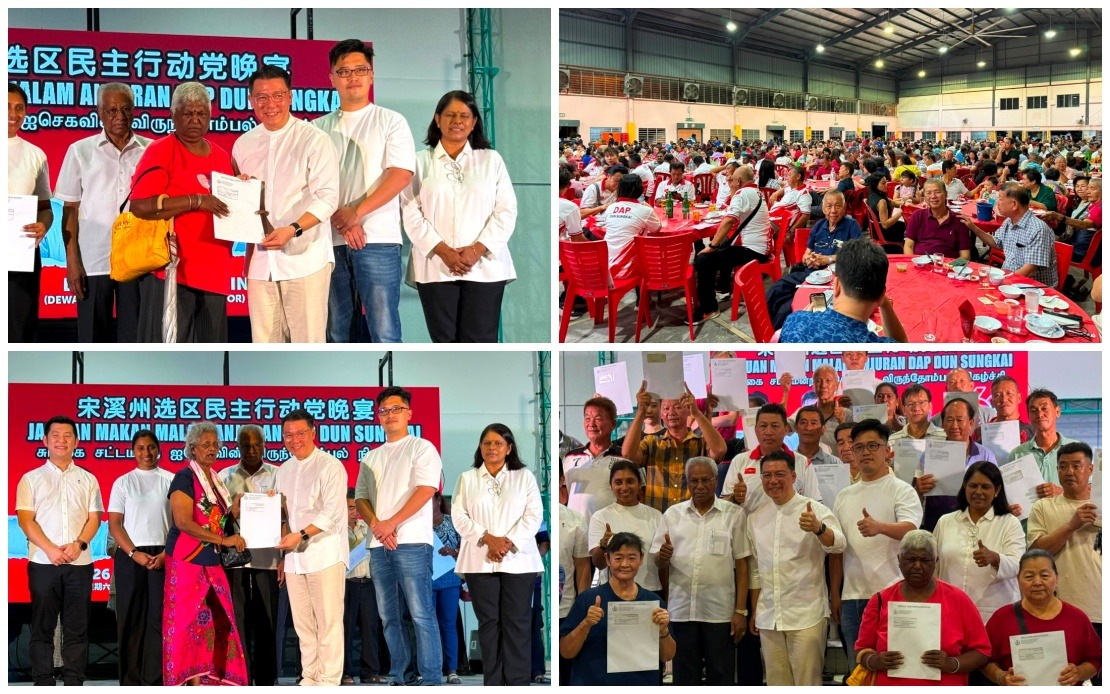
A significant milestone in housing justice has been reached in Perak, where 120 families residing in squatter communities around Sungkai and Kuala Bikam have finally received land grants after enduring more than 40 years of housing insecurity. The resolution marks a watershed moment for these vulnerable populations, whose decades-long struggle for tenure security and stable shelter has shaped their lives and those of their children. Housing and Local Government Minister Nga Kor Ming announced the achievement during a formal presentation ceremony at a DAP Sungkai division dinner, emphasising that the resolution exemplifies the government's commitment to inclusive development across all demographic groups regardless of race or economic standing.
The minister framed the resolution within the broader context of the MADANI Government's stated philosophy, which positions itself as deliberately working to ensure that no segment of Malaysian society is excluded from development opportunities or marginalised in policy implementation. Nga characterised the granting of land titles to these 120 families as tangible proof of this ideological commitment, describing the land grants as symbolic representations of a more economically stable and legally secure future not only for the current generation of recipients but for their descendants as well. This framing suggests an intentional political narrative: that the government views housing security as foundational to breaking cycles of poverty and enabling intergenerational social mobility among disadvantaged communities.
The magnitude of the gathering—over 1,200 guests representing multiple ethnic and religious communities—underscores the symbolic importance officials attached to the announcement. By conducting the presentation at a broad, inclusive dinner rather than a routine administrative ceremony, the government signalled that housing justice and community inclusion are central to its political messaging. The presence of numerous state and federal representatives, including Ipoh Timur MP Howard Lee Chuan How and several state assemblymen, reinforced the cross-party significance of the resolution and demonstrated substantial political investment in publicising the achievement across the Perak constituency landscape.
Nga specifically acknowledged the instrumental role played by Sungkai assemblyman Datuk A. Sivanesan, whose position as chair of the Human Resources, Health, Indian Community Affairs and National Integration Committee positioned him as a key advocate for this particular community. The minister's explicit gratitude toward both the elected representative and civil servants who worked on the resolution reflects a deliberate effort to distribute credit across multiple governance tiers. This approach acknowledges that resolving entrenched housing disputes requires sustained bureaucratic effort, political pressure, and coordination between various government agencies—suggesting that the four-decade timeframe reflected genuine complexity rather than simple administrative neglect.
The announcement also served as a platform for the minister to outline broader initiatives targeting the Indian Malaysian community specifically. Nga highlighted RM20 million allocated for Indian settlements, RM50 million designated for Tamil vernacular schools, and an increase in Malaysian Indian Transformation Unit funding to RM150 million. These figures, presented in immediate conjunction with the Sungkai land grants resolution, construct a narrative of systematic, multi-faceted government commitment to addressing longstanding inequities affecting Indian Malaysians. For readers in the region, this signals that Malaysia's government is actively working to address historical disparities through targeted financial and programmatic investments, a dynamic that shapes how demographic groups evaluate government performance and political viability.
The minister's subsequent remarks cautioning against allowing perception to overshadow actual performance constitute a noteworthy political argument. Nga implicitly acknowledged that public perception of government efficacy—shaped by media coverage, word-of-mouth, and competing political messaging—may diverge from documented achievements like the Sungkai resolution. This tension between objective accomplishment and subjective perception reflects a fundamental challenge confronting governing coalitions: demonstrating that their stated commitments translate into tangible material improvements in citizens' lives. For Malaysian readers, this debate resonates with broader questions about how to evaluate government legitimacy when assessments hinge partly on measurable outputs and partly on how effectively those outputs are communicated and perceived.
Nga's call for abandoning what he characterised as outdated, destructive politics rooted in racial sentiment in favour of unity-based, performance-driven governance introduces an explicit normative argument about how Malaysia should conduct its political discourse. This rhetorical move positions the MADANI Government as forward-looking and transcendent while implicitly critiquing opposition approaches as backward-looking and divisive. The framing gains particular salience in the context of Malaysian electoral politics, where mobilising different ethnic and religious communities remains central to coalition-building and where competing narratives about whether the government genuinely prioritises inclusion or merely performs inclusion meaningfully influence voter calculations.
For Southeast Asian observers, the Sungkai resolution demonstrates how housing security interfaces with political legitimacy across the region's diverse democracies. In Malaysia, as in other Southeast Asian nations, squatter communities often occupy politically ambiguous positions: spatially present but administratively marginalised, numerically significant but often lacking organised political voice, and constituting visible manifestations of inequality that electoral politics either ignores or instrumentalises. The decision to resolve the Sungkai dispute, after four decades of inaction, reflects calculations about political cost and benefit—suggesting that the government perceived sufficient political advantage in addressing this particular community's grievances to allocate bureaucratic resources and ministerial attention to resolving the matter.
The implicit timeline embedded in the minister's statement warrants analytical attention. The dispute predated the MADANI Government's formation, yet Nga positioned the current administration as the agent responsible for resolution. This framing obscures the historical roots of the problem while crediting contemporary leadership with breaking a decades-long impasse. For Malaysian voters assessing government performance, this rhetorical strategy asks them to evaluate the current administration against its predecessors' inaction rather than against the original failure to prevent four decades of housing insecurity. Such framing contests influence how citizens calibrate their expectations and assessments of governmental competence and commitment.
The resolution also illuminates broader challenges in Malaysian housing policy. That a settlement dispute could persist for 40 years suggests systemic inefficiencies or insufficient political will at earlier junctures. While celebrating the resolution is appropriate, understanding why resolution took four decades remains important for designing policies that prevent similar extended disputes in other communities. The grant of land titles addresses immediate tenure insecurity but may require complementary investments in infrastructure, services, and economic opportunity if recipients are to achieve genuine residential security and improved living standards. For Malaysian and regional readers, the Sungkai case exemplifies both the possibilities of belated government action and the risks of allowing acute housing challenges to fester for extended periods before addressing them comprehensively.
The gathering's composition and the minister's explicit acknowledgment of cross-community representation suggest deliberate political coalition-building. By positioning the resolution as benefiting families across different ethnic backgrounds and socioeconomic circumstances, the government attempts to demonstrate that its inclusive rhetoric translates into inclusive practice. Yet the specific focus on Indian Malaysian settlements in the minister's subsequent remarks indicates that the government also views this resolution through a community-specific lens—recognising that particular demographic groups may interpret government responsiveness through the lens of how their specific communities are addressed. This dual approach—simultaneously emphasising universal inclusion and community-specific attention—characterises contemporary Malaysian political communication, reflecting the country's complex ethnic and religious demographics.
Looking forward, the Sungkai resolution establishes a precedent that may influence how other squatter communities and their representatives approach land security claims against the government. If 120 families successfully obtained tenure security after organised advocacy and political engagement, other communities may perceive opportunity to pursue similar campaigns. Conversely, if land grants prove insufficient without accompanying investments in service provision and economic development, the resolution may generate new dissatisfaction despite addressing the immediate tenure question. For Malaysian policymakers, the challenge involves ensuring that land grants translate into substantive improvements in recipients' material circumstances rather than constituting primarily symbolic gestures. The next phase of the Sungkai story—how recipients integrate into formalised residential communities and what opportunities and challenges emerge—will ultimately determine whether this resolution represents genuine progress or incomplete justice in the ongoing struggle for inclusive, equitable housing access across Malaysia.

