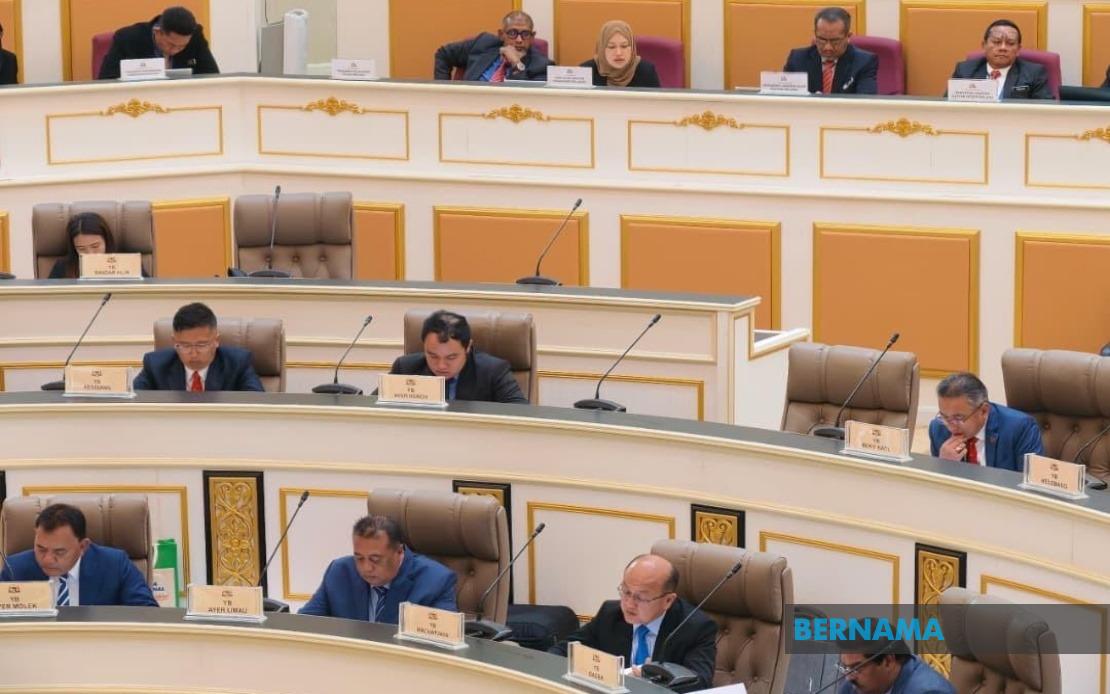
The political landscape in Melaka shifted on the final sitting day of the State Legislative Assembly as four DAP representatives formally relocated to the opposition benches, marking a significant rupture in the coalition that has governed the state since 2022. Allex Seah Shoo Chin, Low Chee Leong, Leng Chau Yen, and Kerk Chee Yee, representing Kesidang, Kota Laksamana, Banda Hilir, and Ayer Keroh respectively, took their new seats alongside Perikatan Nasional and Independent assemblymen following their announcement the previous day that they were terminating support for the Barisan Nasional administration.
The move represents a calculated political response to what Melaka DAP views as a fundamental assault on democratic principles. The immediate catalyst came when the state legislature approved constitutional amendments that would permit the appointment of nominated assemblymen—a mechanism the party characterizes as antithetical to the electoral mandate and representative democracy. Khoo Poay Tiong, who chairs Melaka DAP, framed the withdrawal as principled opposition grounded in the party's long-standing commitment to democratic governance and the sanctity of the ballot box.
What renders this development particularly intricate is the divergent path taken by Amanah, the third coalition partner in Melaka's Pakatan Harapan arrangement. Adly Zahari, the sole Amanah representative and simultaneously chairman of the Melaka PH bloc, opted to remain seated within the government coalition despite the constitutional amendments that provoked DAP's departure. This fragmentation reveals the competing strategic calculations within the broader Pakatan alignment, with Amanah apparently determined to preserve its ministerial positions and administrative influence despite ideological objections to the constitutional changes.
The constitutional amendments themselves represent a consequential departure from established norms in Malaysian state governance. The provision for nominated assemblymen substantially weakens the direct democratic representation that voters exercise through elections, potentially allowing the ruling coalition to augment its numbers without winning additional electoral support. This mechanism has historically been controversial in Malaysian politics, as it divorces representation from electoral accountability and creates a class of legislators answerable primarily to their appointers rather than constituents.
Prime Minister Datuk Seri Anwar Ibrahim, seeking to contain the escalating tensions within the federal coalition, had urged Melaka DAP to postpone their decision and maintain focus on developmental priorities and public welfare. His intervention underscored the sensitive nature of the rupture, as the loss of four assemblymen substantially complicates the mathematics of Melaka governance and threatens the coalition's broader cohesion. Yet DAP's resolve proved immovable, suggesting fundamental frustration within the party with the constitutional trajectory in Melaka.
Assembly Speaker Datuk Ibrahim Durum's remarks at the sitting emphasized the institutional expectation that all legislators would conduct themselves with discipline and adherence to house protocols, a standard invocation that nonetheless highlighted the unusual parliamentary dynamics created by the repositioning. The seating changes themselves, while procedurally straightforward, carry symbolic weight in reflecting the assembly's actual political alignment and serve as a visible manifestation of the coalition fracture.
For Malaysia's broader political ecosystem, particularly in the context of Southeast Asian democracy, the episode illuminates persistent tensions between legislative majoritarianism and representative accountability. The nomination mechanism, while permissible under constitutional frameworks, raises questions about governance legitimacy that resonate beyond Melaka. In an era when Malaysian voters have demonstrated willingness to substantially realign electoral support through the ballot box, measures that circumvent this mechanism arguably generate legitimacy deficits that extend beyond the immediate assembly chambers.
The split also underscores the fragility of coalition governance in Malaysia's devolved federal system. The Melaka administration, cobbled together through electoral bargaining and inter-party negotiation, now operates with diminished internal coherence. DAP's withdrawal transforms what was nominally a unified coalition into a more adversarial configuration, requiring either the acquisition of additional independent support or a reconstitution of the governing arrangement. These practical complications will occupy state administrators throughout the remaining term.
From the perspective of Southeast Asian political observers, the Melaka episode provides further evidence that Malaysia's electoral and constitutional frameworks remain sites of ongoing contestation and interpretation. Unlike systems with entrenched constitutional provisions or established jurisprudential consensus, Malaysian state constitutions demonstrate considerable flexibility in accommodating amendments that substantively alter representation mechanisms. This plasticity creates opportunities for incumbent coalitions to reshape their mathematical foundations through legislative means—but, as the DAP response demonstrates, such maneuvers carry political costs in terms of coalition stability and public confidence in democratic processes.
The coming months will test whether this separation proves permanent or represents a negotiating position. DAP's relocation to opposition provides leverage in demanding either the reversal of constitutional amendments or enhanced ministerial representation commensurate with its electoral contribution. The calculations of both BN and Amanah regarding optimal strategies for managing this altered configuration will substantially influence Melaka's governance trajectory and may signal broader patterns in how Malaysia's federal coalition manages internal disputes and constitutional challenges.

