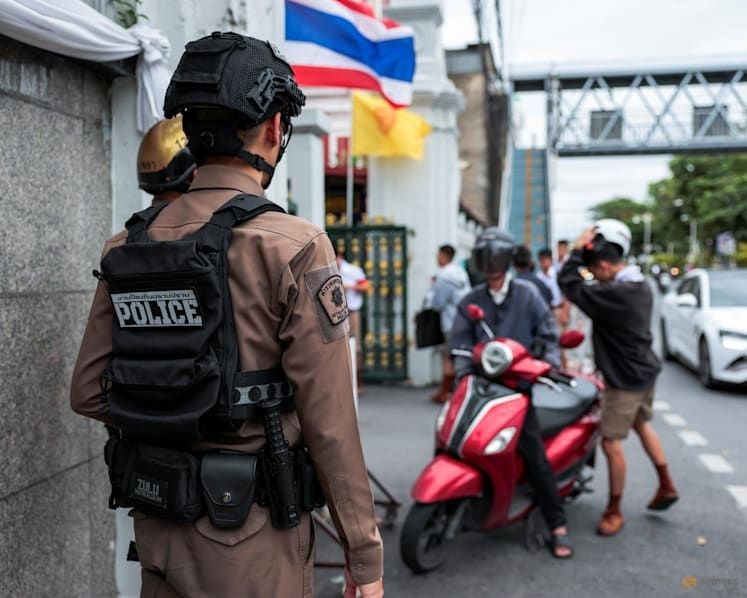
Thai authorities have arrested a former member of parliament on suspicion of shooting and injuring a local government official and his driver in Nonthaburi province, just north of Bangkok. The incident represents the latest in a series of armed violence cases that have troubled the Southeast Asian nation in recent days. Chalong Riewrang, who previously served in the national legislature, was taken into custody for questioning at the provincial police station, according to Nonthaburi police chief Dejrapee Kongdee.
The alleged shooting targeted the chairman of the Nonthaburi local government administration, who sustained serious injuries during the attack. His driver was also shot, though police did not disclose the extent of the second victim's injuries. Both men were transported to hospital for medical treatment, and authorities are currently working to establish the motive behind the alleged assault. Police indicated they were examining various aspects of the case to understand what prompted the alleged gunfire.
Chirping from local media outlets suggested that a private dispute may have sparked the shooting incident, though the police chief refrained from confirming or elaborating on this theory. The alleged attack occurred against a backdrop of heightened concern about firearms violence in Thailand. Chalong had previously held membership in the political party led by Prime Minister Anutin Charnvirakul, adding a political dimension to what might otherwise appear to be a straightforward criminal matter.
The timing of this incident proves particularly significant given recent events in the same region. On Friday of the previous week, a fourteen-year-old boy carried out a devastating attack in Nonthaburi, first killing the elderly grandparents who had raised him at their home, then proceeding to a school where he opened fire on students and staff. Before police could apprehend him, the teenager turned the weapon on himself, bringing the death toll to eight people. The school shooting sent shockwaves through the country and prompted urgent calls for reform in Thailand's firearms regulations.
Thailand confronts a significant challenge when it comes to gun ownership and regulation. Approximately ten million firearms are believed to be circulating throughout the country, a figure that translates to roughly one weapon for every seven inhabitants. This places Thailand among the most heavily armed nations in Southeast Asia, a distinction that has contributed to recurring incidents of armed violence. The sheer volume of firearms in civilian hands creates substantial public safety concerns and complicates law enforcement efforts to prevent misuse.
The back-to-back shooting incidents have forced policymakers to confront the inadequacy of existing gun control frameworks. Following Friday's school massacre, government officials publicly pledged to introduce stricter legislation governing firearm ownership, licensing, and registration. However, this commitment comes amid a troubling historical pattern in Thailand. Previous administrations have made similar promises following prior shooting incidents, yet these pledges have consistently failed to translate into effective preventive measures or meaningful reductions in armed violence.
The apparent disconnect between rhetorical commitments and legislative action reflects deeper structural challenges within Thailand's political system. Gun culture remains deeply embedded in Thai society across rural and urban areas alike, and efforts to regulate firearm ownership have historically encountered resistance from various constituencies. The rapid succession of major shooting incidents raises critical questions about whether current political will can finally produce the comprehensive reforms that previous cycles of outrage have failed to deliver.
For Southeast Asian observers and Malaysian policymakers in particular, Thailand's firearms crisis offers cautionary lessons about the consequences of inadequate regulation. Malaysia maintains stricter gun control laws than Thailand, with firearms ownership more tightly restricted and subjected to rigorous licensing requirements. The contrast between the two nations' regulatory approaches underscores how policy choices made years or decades earlier continue to shape public safety outcomes in the present.
The arrest of Chalong Riewrang adds another layer of complexity to an already troubling situation. The involvement of a former parliamentarian in an alleged shooting raises questions about access to weapons among political and social elites, and whether prominent figures operate under different standards or constraints than ordinary citizens. Whether political connections played any role in his alleged acquisition or possession of a firearm remains unclear, but such cases inevitably fuel perceptions of unequal justice and selective enforcement.
As Thai authorities proceed with their investigation into both the alleged shooting by Chalong and the broader context of recent firearms violence, the country faces mounting pressure to move beyond symbolic gestures toward substantive reform. The convergence of a private gun violence incident with a mass shooting within days has created a rare political moment when public and official attention focuses sharply on the firearms question. Whether Thailand's leadership can translate this renewed urgency into lasting legislative change remains the critical uncertainty, one that will significantly influence public safety outcomes for years to come.

